

When to Use 20 mg/kg Fisetin Cycles or 100–500 mg Daily
There are two very different fisetin dosing patterns in circulation: intermittent high-dose senolytic cycles (around 20 mg per kg of body weight for two consecutive days) and daily low-dose supplementation (100 to 500 mg per day). Human evidence for either is still thin, and the two approaches were designed to do different jobs. Before attempting the higher intermittent protocol especially, speak to a clinician, and factor in that formulation changes how much of a stated dose your body actually absorbs.
TL;DR:
- Intermittent high-dose protocols aim to trigger senescent cell clearance through a “hit-and-run” mechanism, requiring doses around 20 mg per kg for two days, but safety and optimal cycle frequency are unproven.
- Daily low-dose fisetin supplements, typically 100 to 500 mg, are more tolerable and convenient but unlikely to reach tissue levels needed for senolytic effects, functioning mainly as antioxidants.
- Formulation significantly affects absorption; encapsulations like hydrogel or liposomal delivery can increase bioavailability by over 20 times compared to unformulated fisetin, even at lower doses.
- Current human trial results are mixed with small sample sizes, no definitive dose-response relationship established, and protocols vary, making personalized, cautious dosing essential.
- Fisetin interacts with liver enzymes, so those on multiple medications should consult healthcare providers before high-dose or intermittent protocols to avoid adverse interactions.
Table of Contents
- Intermittent high-dose cycles vs daily low-dose fisetin dosing
- What human trials have actually tested
- Why formulation changes what a labelled dose actually delivers
- Safety profile, drug interactions, and how to monitor yourself
- Choosing and taking a fisetin product: a practical walkthrough
- Jord’s perspective: what Vivetus recommends and why
- The gap between senolytic promise and daily supplement reality
- Where Vivetus fits into your fisetin dosering plan
- Sources
- FAQ
Intermittent high-dose cycles vs daily low-dose fisetin dosing
The gap between these two approaches isn’t marketing spin. It comes down to a specific biological mechanism: clearing senescent cells versus general antioxidant support.
Senolytic compounds work through what researchers call a “hit-and-run” mechanism. The idea is to hit senescent cells hard enough, briefly enough, to trigger their clearance, then withdraw and let the body’s own cleanup processes take over. This is why most senolytic research protocols use a short, high-dose burst rather than sustained daily exposure. The pattern most often referenced in senolytic literature, including work associated with Mayo Clinic and the AFFIRM-LITE trial framework, is roughly 20 mg per kg of body weight for two consecutive days, repeated periodically (monthly, in many protocols) rather than every day.
In practical terms, that dose scales like this:
- A 60 kg adult: roughly 1,200 mg per day for two days.
- A 70 kg adult: roughly 1,400 mg per day for two days.
- An 80 kg adult: roughly 1,600 mg per day for two days.
- A 100 kg adult: roughly 2,000 mg per day for two days.
Those are large numbers next to a typical supplement bottle. Daily low-dose supplementation, by contrast, commonly involves doses within the range of 100 to 500 mg per day, taken continuously rather than in bursts. This is the format most commercial fisetin capsules are built around, largely because a 1,200 to 2,000 mg daily intake isn’t commercially practical or well tolerated in most standard formulations. The problem is mechanistic: reviewers of fisetin’s senotherapeutic properties note that its poor water solubility and rapid metabolism mean modest daily doses are unlikely to reach the tissue concentrations senolysis appears to require.
Pros of the intermittent high-dose approach: aligns with the mechanistic rationale used in most senolytic trials; limits cumulative exposure to short windows. Cons: far larger doses, unproven optimal cycle frequency, and meaningfully higher theoretical risk of side effects during the dosing days.
Pros of daily low-dose supplementation: better tolerated, simpler to fit into a routine, more consistent with standard supplement safety margins. Cons: unlikely to deliver senolytic tissue exposure, and its benefits (if any) are better understood as general antioxidant support rather than active senescent cell clearance.
Neither pattern currently has a validated, standardised human dose. A summary of novel fisetin formulations points out that human trials remain small and inconsistent in design, which is exactly why “how much fisetin daily” doesn’t yet have a single settled answer.
What human trials have actually tested
Documented human protocols cluster around a small number of dosing patterns, and the outcomes so far are genuinely mixed rather than uniformly positive.
- A registered trial (NCT07195318) is testing 100 mg fisetin daily for 7 weeks against placebo in healthy middle-aged and older adults, tracking safety alongside markers of chronic inflammation and cellular senescence. This is one of the clearer examples of a low-dose daily protocol being formally evaluated rather than assumed safe by extrapolation.
- A pilot study gave participants 500 mg daily for one week per month, over six months. Among the ten participants, four showed a reduction in biological age, five showed an increase, and one showed no change. That’s not a clean win, and with a sample this small it tells you more about variability between individuals than about fisetin’s average effect.
- Pharmacokinetic crossover work has tested single-dose arms in the 500 mg to 1,000 mg range, measuring area under the curve (AUC), peak plasma concentration (Cmax), and time to peak concentration (tmax) to characterise how fisetin moves through the body.
- The intermittent 20 mg/kg × 2 day pattern appears repeatedly across senolytic literature as an adapted protocol rather than a single definitive trial outcome, reflecting how researchers have translated preclinical senolytic dosing into human-scale estimates.
The honest summary is that sample sizes are small, designs vary, and no trial has yet produced a dose that reliably and consistently improves a defined ageing biomarker across participants. That doesn’t mean fisetin does nothing. It means the dose-response relationship in humans isn’t mapped out yet, which is precisely why cautious, conservative dosing makes more sense than copying a trial protocol wholesale.
Why formulation changes what a labelled dose actually delivers
A capsule that says “500 mg” and a capsule that says “200 mg” can deliver wildly different amounts of fisetin into your bloodstream, because unformulated fisetin is poorly water-soluble and much of a standard dose may never be absorbed in meaningful quantity.
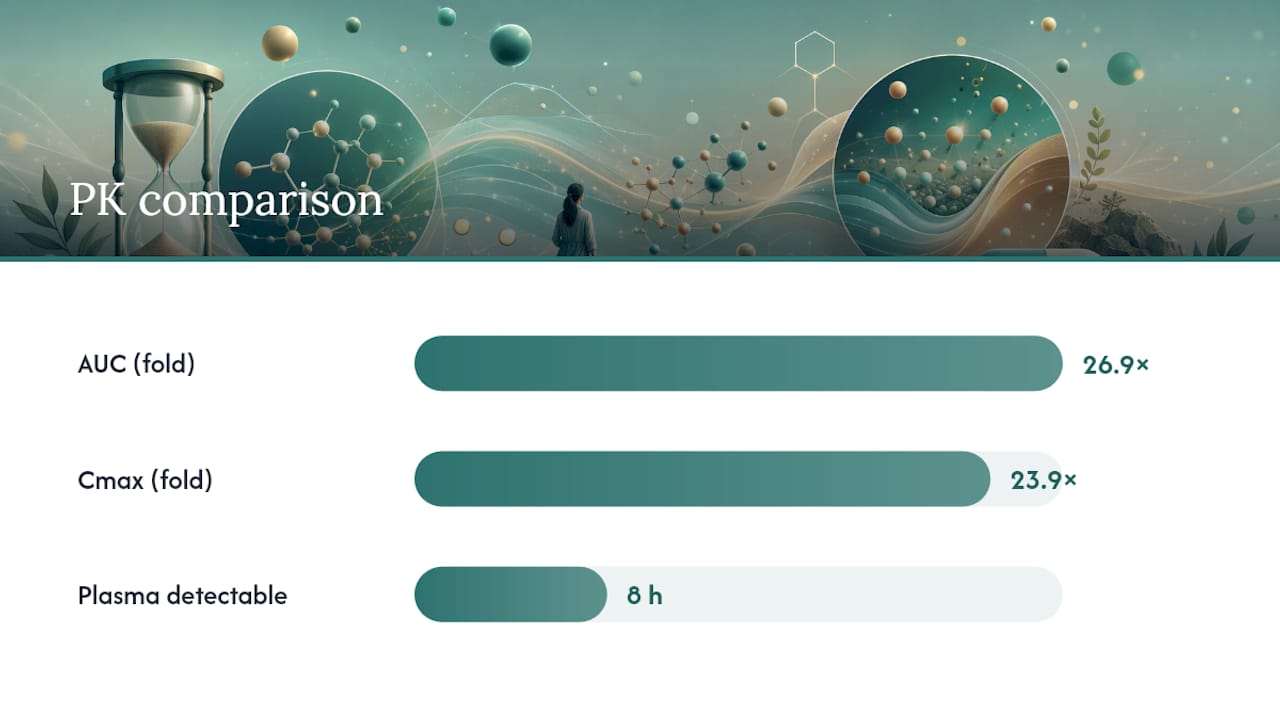
This is where bioavailability science becomes practical rather than academic. A human pharmacokinetic crossover study found that a hybrid-hydrogel encapsulated formulation, dosed at just 192 mg fisetin equivalent, produced roughly 26.9 times greater AUC and 23.9 times greater Cmax than an unformulated dose of 982 to 1,000 mg. Plasma levels from the encapsulated version also stayed quantifiable for up to 8 hours, versus around 2 hours for the plain compound. In other words, a smaller labelled number delivered dramatically more usable fisetin than a much larger one.
Fat matters here too. Fisetin is lipophilic, meaning it dissolves in fat rather than water, so taking it alongside a fat-containing meal improves how much gets absorbed through the gut wall, regardless of formulation. Practitioner-adapted protocols sometimes combine this timing advice with splitting a trial-equivalent dose across the day to smooth out peak-related side effects while keeping tissue exposure meaningful.
Pro Tip: Two products both labelled “500 mg fisetin” are not interchangeable unless you know the formulation behind the number. A hydrogel, liposomal, or self-emulsifying delivery system can outperform a much higher unformulated dose, so check what the label is actually telling you.
Before trusting an “enhanced absorption” claim on a product label, look for:
- Published pharmacokinetic data (AUC or Cmax figures) specific to that formulation, not generic fisetin research.
- A named delivery technology (hydrogel, liposomal, self-emulsifying, or similar), rather than a vague phrase like “advanced formula”.
- Third-party purity or potency testing that verifies the label matches what’s actually in the capsule.
Safety profile, drug interactions, and how to monitor yourself
Fisetin’s safety data in humans is reassuring but incomplete, and that gap matters more the higher your dose climbs. Animal studies and small human pilots have generally reported good tolerability at the doses tested, without major red flags emerging from short-term use. That said, reviewers of fisetin’s biopharmaceutical profile note that some in-silico toxicology screens flag mutagenicity-related signals worth taking seriously rather than dismissing, particularly given how limited long-term human safety data still is.
The interaction risk that deserves the most attention is cytochrome P450 (CYP) enzyme inhibition. Fisetin, like many polyphenols, has the potential to interfere with liver enzymes responsible for metabolising a wide range of prescription medications, including some blood thinners, statins, and blood pressure drugs. This is precisely why older adults on multiple medications face a meaningfully higher risk profile than a younger, medication-free adult experimenting with the same dose.
Practical monitoring steps worth following regardless of which dosing pattern you choose:
- Review your current medication list with a pharmacist or doctor before starting, especially if you take anything metabolised by the liver.
- Start at the lower end of the daily low-dose range rather than jumping straight to a higher figure.
- Stop immediately and seek medical advice if you notice unusual bruising, digestive upset, or unexplained fatigue.
- If you’re considering an intermittent high-dose cycle similar to trial protocols, do this only under medical supervision, given the size of the doses involved and the still-limited human safety record at that intensity.
The same caution applies whether you’re 45 and otherwise healthy or 75 and managing several prescriptions. Higher doses simply widen the margin for something to go wrong, so the more aggressive the protocol, the more conservative your monitoring needs to be.
Choosing and taking a fisetin product: a practical walkthrough
Start by deciding what you actually want fisetin to do for you, because that decision should drive every choice that follows.
If your goal is general daily antioxidant support, a standard 100 to 500 mg daily capsule fits that objective reasonably well, taken consistently. If your goal is closer to the senolytic effect studied in trials, you’re looking at a fundamentally different, much higher, intermittent protocol, and that distinction changes which product and formulation actually make sense for you.
Here’s how the maths plays out for a 200 mg capsule against the 20 mg/kg intermittent benchmark:
- 60 kg body weight: approximately 1,200 mg target, which is six 200 mg capsules across the day.
- 70 kg body weight: approximately 1,400 mg target, or seven 200 mg capsules.
- 80 kg body weight: approximately 1,600 mg target, or eight 200 mg capsules.
Splitting that total into two or three servings across the day, each with a fat-containing meal, is the approach practitioner-adapted protocols tend to favour, both for absorption and for reducing the chance of digestive discomfort from a single large dose. Never combine an intermittent high-dose cycle with other strong CYP-inhibiting supplements or medications without checking with a clinician first, since the interaction risk compounds at higher intakes. For daily low-dose use, timing is simpler: take your capsule with the largest fat-containing meal of the day and keep the schedule consistent.
Jord’s perspective: what Vivetus recommends and why
Fisetin dosing isn’t a single number, and pretending otherwise does readers a disservice. My starting position is that the trial-derived intermittent protocol and the daily supplement dose are answering different questions, and conflating them is where most confusion comes from.
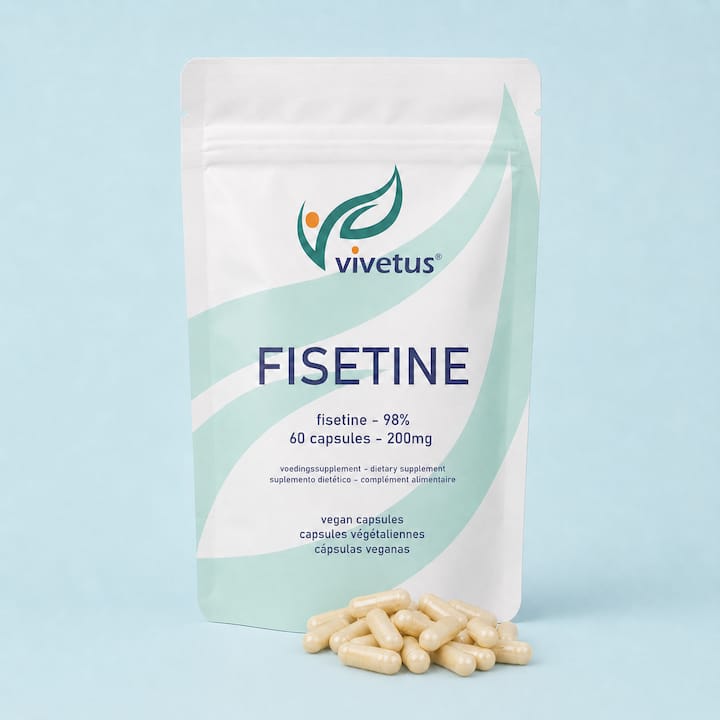
Some fisetin capsules are formulated with dosing transparency in mind, so the labelled 200 mg reflects a figure you can actually build a daily or intermittent plan around, rather than a number chosen for shelf appeal. For readers who want to go deeper on the mechanics before deciding, our articles on fisetin’s absorption profile and fisetin side effects and interactions cover ground this guide only summarises.
The gap between senolytic promise and daily supplement reality
Most fisetin content online blurs the line between “senolytic compound studied in trials” and “daily supplement sold on shelves,” and that blurring does readers a disservice. The honest read of the evidence is that daily low-dose fisetin is best understood as a general wellness supplement, not a senescent-cell-clearing intervention. The intermittent high-dose protocol is the one with an actual mechanistic argument behind it, but it also carries doses and risks that most healthy adults have no business self-administering without medical oversight.
What gets underestimated constantly is formulation. A reader fixated on hitting a specific milligram number while ignoring whether that number is bioavailable is optimising for the wrong variable entirely. The 26.9 times AUC difference between formulated and unformulated fisetin is the single most important number in this entire topic, and it rarely makes it into casual advice.
My advice: pick your objective first, respect the dosing pattern that matches it, and treat formulation quality as equally important as the number on the label.
— Jord
Where Vivetus fits into your fisetin dosering plan
Once you’ve settled on daily support or a more structured cycle, the practical question becomes which product actually matches that plan. Vivetus keeps this straightforward: Vivetus® Fisetine, 60 capsules at 200 mg each, gives you a clean, calculable building block, whether you’re taking one capsule daily with a fat-containing meal or working towards a supervised, higher intermittent total using the maths outlined earlier.
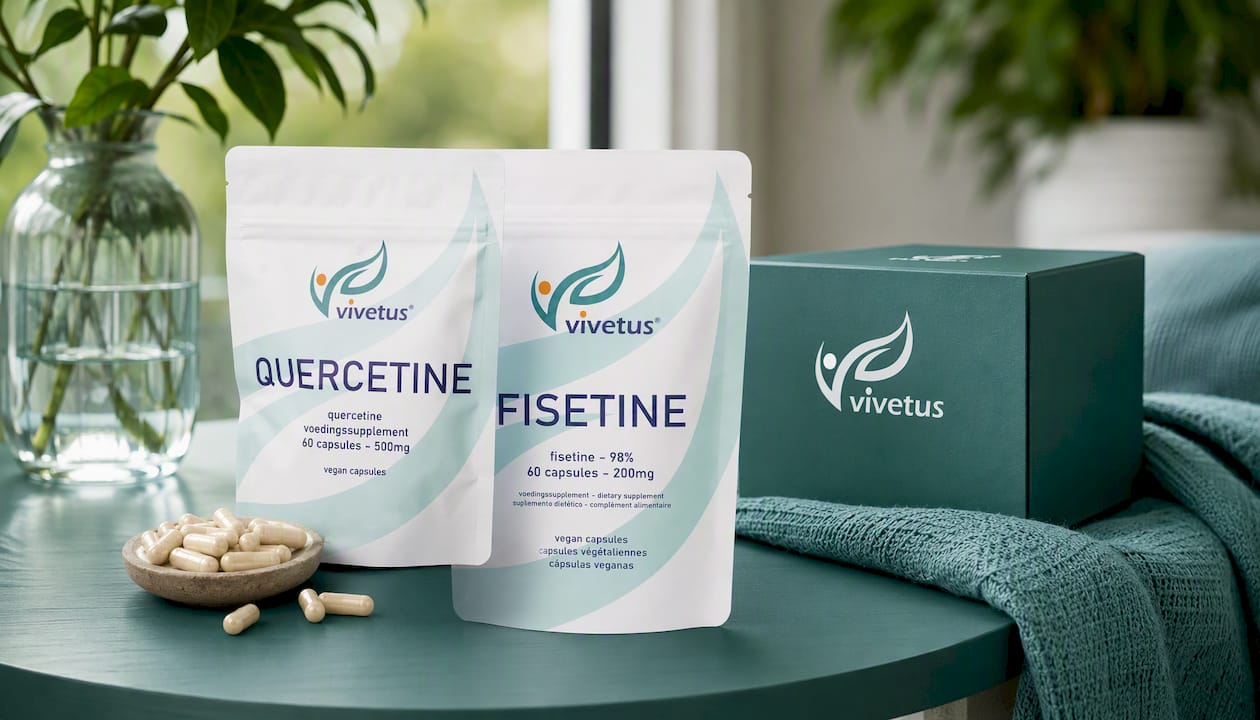
For readers who want fisetin alongside complementary support compounds rather than on its own, the ♻ CelReset bundel pairs it with related ingredients often used in the same longevity-focused routines. Whichever route you choose, treat the higher intermittent protocol as something to plan with a clinician, not something to self-direct from an online table of numbers. If daily support is your goal, start conservatively and build from there. Visit the fisetin product page to check current capsule counts and subscription options before you decide.
This article is general information, not a substitute for advice from a qualified doctor. Consult a qualified healthcare professional about your own circumstances before acting on anything here.
Sources
- Fisetin as a senotherapeutic agent: biopharmaceutical properties and neuroprotection review
- The effects of fisetin on reducing biological aging: a pilot study
- Clinicaltrials
FAQ
What is the working mechanism of fisetin?
Fisetin is a plant flavonoid studied for its senolytic activity, meaning it may help trigger the clearance of senescent, or “worn out,” cells by suppressing proteins in the BCL-2 family that these cells rely on to survive, as outlined in a review of its biopharmaceutical properties.
How much fisetin should I take daily?
Common daily supplement doses range from 100 to 500 mg, though no standardised dose has been validated in human trials; a registered study is currently testing 100 mg daily for 7 weeks.
What is the intermittent senolytic protocol?
It’s an approach adapted from senolytic research using roughly 20 mg per kg of body weight for two consecutive days, repeated periodically, rather than a continuous daily dose, and it should only be attempted under medical supervision.
Does taking fisetin with food matter?
Yes. Fisetin is fat-soluble, so taking it with a fat-containing meal improves absorption, and choosing an enhanced-delivery formulation can multiply plasma exposure many times over compared with unformulated fisetin.
Can fisetin interact with medications?
Fisetin may inhibit certain liver enzymes (CYP pathways) involved in metabolising common prescription drugs, so anyone on multiple medications, particularly older adults, should consult a clinician before starting, especially at higher intermittent doses.