

Resveratrol Absorption for Dutch Buyers: 10.6× Cmax Evidence
Resveratrol’s systemic availability after an oral dose is very low, often under 1%, because the body clears it through rapid glucuronidation and sulfation before it can circulate freely. The most reproducible way to raise measurable plasma exposure in humans is formulation, not folklore: micellar solubilisation and cyclodextrin inclusion complexes have both shown genuine, trial-backed gains in Cmax and AUC. Piperine, by contrast, looks convincing in animal data but has not held up in the one controlled human trial that tested it properly.
TL;DR:
- Formulations like micellar solubilisation and cyclodextrin complexes significantly increase plasma resveratrol levels, with micelles offering the most consistent human data.
- Oral bioavailability of unchanged resveratrol in humans is frequently below 1%, making dose alone ineffective at improving tissue absorption.
- Piperine supplementation shows no significant effect on resveratrol absorption in human trials, despite promising animal and in vitro results.
- Choosing a supplement with cited human pharmacokinetic data and a proven formulation type is essential for better resveratrol absorption and potential benefits.
- Proper storage, taking with a fatty meal, and realistic dose expectations are key factors in maximizing resveratrol’s effectiveness.
Table of Contents
- Why oral bioavailability of resveratrol is so low
- Does piperine actually improve resveratrol absorption in people?
- Which formulation strategies actually raise plasma resveratrol in humans?
- How to choose a resveratrol supplement that actually gets absorbed
- Where does Vivetus fit into the absorption picture?
- What a realistic view of resveratrol absorption looks like
- Get a formulation built around the absorption evidence
- Sources
Why oral bioavailability of resveratrol is so low
Swallow a resveratrol capsule and most of it never reaches your bloodstream intact. Absorption across the gut wall happens reasonably well, but the compound is caught almost immediately by two enzyme systems, glucuronidation and sulfation, that attach it to water-soluble tags so the liver and kidneys can flush it out. This is first-pass metabolism: the substance is processed by the gut lining and liver before it ever gets a chance to circulate as free, active resveratrol.
The scale of the loss is the part most people underestimate. Human pharmacokinetic work has repeatedly shown that unchanged trans-resveratrol makes up a tiny fraction of what was swallowed.
- Absorption into the gut wall can be substantial, sometimes reported above 70% of the dose.
- Yet free, unmetabolised resveratrol in plasma is usually under 1% of that same dose.
- The rest circulates as glucuronide and sulfate conjugates, not as active resveratrol.
- Cmax (peak plasma concentration) and AUC (area under the curve, a proxy for total exposure over time) are the two markers researchers use to judge whether a formulation actually works.
Statistic to remember: oral systemic availability of unchanged resveratrol in humans is frequently below 1%, a gap wide enough that dose alone rarely fixes the problem.
This also explains why marketing claims built purely around milligram counts can mislead. A 500 mg dose sounds substantial, but if 99% of it is inactivated within hours, the number on the label tells you very little about what reaches your tissues. Researchers increasingly note that plasma levels of free resveratrol are an imperfect stand-in for what actually accumulates in target tissue, so a formulation that lifts blood plasma readings is not automatically proof of a proportional clinical effect. It is a strong signal, but not the whole story.
Does piperine actually improve resveratrol absorption in people?
Piperine, the pungent alkaloid in black pepper, has a plausible mechanism: it can inhibit some of the same metabolic pathways responsible for clearing resveratrol. That mechanism has performed well in animal studies and cell models, which is where most of the enthusiasm for pepper-and-resveratrol stacking originated.
Human data tells a different story. A randomised, double-blind pilot trial in 24 healthy adults tested piperine co-supplementation at both 5 mg and 25 mg alongside resveratrol and found no statistically significant improvement in pharmacokinetics at either dose.
- The trial measured standard PK markers, including Cmax and AUC, across both piperine doses.
- Neither dose produced a reliable, significant shift in resveratrol exposure compared with resveratrol alone.
- Animal and in vitro models often overestimate what a simple enhancer will do in people, largely because metabolic pathways and enzyme kinetics differ between species and experimental systems.
The practical takeaway is not that piperine is worthless. It is that a small pepper extract addition is not a substitute for genuine formulation work, and product claims resting solely on piperine’s animal pedigree deserve scepticism until backed by human trial data.
Which formulation strategies actually raise plasma resveratrol in humans?
This is where the real gains sit. Several formulation approaches have moved beyond theory and into measured human pharmacokinetic data, and the differences between them are not subtle.
Micellar solubilisation is the standout example. A human trial comparing a micellar liquid formulation against standard resveratrol powder recorded roughly a 10.6-fold increase in Cmax and a 5.0-fold increase in AUC. Micelles work by wrapping the poorly soluble resveratrol molecule in a lipid-friendly shell, which improves how much dissolves in the gut fluid before absorption and appears to shield the compound from degradation on the way there.
Cyclodextrin inclusion complexes take a related approach. Modified solid formulations using agents such as HP-β-CD have shown improved absorption and relative bioavailability compared with plain powder, by trapping the resveratrol molecule inside a ring-shaped carrier that keeps it dissolved and protected until it reaches the gut wall. Separate comparative work between two solid formulations has also found several-fold differences in Cmax and AUC depending purely on how the resveratrol was formulated, underlining that solid-dose products are not interchangeable just because they list the same milligram amount.
Nanoencapsulation is the newer frontier. These carriers aim to shield trans-resveratrol from light, oxygen and the acidic environment of the stomach, all of which degrade the molecule before it can be absorbed. Recent reviews describe encouraging results in preclinical models and some early human work, but note that more human trials are still needed before nanoformulations can be judged on the same evidence footing as micellar or cyclodextrin systems.
- Micellar solubilisation: the largest, most consistently reproduced human PK gain to date.
- Cyclodextrin inclusion: solid, trial-supported improvements over standard powder.
- Nanoencapsulation: promising mechanism, thinner human evidence base so far.
Pro Tip: Higher plasma exposure is a strong signal a formulation works, but it is not automatically the same as proven clinical benefit. Treat Cmax and AUC data as evidence of better delivery, not as a guarantee of a specific health outcome.
How to choose a resveratrol supplement that actually gets absorbed
Reading a label with absorption in mind changes what you look for. A few practical checks separate a formulation built on evidence from one built on marketing language alone.
- Check the formulation type. Favour products described as micellised, micellar, or using an inclusion complex such as HP‑β‑CD over plain crystalline powder, since these are the categories with actual human pharmacokinetic data behind them.
- Look for cited human PK figures. A brand willing to reference Cmax or AUC data, rather than just a milligram count, is signalling it understands the bioavailability problem rather than ignoring it.
- Take it with a meal containing some fat. Dietary lipids and timing relative to meals can shift absorption and Tmax, so dosing with food rather than on an empty stomach is the more sensible default for most people, as covered in more detail in this resveratrol dosering guide.
- Be realistic about high single doses. Larger doses can push exposure higher, but they also raise the chance of gastrointestinal discomfort, so check the safety and side-effect profile for the dose range you are considering.
- Store it properly. Trans-resveratrol is sensitive to light and heat, since its aqueous solubility sits around just 0.05 mg/mL and it degrades on exposure to oxygen, so a dark container kept away from heat matters more than people assume.
Between these five checks, the formulation type and the presence of cited human data do the heaviest lifting. Everything else is refinement.
Where does Vivetus fit into the absorption picture?
Vivetus supplies vegan, clinically referenced supplements built around the same healthy-ageing science this guide draws on, including resveratrol alongside NAD+ boosters, fisetin, quercetin and pterostilbene. The formulation questions raised throughout this article, solubility, stability, and how a product is delivered to the gut, are the same questions worth applying to any resveratrol product on a shelf, including Vivetus’s own.
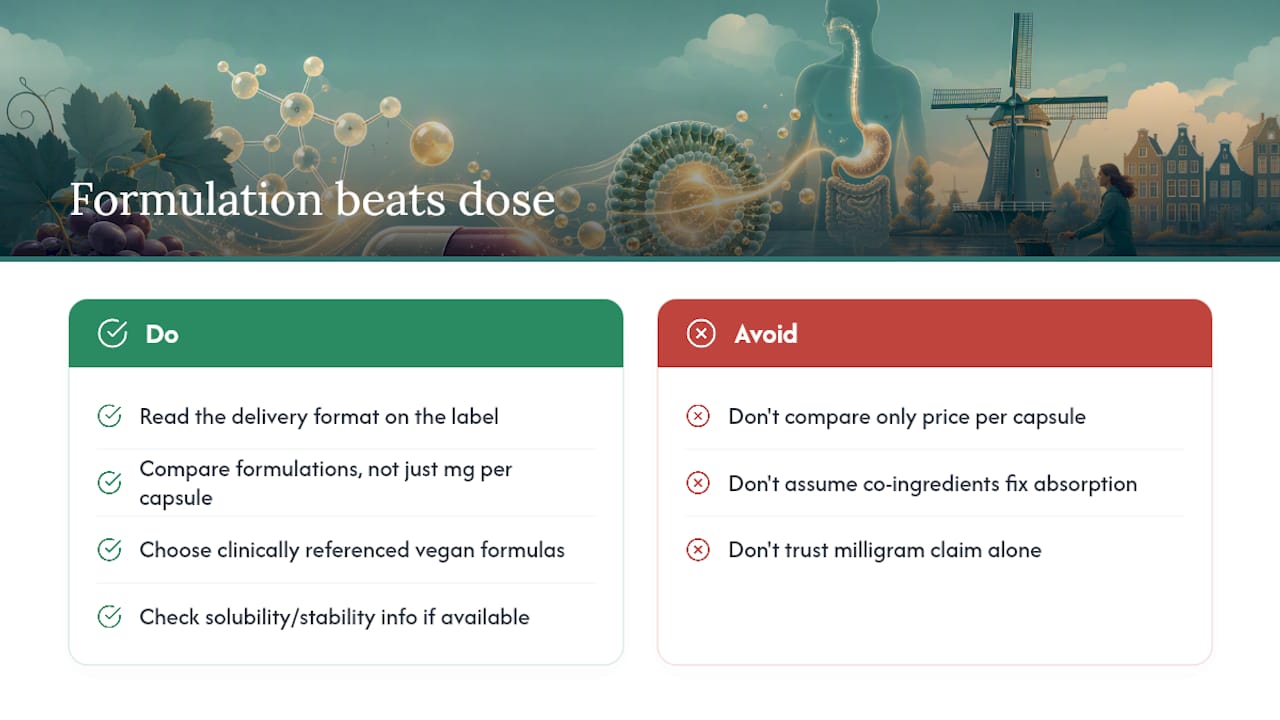
The gap between a resveratrol label’s milligram claim and what actually reaches your bloodstream is the single most important thing to understand before buying. Formulation closes that gap far more reliably than any single co-ingredient does.
Pro Tip: When comparing resveratrol products, read the ingredients list for the delivery format before you compare price per capsule. Two products at the same dose can behave very differently once swallowed.
For readers who want the underlying mechanism spelled out further, Vivetus’s own explainer on how resveratrol supports vitality covers the nutraceutical rationale in more depth.
What a realistic view of resveratrol absorption looks like
Formulation is the variable that matters most here, more than dose, more than a pepper extract sprinkled on top, more than any single number on a label. What clinical benefit you get still depends on the dose used, how long you take it, and the context of your overall health, and no formulation trick substitutes for that. Treat strong Cmax and AUC figures as a reason to trust a product’s delivery system, not as a promise about outcomes.
— Jord
Get a formulation built around the absorption evidence
Vivetus’s approach to resveratrol starts from the same formulation science covered above, rather than a milligram figure alone.
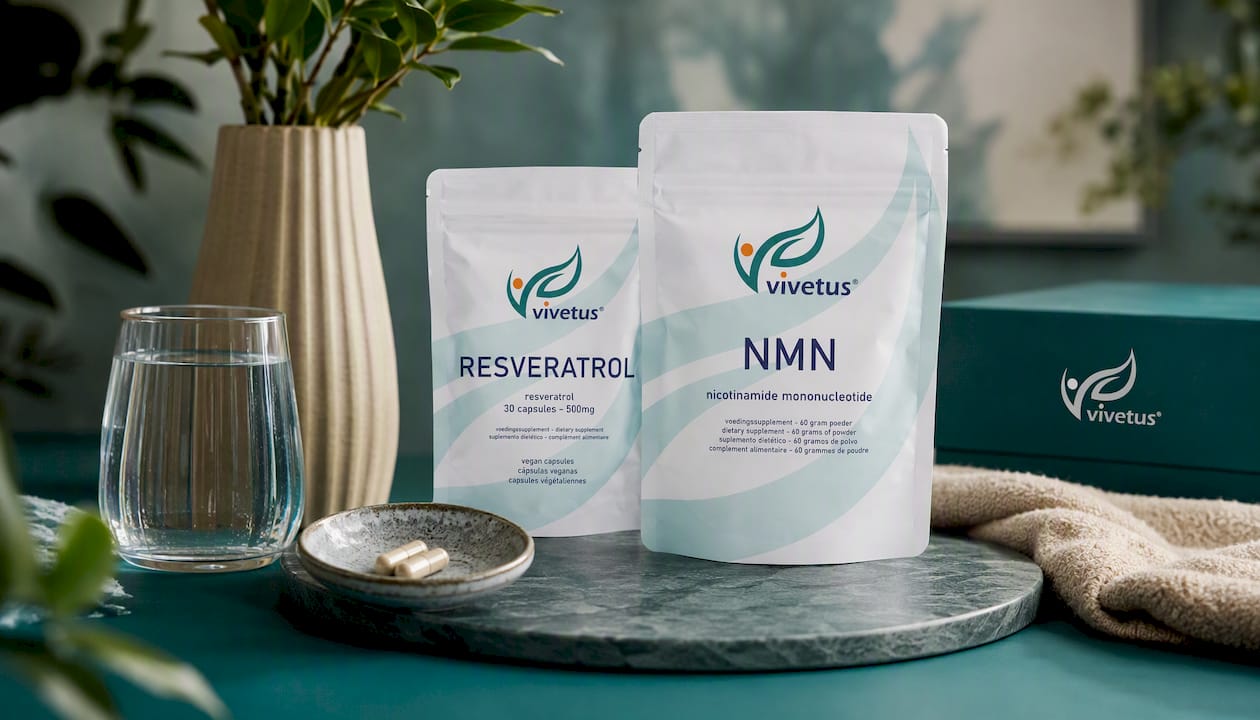
If you have read this far, you already know that a resveratrol capsule is only as good as its delivery system. The Vivetus® Resveratrol, 30 capsules at 500mg is built with that in mind, and it is available as a one-time purchase or a recurring subscription if you would rather not reorder manually. For a broader healthy-ageing stack, the 🔬 Longevity Core bundel pairs resveratrol with complementary compounds from the same product range. Orders over a certain amount often ship free, and product options are typically viewable in full on the respective product pages before purchase commitment.
Sources
- High absorption but very low bioavailability of oral resveratrol in humans
- The oral bioavailability of trans‑resveratrol from a grapevine‑shoot extract in healthy humans is significantly increased by micellar solubilization
- A randomized, double-blind, dose-ranging, pilot trial of piperine with resveratrol
- Resveratrol—A promising therapeutic agent with problematic properties