

Save 10–15% Safely: Supplement Subscriptions That Work for Dutch Shoppers
For most people who take supplements regularly, a subscription beats one-off buying: you get automatic delivery, a recurring discount and easy control over frequency and products from one account. It only makes sense once you know which supplements you actually need, so check your dosage and health goals first. If you fit that profile, a flexible plan like Vivetus’s subscription, or a Vivetus® Cadeaubon as a gift, is the simplest place to start.
TL;DR:
- Most supplement subscriptions are cost-effective only if you genuinely need the product, especially for items like vitamin D, B12, or folic acid.
- Setting your delivery cadence and managing your account allows flexibility, but always review your actual needs and dosage to avoid unnecessary spending or risks.
- Reimbursement through insurance is rare and usually requires a prescription, so compare the subscription cost against paying out of pocket to ensure savings.
- Starting with a trial month and consulting a healthcare professional helps verify if a recurring supplement plan aligns with your health goals.
- Vivetus offers flexible, transparent, and vegan-backed supplement subscriptions focused on healthy aging, with a gift option available.
Table of Contents
- What does a supplement abonnement usually include?
- How do subscriptions work day to day?
- Is your dosage actually necessary?
- What does a subscription actually cost you?
- How do you pick the right plan?
- What makes Vivetus’s subscription different?
- A pragmatic view on subscribing to supplements
- Ready to set up your own supplement plan?
- Sources
- FAQ
What does a supplement abonnement usually include?
A typical supplement subscription runs on a delivery cycle rather than a single transaction. Most providers let you choose a frequency of 30, 60, or 90 days, and the right cadence usually depends on the product: a multivitamin taken daily needs a monthly top-up, while a bottle of 180 fish oil capsules might comfortably stretch to 90 days.
The incentives are fairly standard across the market:
- A recurring discount, typically 10 to 15% off the one-time price,
- Free shipping once your order passes a set threshold, commonly around €50
- Priority or automatic restocking, so you never run out mid-course
The products people subscribe to tend to follow the same shortlist: a daily multivitamin, vitamin D drops or tablets for the darker months, vitamin B12 (especially for vegans and older adults), omega-3, and increasingly, targeted longevity bundles combining several compounds aimed at healthy ageing rather than filling a single gap.
How do subscriptions work day to day?
Signing up is the easy part. Managing the account well is what determines whether a subscription actually saves you time, and most platforms give you similar controls.
- Set your cadence. Choose 30, 60, or 90 days per product, with the option to stagger different items so multivitamins arrive monthly while a 90-day omega-3 supply doesn’t clutter your letterbox.
- Adjust before the next shipment. You can usually change frequency, swap the delivery date, or update your shipping address from your account at any point before an order locks for dispatch.
- Pause, skip, or cancel. Reputable providers let you skip a single delivery, pause the whole plan, or cancel outright without a lock-in period, though cancellation windows vary, so check the cut-off date before your next billing cycle.
- Pay how suits you. Dutch shoppers typically pay by iDEAL or credit card, with invoices and receipts stored in the account dashboard for each shipment, useful if you need them for expense records or insurance claims.
Pro Tip: Set a calendar reminder a few days before each subscription renewal. It takes thirty seconds to check whether you still need that product at that dose, and it stops you paying for supplements you’ve already stopped taking.
Is your dosage actually necessary?
Before locking in any recurring order, it’s worth asking whether you need the supplement at all. The Voedingscentrum is clear that most healthy adults don’t need daily supplements if they eat a varied diet. Specific groups do benefit: everyone in the Netherlands is advised to take vitamin D during autumn and winter, vegans need B12, and pregnant women need folic acid and vitamin D.
A considerable portion of the Dutch population uses dietary supplements, yet most of that group doesn’t meet the criteria that would make supplementation medically useful.
That gap between habit and actual need is worth sitting with before you commit to a monthly delivery.
Dosage matters as much as the decision to supplement at all. The Voedingscentrum’s factsheet on supplement advice warns that many vitamins and minerals have EFSA-established upper intake limits, and taking chronically high doses of nutrients like vitamin A, vitamin D, or zinc offers no extra benefit and can actually cause harm. Always check what percentage of the recommended daily allowance (ADH) a product delivers per serving, not just the raw milligram or microgram figure on the label. If you’re pregnant, on prescription medication, or have a diagnosed deficiency, talk to your GP or pharmacist before subscribing to anything, and treat marketing claims about “boosting” or “optimising” your health with a healthy dose of scepticism. Our guide to clinically backed supplements explains how to separate substantiated evidence from label copywriting.

What does a subscription actually cost you?
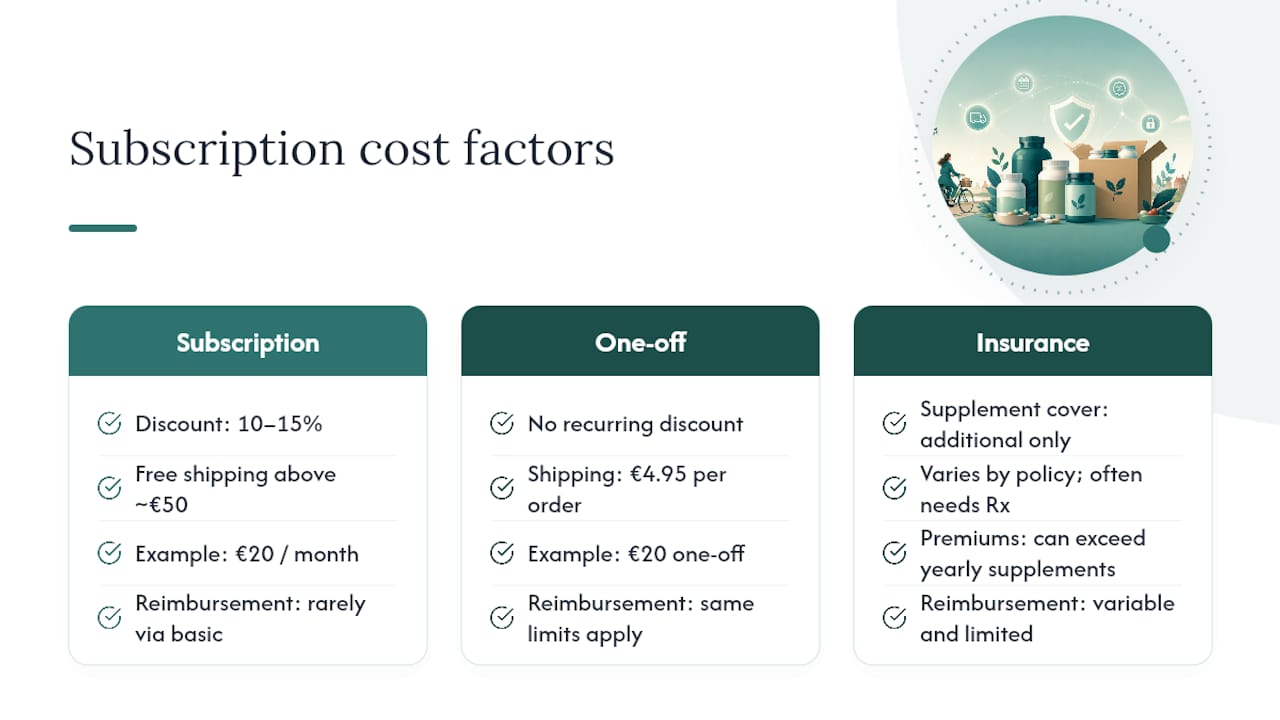
The maths behind a subscription discount is straightforward, but the insurance picture is where most people get it wrong. A recurring discount of 10 to 15% combined with free shipping above roughly €50 usually beats buying single bottles, especially once you factor in the shipping fee you’d otherwise pay on smaller one-off orders.
Take a typical multivitamin priced at €20 a month as a one-off purchase, plus a €4.95 shipping charge if you order it alone.
Reimbursement rarely changes that equation. Supplements sit outside the standard basic insurance package; the BodySwitch overview of 2026 cover shows reimbursement is only available through additional insurance, and even then it varies widely and often requires a prescription. Independer’s analysis makes the same point: the extra premium frequently costs more over a year than the supplements themselves. Calculate your annual supplement spend against the premium increase before adding cover purely for vitamins.
How do you pick the right plan?
Choosing well comes down to a handful of checks rather than picking whichever bundle looks most appealing.
- Confirm the need. Does the product address a documented gap (low vitamin D, B12, or a diagnosed issue) rather than a vague wellness goal?
- Check the dose per serving. Compare it against the ADH percentage on the label, not just the total quantity in the pack.
- Look for third-party testing. Batch testing and transparent sourcing matter more with recurring purchases, since you’re committing to months of the same product.
- Read the cancellation terms. Confirm you can pause or cancel without penalty before your next billing date.
- Start with a trial month. If you’re unsure a product suits you, buy one order first before switching to a recurring plan.
Pro Tip: Ask any provider directly for their lab certificates and exact micrograms per serving. A supplier that answers quickly and specifically is usually more trustworthy than one that only points you to a glossy product page.
Our piece on scientific evidence for supplement choices after 50 goes deeper into age-specific dosing questions.
What makes Vivetus’s subscription different?
Vivetus focuses on vegan, clinically backed supplements built around healthy ageing, organised into bundles such as Longevity Core, Energy & Vitality, and Longevity Plus, so you’re choosing a coherent set of ingredients rather than assembling one yourself. Every subscription runs through your account, where you manage frequency, delivery address, and payment in one place.
Against the decision criteria above, the fit is direct:
- Flexible cadence and easy account-based management rather than a rigid, fixed schedule
- Free shipping above a set order threshold, reducing the per-delivery cost
- Ingredient transparency on product pages, so dosage per serving is stated rather than buried
[Author credentials, case studies, and customer testimonials related to the supplements have been omitted].
A pragmatic view on subscribing to supplements
Subscriptions solve a logistics problem, not a health problem, and conflating the two is where people waste money. If you already know you’re low in vitamin D or B12, or you’re managing a longevity stack you’ve researched properly, a subscription removes the friction of reordering and usually saves you cash. If you’re subscribing because a bundle looked appealing on a landing page, you’re solving the wrong problem.
My practical checklist before you subscribe to anything: get a blood test if you suspect a deficiency, choose one targeted supplement rather than a broad stack, and try a single month before committing to a recurring plan. None of this replaces a conversation with your GP or pharmacist, particularly if you’re pregnant, on medication, or managing a diagnosed condition.
— Jord
Ready to set up your own supplement plan?
Vivetus gives you a subscription built around vegan, clinically backed formulations rather than a generic vitamin aisle repackaged online: flexible 30, 60, or 90-day cadences, a recurring discount, and free shipping once your order clears the threshold, all managed from one account.

If you’d rather gift someone the choice than pick a product for them, the Vivetus® Cadeaubon lets the recipient select their own bundle, whether that’s Longevity Core for a parent or Energy & Vitality for a partner starting out. Cautious buyers should start with a single order before switching to a recurring plan, so you can judge fit and dosage before locking in a schedule. Head to the Vivetus® Cadeaubon page to buy one now, or browse the subscription options directly on the product pages.
This article is general information, not a substitute for advice from a qualified doctor. Consult a qualified healthcare professional about your own circumstances before acting on anything here.
Sources
- Voedingscentrum — Voedingssupplementen
- Which insurers cover dietary supplements in 2026? — BodySwitch
- Slik jij extra vitamines? Dit krijg je wél en niet vergoed — Independer weblog
FAQ
Which supplements are actually effective?
Vitamin D in autumn and winter, B12 for vegans, and folic acid during pregnancy have the strongest backing from Dutch dietary guidance; most other supplements only help if you have a documented gap rather than a general wellness goal.
What types of supplement subscriptions exist?
Most providers offer flexible cadences of 30, 60, or 90 days per product, with options to bundle several supplements, stagger delivery dates, and pause or cancel individual items without affecting the rest of the plan.
Are supplements reimbursed by health insurance?
Not through the standard basic insurance package; reimbursement is only available via additional insurance, varies significantly between insurers, and often requires a prescription, so it’s worth calculating whether the extra premium beats simply paying for supplements yourself.
Is a supplement subscription worth it?
For anyone taking the same product monthly, yes: the recurring discount and free shipping threshold typically bring the per-month cost down, provided the supplement itself addresses a real, documented need.