

The role of collagen in vitality: what the science says
TL;DR:
- Collagen is the most abundant structural protein in the body, supporting skin, joints, and muscles beyond cosmetics. Its benefits for vitality are supported by research, especially when combined with resistance training over long-term use. Consistent supplementation with high-quality collagen and a nutrient-rich diet enhances tissue repair, mobility, and overall energy.
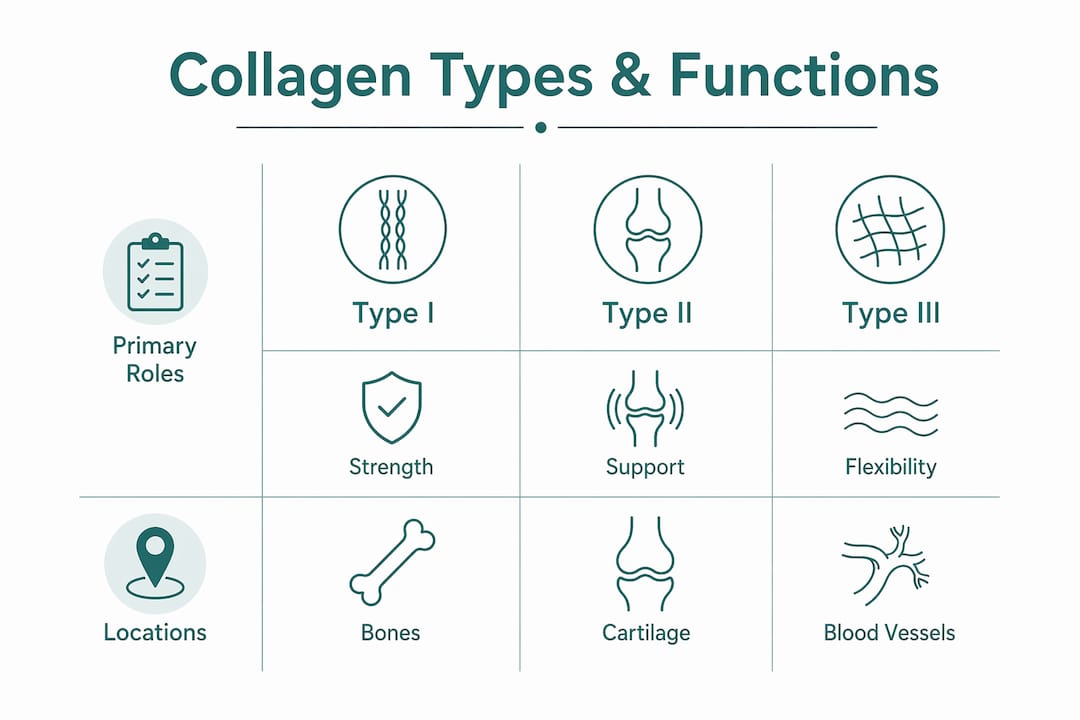
Collagen is defined as the most abundant structural protein in the human body, forming the physical framework of skin, joints, muscles, and connective tissue. Its role in vitality is not cosmetic. Collagen Types I, II, and III account for 80–90% of total body collagen, and their combined function determines how well your body moves, recovers, and holds together as you age. Understanding how collagen supports vitality means looking beyond skin creams and into the biology of tissue repair, joint mobility, and muscle integrity.
What biological roles does collagen play in maintaining vitality?
Collagen is the primary load-bearing protein in the body. It gives skin its firmness, cartilage its cushioning, and muscle tissue its structural scaffolding. Without sufficient collagen, these tissues lose integrity, and physical vitality declines.
Collagen and skin health
Type I collagen dominates the skin’s dermal layer, where it maintains hydration, elasticity, and firmness. As production slows with age, skin loses moisture and becomes less resilient. This is not a superficial concern. Skin integrity reflects broader connective tissue health throughout the body.
Joint support and cartilage function
Type II collagen is the primary component of articular cartilage, the tissue that cushions joints during movement. Collagen peptides at 2.0 g/day significantly improved knee pain and mobility scores in double-blind, placebo-controlled trials over 12 weeks. That finding matters because joint pain is one of the earliest and most limiting factors in declining vitality for adults over 40.
Muscle tissue and force transmission
Collagen forms the extracellular matrix surrounding muscle fibres, transmitting the mechanical forces generated during movement. Without this matrix, muscles cannot contract and recover efficiently. Type III collagen is particularly active in soft tissue repair, making it relevant to recovery from physical exertion.
Broader connective tissue contributions
Collagen also supports tendons, ligaments, blood vessel walls, and organ structure. Collagen hydrolysate exhibits antioxidant, anti-inflammatory, and antihypertensive properties, extending its contribution to vitality well beyond visible tissue support.
| Collagen type | Primary location | Vitality function |
|---|---|---|
| Type I | Skin, tendons, bone | Firmness, structural strength |
| Type II | Cartilage | Joint cushioning, mobility |
| Type III | Soft tissue, blood vessels | Repair, flexibility, circulation |
What does current research say about collagen supplementation?
The evidence base for collagen supplementation has grown considerably. A 2026 meta-analysis of 113 clinical studies involving approximately 8,000 participants found credible evidence supporting collagen’s benefits for skin hydration, elasticity, joint pain relief, and muscle health. That is a substantial body of evidence, though the same analysis confirmed that benefits are modest and vary between individuals.
One of the most striking findings from 2026 research concerns muscle tissue specifically. Supplementing with 15 g daily of specific collagen peptides during 12 weeks of resistance training increased intramuscular Type I collagen content by approximately 3.5 times more than placebo. The placebo group showed a 9.9% increase; the supplement group showed 29.8%. That gap is meaningful for anyone using exercise to maintain strength and mobility with age.
The research also highlights important limitations. Inconsistent results across studies are partly explained by variability in collagen formulations, dosing protocols, and participant demographics. Not all collagen products perform equally, and short-term use consistently fails to deliver meaningful results.
Key findings from the current evidence base:
- Skin hydration and elasticity improve with sustained collagen peptide intake.
- Joint pain and stiffness reduce measurably over 12-week periods.
- Muscle collagen synthesis increases significantly when supplementation is combined with resistance training.
- Positive effects appear gradually and require long-term commitment rather than short-term use.
- Antioxidant and anti-inflammatory effects contribute to vitality beyond structural support.
Pro Tip: If you are evaluating a collagen supplement, look for products specifying the collagen type and peptide molecular weight. Hydrolysed collagen peptides with low molecular weight absorb more readily than whole collagen protein.
How do exercise, nutrition, and collagen type affect its effectiveness?
Collagen supplementation does not work in isolation. Its effectiveness for vitality depends on how it is used, what it is combined with, and which form is taken.
The exercise connection
Collagen supplementation is most effective for muscle and connective tissue health when combined with resistance training. The mechanism is specific: collagen peptides act as bioactive signalling molecules that activate receptor pathways regulating extracellular matrix remodelling in response to mechanical load. This means supplementation amplifies what exercise already triggers. Taking collagen without physical activity produces a weaker response.
Amino acid availability
Collagen synthesis depends on glycine and proline, two amino acids that are often limited in standard diets. Collagen peptide supplements supply these substrates directly, which is why they outperform general protein supplements for connective tissue repair. Glycine also plays a role in sleep quality and cellular energy metabolism, adding another dimension to collagen’s impact on energy levels.
Bioavailability and formulation
Hydrolysed collagen peptides absorb more efficiently than intact collagen protein. The hydrolysis process breaks collagen into smaller fragments that cross the intestinal wall and reach target tissues. This distinction matters when selecting a product. Collagen hydrolysate also carries the antioxidant and anti-inflammatory properties identified in comprehensive collagen research, which contribute to broader vitality beyond joint and skin outcomes.
The importance of collagen in wellness also depends on consistency. Effects accumulate over weeks and months, not days. Adults who stop supplementing after four weeks rarely see the full benefit.
What practical steps support collagen’s role in your wellness routine?
Applying the science to daily life requires a structured approach. The following steps reflect current evidence on how to get the most from collagen supplementation.
-
Choose hydrolysed collagen peptides. These absorb more efficiently and deliver the amino acids glycine and proline directly to connective tissues. Look for products specifying Type I or Type II collagen depending on your primary goal, whether that is skin health or joint support.
-
Combine supplementation with resistance training. The 2026 trial data confirms that collagen’s effect on muscle tissue is significantly greater when paired with high-load exercise. Even two to three sessions per week of weight-bearing activity amplifies the benefit.
-
Commit to at least 12 weeks. Short-term supplementation consistently shows limited results. Collagen turnover cycles and physiological adaptation require sustained intake before meaningful changes occur in skin, joints, or muscle tissue.
-
Support collagen synthesis through diet. Vitamin C is a required co-factor for collagen production. Foods rich in zinc, copper, and antioxidants also support the synthesis pathway. A diet low in these nutrients will blunt the effect of supplementation.
-
Maintain realistic expectations. Collagen is reliable for skin and joint health but not a cure-all. Benefits are real and clinically supported, but they are gradual and moderate. Adults who approach collagen as one component of a broader wellness routine see better outcomes than those expecting rapid transformation.
Pro Tip: Taking collagen peptides 30–60 minutes before a resistance training session may enhance the delivery of glycine and proline to active connective tissues during the period of peak mechanical load.
For a thorough overview of how supplementation fits into a broader ageing strategy, the nutritional supplements guide for healthy ageing from Vivetus covers collagen alongside other evidence-based approaches.
Key takeaways
Collagen supports vitality through structural, anti-inflammatory, and metabolic functions that require consistent, long-term supplementation combined with physical activity to produce meaningful results.
| Point | Details |
|---|---|
| Collagen types I, II, and III | These three types account for 80–90% of body collagen and underpin skin, joint, and muscle health. |
| Supplementation evidence | A 2026 meta-analysis of 113 studies confirmed modest but credible benefits for skin, joints, and muscle tissue. |
| Exercise amplifies results | Combining 15 g daily collagen peptides with resistance training increases muscle collagen by 3.5 times more than placebo. |
| Long-term commitment required | Positive effects on skin and joints appear gradually; short-term use delivers limited benefit. |
| Formulation matters | Hydrolysed collagen peptides offer superior bioavailability and carry antioxidant and anti-inflammatory properties. |
Collagen and vitality: a realistic assessment
The science on collagen is more credible than the marketing around it, and also more modest. What I find most telling about the 2026 meta-analysis is not the positive findings. It is the acknowledgement that inconsistent results across studies are partly a product of inconsistent products. That is a quiet admission that the supplement industry has not standardised collagen formulations, and consumers are bearing the consequences.
What I have seen consistently is that adults who treat collagen as a single fix rarely notice much. Those who pair it with resistance training, maintain intake for three months or more, and support it with a nutrient-rich diet report genuine improvements in joint comfort and skin resilience. The biology supports this. Collagen synthesis is a slow, resource-intensive process. You cannot rush it with a two-week course.
The anti-inflammatory and antioxidant effects of collagen hydrolysate are underreported. Most people focus on skin and joints, but the contribution to systemic inflammation and cellular health is where I think future research will find the strongest case for collagen’s impact on energy levels and sustained vitality. The collagen supplementation guide from Vivetus is a good starting point for understanding how to apply this practically.
My honest position: collagen is worth taking seriously, but only if you take it consistently, choose a quality hydrolysate, and pair it with the lifestyle factors that activate its benefits. Anything less is an expensive shortcut that will not deliver.
— Jord
Collagen supplements from Vivetus, built on evidence
Vivetus focuses on nutritional supplements designed for adults who want to age well and maintain physical vitality. The collagen products available through Vivetus are formulated with bioavailability in mind, drawing on the same clinical evidence reviewed in this article.
Adults looking to support skin health, joint comfort, and muscle integrity will find a range of collagen supplements for active ageing at Vivetus, with free shipping on orders over €50. The focus is on quality formulations that align with what the research actually supports, not what the marketing promises. Visit Vivetus to review the full product range.
FAQ
What is the role of collagen in vitality?
Collagen maintains the structural integrity of skin, joints, muscles, and connective tissue, all of which are central to physical vitality. Its anti-inflammatory and antioxidant properties also contribute to broader wellbeing and energy metabolism.
How long does collagen supplementation take to work?
Meaningful benefits for skin hydration, joint pain, and muscle health typically require at least 12 weeks of consistent intake. Short-term use consistently shows limited results due to collagen turnover cycles.
Does exercise improve collagen supplementation results?
Yes. Combining collagen peptides with resistance training increases intramuscular Type I collagen content by approximately 3.5 times more than supplementation without exercise, according to a 2026 randomised controlled trial.
Which collagen type is best for joint health?
Type II collagen is the primary structural component of articular cartilage and is the most relevant type for joint support. Clinical trials using 2.0 g/day of collagen peptides showed significant improvements in knee pain and mobility over 12 weeks.
Can collagen supplements improve energy levels?
Collagen does not directly boost energy in the way stimulants do. However, glycine, a key amino acid in collagen, supports sleep quality and cellular energy metabolism, and the anti-inflammatory effects of collagen hydrolysate reduce the physiological burden that chronic inflammation places on the body.