

Hydration tips for aging: your practical daily guide
Older adults should aim for at least 1.6 litres per day (women) or 2.0 litres per day (men) from drinks alone, following ESPEN’s geriatric baseline, and should drink on a schedule rather than waiting for thirst. Three steps to start within 24 hours:
- Keep a filled water bottle or cup visible and within reach at all times.
- Set three or four phone or watch reminders spaced across the day.
- Choose drinks you actually enjoy: water, tea (between meals), milk, or diluted juice all count.
If you are on treatment for heart failure or renal failure, or if a clinician has told you to restrict fluids, speak to them before increasing your intake.
Table of Contents
- Why does hydration change as you get older?
- How much fluid do older adults actually need each day?
- Practical ways to increase fluid intake every day
- How can you tell whether you are drinking enough?
- Which medicines and conditions change your fluid needs?
- Do electrolyte drinks and supplements help older adults?
- A simple 7-day hydration routine to get started
- Key takeaways
- The habit that actually moves the needle
- Vivetus Energy & Vitality bundel: a supplement option for active agers
- Useful sources and further reading
Why does hydration change as you get older?
Two physiological shifts make dehydration far more likely with age, and standard adult advice does not account for either.
First, the kidneys lose their ability to concentrate urine. Maximum urinary concentrating ability falls by roughly 50% between ages 30 and 80, meaning the body excretes more water to excrete the same waste load. Second, the thirst signal becomes unreliable. Neural changes delay the brain’s response to rising plasma osmolality, so an older adult can be meaningfully dehydrated before feeling thirsty at all. Relying on thirst is therefore unsafe.
Behavioural factors compound the physiology:
- Continence anxiety: many older adults deliberately drink less to avoid urgency or accidents.
- Reduced social drinking: fewer shared mealtimes mean fewer natural prompts to drink.
- Polypharmacy: diuretics, laxatives, and some psychotropic medicines all increase fluid losses.
Dehydration prevalence in older adults: Community and care-home studies estimate that a substantial proportion of older adults show biochemical evidence of dehydration or impending dehydration, yet the condition is frequently unrecognised.
How much fluid do older adults actually need each day?
The ESPEN practical guideline sets the baseline at 1.6 L/day for older women and 2.0 L/day for older men from drinks, reflecting age-specific physiology. Roughly 20% of daily fluid also comes from food, so a diet rich in soups, fruits, and vegetables contributes meaningfully. A critical review of fluid intake studies recommends 1.5–2.0 L/day from drinks as the practical range for most adults over 65.
When to increase beyond the baseline:
- Fever: increase fluid intake above baseline during fever, with additional volume recommended per degree above a fever threshold.
- Hot weather or increased activity: losses rise; increase intake accordingly.
- Vomiting or diarrhoea: fluid and electrolyte replacement becomes urgent.
When to seek clinician advice before changing intake: heart failure, advanced renal impairment, or severe hyponatraemia all require medically supervised fluid targets.
Pro Tip: Space drinks across the day rather than drinking large volumes at once. Linking a glass of water to each meal and each medication dose is one of the most reliable ways to hit the daily target without discomfort.
Practical ways to increase fluid intake every day
Tactics that address both the physiological and behavioural barriers:
- Bottle strategy: use a marked 500 ml bottle and aim to refill it three to four times daily. Visible bottles prompt drinking without relying on thirst.
- Beverage variety: rotate between water, diluted fruit juice, herbal teas, and milk. Variety reduces monotony and sustains intake over weeks.
- Flavouring: a slice of lemon, cucumber, or a small amount of squash makes plain water more appealing for many older adults.
- Link drinks to existing habits: take a drink with every tablet, after brushing teeth, and at the start of each meal. Habit-stacking removes the need to remember separately.
- Caregiver prompts: for those in assisted living or with home support, regular verbal prompts and assisted drinking at scheduled intervals are more effective than general reminders to “drink more.”
- Continence planning: small, frequent sips (100–150 ml at a time) rather than large glasses reduce urgency. Planned toilet breaks before outings remove a key barrier to drinking enough.
Pro Tip: For frail or underweight older adults, milk-based drinks such as warm milky tea, hot chocolate, or a fortified milk drink serve double duty: they provide fluid and add protein and calories that plain water cannot. Avoid large single-volume drinks, which can cause discomfort and discourage further intake.
How can you tell whether you are drinking enough?
Clinical signs alone, such as skin turgor or dry mouth, are unreliable in older adults because skin elasticity changes with age regardless of hydration. The diagnostic gold standard is plasma osmolality; a calculated osmolarity cut-off of ≥295 mmol/L identifies most cases of low-intake dehydration with 85% sensitivity, though this requires a blood sample.
For day-to-day monitoring at home, three practical checks are sufficient:
- Urine colour: pale straw (similar to lemonade) indicates good hydration. Dark yellow or amber suggests inadequate intake.
- Daily weight: a loss of more than 1 kg overnight usually reflects fluid loss rather than fat change.
- Symptoms: dizziness on standing, reduced urine output, or new confusion warrant prompt action.
| Observation | Likely status | Action |
|---|---|---|
| Pale straw urine, no symptoms | Well hydrated | Maintain current intake |
| Dark yellow urine, mild thirst | Mild deficit | Increase drinks by 200 ml |
| Amber urine, dizziness, dry mouth | Moderate dehydration | Increase intake; monitor closely |
| Confusion, very dark urine, no urination | Significant dehydration | Seek clinician assessment promptly |
Which medicines and conditions change your fluid needs?
Standard hydration advice is unsafe for some older adults without medical review. Conditions that may require fluid restriction or supervised targets include heart failure, advanced renal failure, and severe hyponatraemia. For these, a clinician sets the appropriate daily limit.
Common drug classes that alter fluid balance:
- Diuretics (furosemide, thiazides): increase urine output and raise dehydration risk.
- Laxatives: osmotic types draw water into the bowel, increasing losses.
- Some psychotropics (lithium, certain antipsychotics): affect renal water handling or increase sweating.
If you take any of these medicines, coordinate any change in fluid intake with your prescriber. A practical step: write down your current daily fluid intake and any symptoms (dizziness, dark urine, swollen ankles) and bring that note to your next appointment.
Do electrolyte drinks and supplements help older adults?
Plain water is sufficient for routine daily hydration in most healthy older adults. Electrolyte solutions and oral rehydration products become relevant in specific situations: acute illness with vomiting or diarrhoea, heavy sweating in hot weather, or recovery from a fever episode.
Key points on electrolyte and rehydration products:
- Oral rehydration solutions (ORS) replace both water and electrolytes lost during illness. They are more effective than plain water for acute salt-loss dehydration.
- Sports drinks are formulated for exercise-related losses and tend to contain more sugar than older adults need for routine rehydration.
- High-sodium rehydration products are unsuitable for people with hypertension or heart failure without clinician approval.
- Powdered electrolyte mixes vary widely in sodium content; check the label and discuss with a clinician if you have a relevant condition.
For routine daily hydration, the food-based guidance from the Food Safety Authority of Ireland recommends water as the primary fluid, with milk-based drinks for frail or underweight adults. Strong tea is best consumed between meals to avoid interfering with iron and zinc absorption; caffeine-containing drinks should be avoided close to bedtime.
Pro Tip: Reserve high-sodium oral rehydration solutions for clinician-advised use during illness. For everyday hydration support, a fortified milky drink at medication time adds fluid, protein, and calories in one step.
A simple 7-day hydration routine to get started
This framework is adaptable. Adjust volumes to your clinician’s guidance if you have a relevant condition.
Daily structure (each day):
- On waking: 200 ml water or diluted juice before breakfast.
- With breakfast: 200 ml milk, tea, or coffee.
- Mid-morning: 150–200 ml water or herbal tea (set a reminder).
- With lunch: 200 ml of your preferred drink; include a soup or water-rich food.
- Mid-afternoon: 150–200 ml water or a milky drink (frail adults: fortified milk drink here).
- With evening meal: 200 ml of your preferred drink.
- Early evening: 150 ml water or herbal tea (stop caffeine by 6 PM).
Caregiver checklist:
- Place a filled drink within arm’s reach at each sitting area.
- Set phone or smart-speaker reminders at mid-morning and mid-afternoon.
- Record total daily intake in a notebook or app for the first week.
- If urine remains dark after two consecutive days of increased intake, arrange a clinician review.
- Add an oral rehydration solution only on clinician advice during illness.
Pro Tip: On day one, simply count how many drinks you currently have. Most people are surprised to find they are two or three short of the ESPEN baseline. Knowing the gap makes the target concrete.
For a broader look at healthy ageing habits, Vivetus has a practical checklist that pairs well with this routine.
Key takeaways
Older adults who drink to a schedule, monitor urine colour daily, and adjust for illness or heat can maintain adequate hydration without relying on thirst.
| Point | Details |
|---|---|
| ESPEN daily baselines | At least 1.6 L/day for older women and 2.0 L/day for older men from drinks alone. |
| Scheduled sipping | Drink at fixed times linked to meals and medication; never rely on thirst as the trigger. |
| Monitor urine colour | Pale straw is the target; dark yellow or amber signals a need to increase intake. |
| Medical caution | Heart failure, renal failure, and several drug classes require clinician-supervised fluid targets. |
| Vivetus option | The Energy & Vitality bundle is a supplement option for those supporting their hydration routine with targeted nutritional products. |
The habit that actually moves the needle
Most hydration advice tells older adults to “drink more water.” The problem is that the thirst signal that would prompt that drinking is often already impaired by the time advice is needed. The single most underestimated shift is moving from reactive drinking (responding to thirst) to structured drinking (a glass at every medication time, every meal, every mid-morning break). That structural change removes the broken signal from the equation entirely.
Supplements can support a broader vitality routine, but they do not replace fluid volume. If you take medicines that affect fluid balance, bring a written note of your daily intake to your next appointment. Personalised advice from a clinician will always outperform a general guideline for your specific situation.
Vivetus Energy & Vitality bundel: a supplement option for active agers
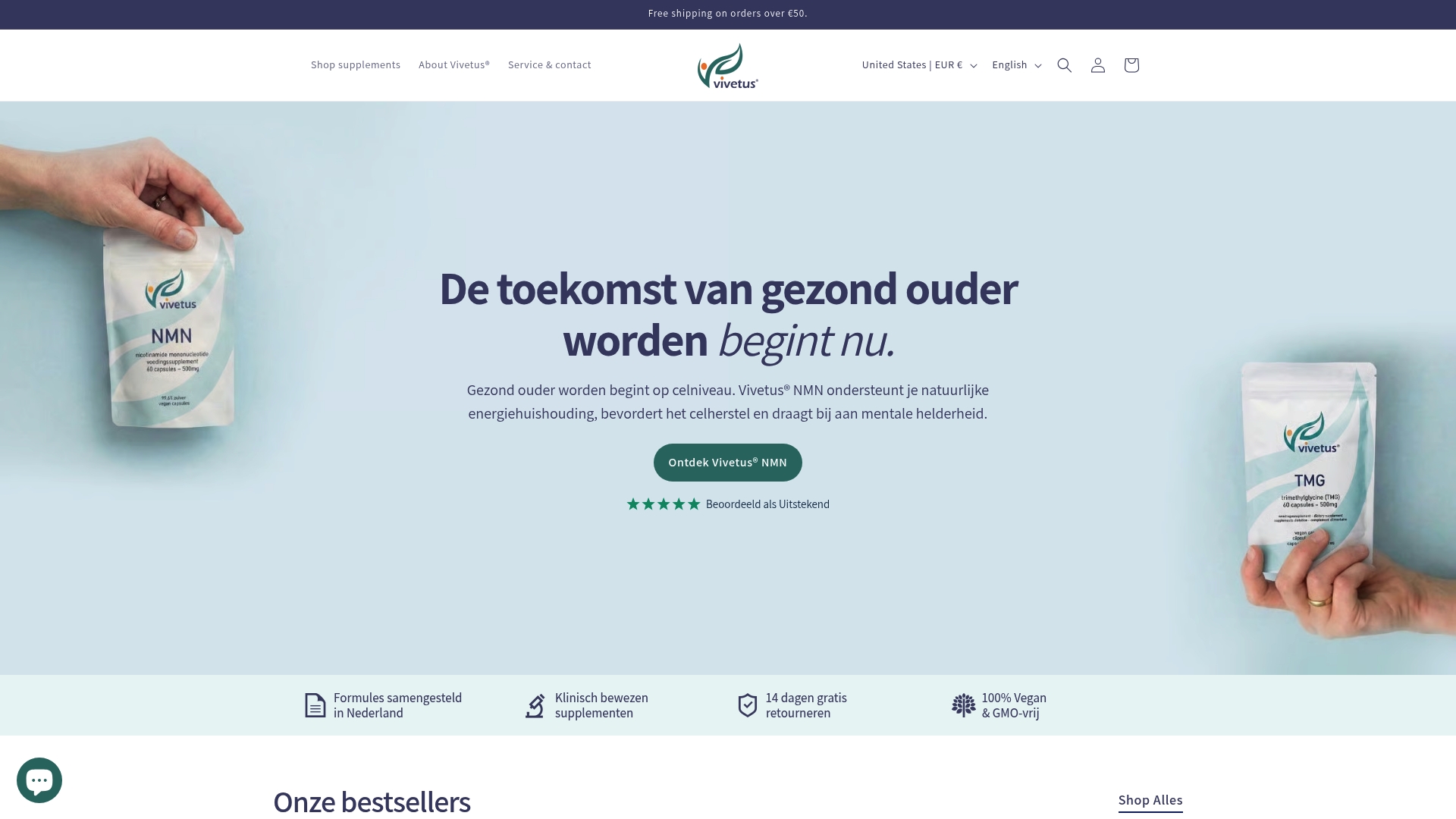
Hydration habits are the foundation. For older adults who also want targeted nutritional support alongside their daily fluid routine, Vivetus offers the Energy & Vitality bundel, a supplement package designed to support vitality and healthy ageing. It pairs naturally with a structured hydration plan: take it at a fixed mealtime drink, and the supplement dose becomes part of the same scheduled habit that keeps fluid intake on track.
The bundle is not a replacement for adequate fluid intake or clinical advice. If you have fluid restrictions or take medicines that affect hydration, consult your clinician before adding any supplement. For those without such restrictions, it is a practical way to support elder vitality alongside the daily habits described in this guide. Visit the product page to check current availability and order with free shipping on orders over €50.
Useful sources and further reading
“Older adults are more vulnerable to dehydration, especially those living with multiple chronic diseases. Dehydration is associated with adverse health outcomes in older adults, and acts as an independent factor of hospital length of stay, readmission, intensive care, in-hospital mortality, and poor prognosis.” — Hydration Status in Older Adults: Current Knowledge and Future Challenges, PMC
Core references for clinical thresholds and practical guidance:
- ESPEN practical guideline on clinical nutrition and hydration in geriatrics — the primary source for daily volume targets (1.6 L/2.0 L) and multicomponent care strategies. Use this for clinical thresholds.
- Multidisciplinary consensus on dehydration (Annals of Medicine, 2019) — covers diagnostic methods including plasma osmolality and the 295 mmol/L screening cut-off. Use this for monitoring guidance.
- Dysregulation of the fluid homeostasis system by aging (PMC, 2024) — detailed review of renal concentrating ability decline and blunted thirst. Use this for physiology background.
- Fluid intake recommendation for adults over 65 (Nutrients, 2020) — critical review supporting the 1.5–2.0 L/day practical range and the case for ESPEN as the age-aware guideline.
- FSAI scientific recommendations for older adults — food-based guidance on beverage choice, milk-based drinks for frail adults, and tea timing relative to meals.
- EFSA dietary reference values for water — broader population reference values and the physiological basis for age-adjusted targets.