

1,544% Mouse Cmax for Resveratrol and Piperine: Why Humans Differ
Piperine can raise resveratrol’s blood levels by a striking margin in animals, and human data show real physiological effects, but not the dramatic plasma spikes seen in rodents. A mouse study found resveratrol exposure jumped by 229% in AUC and 1,544% in Cmax when paired with piperine (Johnson et al., 2011). A human trial using 250 mg resveratrol with 20 mg piperine found improved cerebral blood flow (Wightman et al., 2014), even without a clear rise in plasma resveratrol. The rest of this article unpacks why that gap exists, what doses were actually studied, and what it means for anyone weighing up a supplement with both ingredients.
TL;DR:
- Human studies show that piperine may improve resveratrol’s effects on blood flow, but does not consistently increase its plasma concentration.
- The doses tested in trials are usually around 250 mg of resveratrol with 20 mg of piperine, not significantly higher, and formulations should specify trans-resveratrol content.
- In mice, piperine caused a fifteen-fold increase in resveratrol’s peak plasma level, but that effect does not reliably translate to humans due to metabolic differences.
- Short-term human trials report good tolerability for combined resveratrol and piperine, but caution is advised for those on medications metabolized through glucuronidation pathways.
- Mechanistically, piperine inhibits gut enzymes and transporters that affect resveratrol absorption, likely acting mainly at the intestinal level rather than systemically.
Table of Contents
- How piperine could increase resveratrol and piperine absorption
- What animal studies show about resveratrol and piperine
- What do human trials show about pharmacokinetics and effects?
- What doses were used in trials and how should you apply them?
- Are there safety risks or side effects to know about?
- What does Vivetus’s own research say about resveratrol absorption?
- Is the piperine and resveratrol pairing worth it?
- Vivetus resveratrol supplements built around the actual research
- Selected primary literature and reviews
- Sources
- FAQ
How piperine could increase resveratrol and piperine absorption
Resveratrol has a problem the moment it hits your gut: your body treats it like an intruder to be neutralised fast. Within minutes of absorption, liver and intestinal enzymes attach a sugar molecule to it through a process called glucuronidation, converting the active compound into a water-soluble form your kidneys can flush out. This is precisely why oral resveratrol has such notoriously poor bioavailability on its own, despite being absorbed reasonably well at the gut wall.
Piperine, the alkaloid responsible for black pepper’s bite, appears to interrupt part of that clearance process. Reviews of the mechanism point to two main routes:
- UGT enzyme inhibition — piperine can inhibit UDP-glucuronosyltransferase (UGT) enzymes, the family responsible for tagging resveratrol for excretion, which slows how quickly the compound gets deactivated in the gut wall and liver.
- Efflux transporter effects — piperine also appears to inhibit transporters like P-glycoprotein (P-gp) and multidrug resistance protein (MRP), which normally pump absorbed compounds back out of intestinal cells and into the gut lumen before they can reach circulation.
- Membrane permeability changes — some evidence suggests piperine alters the fluidity of the intestinal cell membrane itself, making it easier for lipophilic molecules like resveratrol to pass through in the first place.
A review in Nutrients confirms this dual action on UGT and ABC-family transporters, framing piperine as a genuine bioenhancer candidate rather than a marketing flourish. The mechanistic case is coherent, even if the clinical results (covered further down) are messier than the biochemistry would suggest.
There’s a distinction worth sitting with here, because it explains a lot of the confusion around this topic: local gut inhibition of metabolism is not the same as systemic enzyme blockade. Piperine’s effect seems to happen predominantly at the intestinal wall and during first-pass metabolism in the liver, rather than by circulating through your bloodstream and switching off UGT enzymes everywhere in the body. That distinction matters practically, because it means piperine’s main job may be getting more resveratrol past the gate rather than keeping it active once it’s already circulating.
This is also where the difference between bioavailability and bioefficacy becomes central to understanding the whole debate. Bioavailability refers strictly to how much of a compound reaches your bloodstream, usually measured as plasma concentration over time. Bioefficacy refers to whether that compound actually produces a measurable physiological effect, regardless of what the blood test shows. Piperine could, in theory, boost one without dramatically shifting the other; a small increase in tissue-level exposure to resveratrol, or its bioactive metabolites, might trigger a measurable effect (like improved blood flow) without pushing plasma resveratrol high enough to register clearly on a standard assay. That’s not a contradiction. It’s a sign that the story is more complicated than “more piperine equals more resveratrol in the blood.”
What animal studies show about resveratrol and piperine
The number that gets quoted most often in this space comes from a mouse study by Johnson and colleagues in 2011. Mice received 100 mg/kg of resveratrol either alone or combined with 10 mg/kg of piperine, and researchers tracked plasma resveratrol levels over time to calculate area under the curve (AUC) and peak concentration (Cmax).
The headline figures: resveratrol’s AUC increased by 229% and its Cmax rose by 1,544% when piperine was added to the same dose, according to the PMC-published study.
That Cmax figure, over fifteen times higher, is the number that circulates in supplement marketing everywhere, and it’s a real result from a peer-reviewed paper. But it needs context most product pages skip entirely:
- The doses used (100 mg/kg resveratrol, 10 mg/kg piperine) don’t scale directly to human dosing; mouse metabolism runs faster and handles xenobiotics differently than human metabolism does.
- Other rodent and animal work on bioenhancers broadly supports the direction of this finding, showing that piperine and similar compounds can raise both Cmax and AUC for various poorly absorbed nutraceuticals, not resveratrol alone.
- Mice also lack the same UGT enzyme profile and gut microbiome composition as humans, both of which shape how much of an oral dose of resveratrol ever reaches circulation in the first place.
Translational pharmacology has a consistent pattern: effect sizes measured in rodents tend to shrink substantially once the same intervention is tested in humans, sometimes to a fraction of the original magnitude. That’s not a flaw in the mouse study. It’s simply a reminder that a fifteen-fold Cmax increase in a mouse is a starting hypothesis for human research, not a guaranteed outcome once you’re the one swallowing the capsule.
What do human trials show about pharmacokinetics and effects?
This is where the story gets genuinely interesting, and where most supplement marketing quietly stops talking. The best-known human trial on this pairing is a randomised, double-blind, placebo-controlled crossover study by Wightman and colleagues in 2014, registered as NCT01331382 on the clinical trials registry.
Participants received 250 mg of trans-resveratrol either alone or combined with 20 mg of piperine, in a crossover design where each person acted as their own control across different testing sessions. Researchers measured two very different things: cerebral blood flow during cognitive tasks, and plasma concentrations of resveratrol and its metabolites.
The results split in a way that surprises a lot of people expecting a straightforward “piperine boosts resveratrol” story:
- Cerebral blood flow increased with the resveratrol-plus-piperine combination compared with resveratrol alone, an effect the researchers linked to task-related brain activity during cognitive testing.
- Plasma resveratrol levels did not rise significantly with the addition of piperine, despite the improvement in blood flow.
The trial’s own findings point to something the animal data alone can’t explain: bioefficacy and bioavailability moved in different directions. Cerebral blood flow improved measurably with the combination, yet plasma concentrations of resveratrol and its metabolites showed no clear jump when piperine was added.
Why the mismatch? Part of the answer is methodological. Parent resveratrol is notoriously hard to detect in human plasma after oral dosing, largely because it gets converted into glucuronide and sulphate metabolites so quickly that researchers often measure those metabolites instead of the original compound. That measurement challenge complicates any comparison across studies, and it may mean piperine’s effect on tissue-level exposure, in the brain or elsewhere, doesn’t show up cleanly in a blood draw even when something physiologically meaningful is happening.
Other pilot and dose-ranging human trials in this space report a similarly mixed picture: some show modest pharmacokinetic shifts with piperine, others show none, and few show anything approaching the rodent-scale increases. Reviews summarising this literature describe the clinical PK evidence as inconsistent, even while acknowledging the mechanistic rationale for enhancement is sound. Analytical detection limits, the reliance on metabolite tracking rather than parent-compound measurement, and natural variability between individuals’ UGT enzyme activity all contribute to that inconsistency.
Put together, human evidence supports the idea that piperine may improve some physiological endpoints of resveratrol supplementation, cerebral blood flow being the clearest example so far, without necessarily producing the dramatic plasma increases seen in animal models. That’s a meaningfully different claim from “piperine makes resveratrol 15 times more bioavailable in people,” and it’s one worth holding onto before reaching for a bottle.
What doses were used in trials and how should you apply them?
Study doses give you the only genuinely useful anchor point if you’re weighing up how to combine these two ingredients yourself, rather than guessing at ratios pulled from a product label.
Human trials have generally used the following:
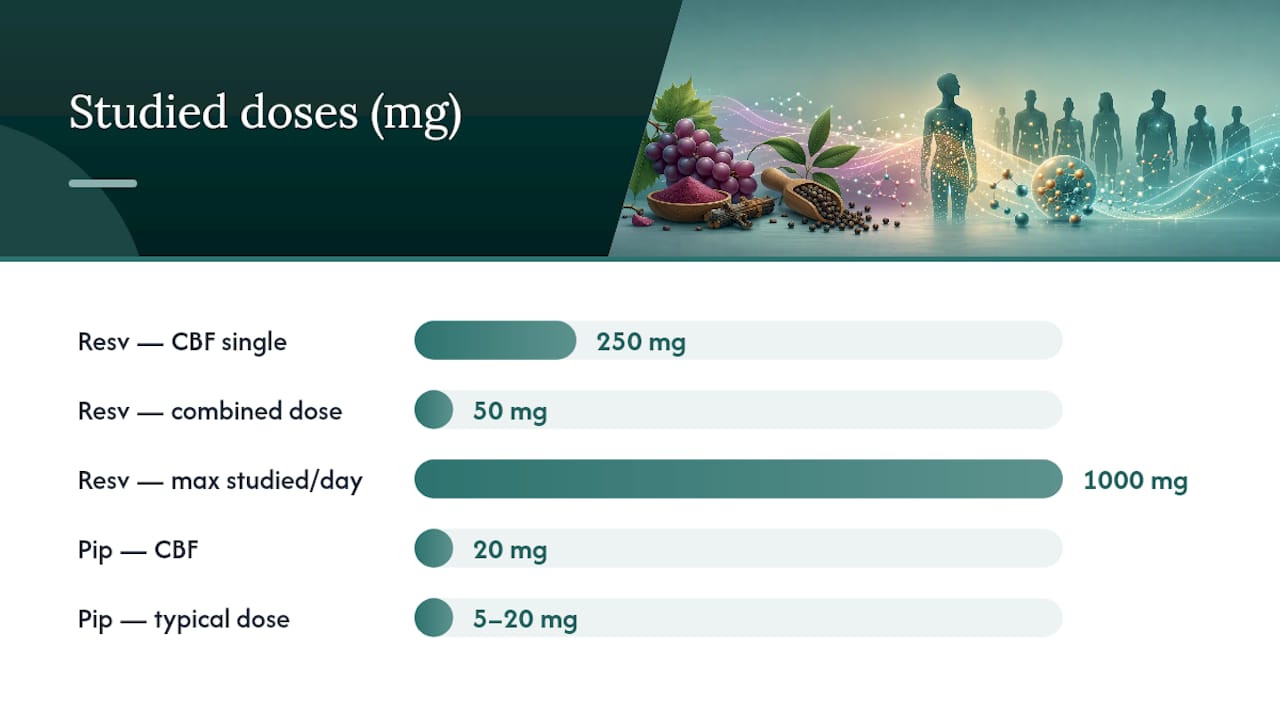
- Resveratrol, single doses of 250 mg in the CBF trial, with some other dose-ranging studies testing up to 1 g/day in separate protocols exploring tolerability and metabolism at higher intakes.
- Piperine, typically 5 mg to 20 mg per dose, with the CBF trial specifically pairing 20 mg piperine with 250 mg resveratrol in a single-dose design.
- Combined formulations in other clinical work, such as a 90-day metabolic syndrome study using 50 mg resveratrol plus 5 mg piperine plus 25 mg alpha-tocopherol taken twice daily, which reported reductions in inflammatory markers like US-CRP and ferritin with good tolerability in that patient group.
None of these figures are prescriptions. They’re the specific pairings researchers tested, and they’re the closest thing available to an evidence-based starting point if you want your own supplementation to resemble something that’s actually been studied, rather than an arbitrary ratio.
Formulation matters more than most buyers realise. Trans-resveratrol, the form used in the CBF trial, behaves differently from cis-resveratrol or mixed-isomer extracts, and it’s the form most human research has focused on. Micronisation (reducing particle size to increase surface area) and other delivery approaches can also shift how much resveratrol gets absorbed before piperine or any other bioenhancer even comes into play. This is worth checking on a product label, because “resveratrol” alone doesn’t tell you which isomer, purity level, or delivery format you’re actually getting.
Pro Tip: If you’re new to combining resveratrol and piperine, start with a dose close to what’s actually been studied, 250 mg resveratrol with roughly 20 mg piperine, rather than assuming a higher dose of either ingredient automatically means a stronger effect. Track how you feel over several weeks; the human trial evidence is about physiological signals, not overnight transformation.
A sensible approach looks like this: start at the lower end of studied doses, stick with formulations that specify trans-resveratrol content, give it several weeks before judging any effect, and loop in a clinician if you take prescription medication regularly. That last point isn’t a throwaway caution. It leads directly into the next section.
Are there safety risks or side effects to know about?
Short-term human trials of resveratrol with piperine have generally reported good tolerability, with the 90-day metabolic syndrome study noting no significant adverse events in that patient cohort while inflammatory markers improved. That’s reassuring, but it’s also a narrow evidence base, mostly small trials over limited timeframes, not the kind of long-term, large-population safety data available for well-established medicines.
The mechanism that matters most for safety: the same UGT enzyme and efflux transporter inhibition that may boost resveratrol’s exposure also affects how your body clears other substances metabolised through the same glucuronidation pathway.
This is the crux of the interaction concern, and it’s worth taking seriously precisely because the mechanism is well documented, not speculative:
- Many prescription medicines rely on glucuronidation as part of how the liver clears them from your system, spanning several broad drug categories rather than one narrow class.
- If piperine slows that clearance pathway, blood levels of an affected medicine could theoretically climb higher than intended, even without any change to the prescribed dose.
- The same efflux transporters piperine inhibits (P-gp and MRP) are involved in how several other compounds move across the gut wall and into circulation, widening the potential for unintended interactions beyond resveratrol itself.
Given that, a few groups should be particularly cautious before combining resveratrol and piperine: anyone pregnant or breastfeeding, anyone taking prescription medication on an ongoing basis, and anyone with existing liver disease, since the liver does most of the metabolic work involved here. None of this means the combination is dangerous for everyone. It means the sensible move is a conversation with a pharmacist or GP first, particularly if you’re on regular medication, rather than assuming a supplement aisle product is automatically risk-free.
Practically, that conversation is quick: mention the specific doses you’re considering, ask whether any current medicine relies on glucuronidation for clearance, and consider spacing the supplement away from other medications by a few hours if your pharmacist suggests it. If you notice anything unusual after starting, unexpected fatigue, digestive changes, or anything that feels off, stop and report it rather than waiting to see if it passes. For a fuller breakdown of dosing thresholds and reported side effects, detailed safety guidance on resveratrol dosing is available before you start.
What does Vivetus’s own research say about resveratrol absorption?
Some research has looked closely at how resveratrol absorption claims hold up against the published pharmacokinetic literature, rather than simply repeating the mouse study’s headline number without context. A detailed breakdown of the 10.6× Cmax evidence walks through what that figure actually measures, where it comes from, and why it shouldn’t be read as a guarantee of the same effect in every person.
That same evidence-first approach shapes how some resveratrol capsules are positioned: as a formulation built around trans-resveratrol content and study-aligned dosing, rather than a product marketed on inflated absorption claims borrowed from rodent data. The goal is a supplement that reflects what the human trials actually found, not just what sounds most impressive on a label.
A few things worth keeping in mind if you’re researching this ingredient seriously:
- Some blogs on resveratrol side effects and safe dosing thresholds cover the practical upper limits researchers have tested and what’s known about tolerability at higher intakes.
None of this replaces primary literature or professional medical advice. If you’re managing a health condition or taking regular medication, the studies referenced throughout this article, and a conversation with your GP or pharmacist, matter more than any single product page, including this one.
Is the piperine and resveratrol pairing worth it?
Here’s where the evidence actually lands, once you strip away the marketing gloss: animal data is genuinely promising, human data is mixed but not empty-handed. The Wightman 2014 trial found a real physiological signal, improved cerebral blood flow, without the plasma spike the mouse study would predict. That’s not a failure of the theory. It’s a sign the human story is more nuanced than a single AUC number can capture.
My advice for anyone weighing this up: start at study-aligned doses, monitor how you feel over weeks rather than days, and skip the combination entirely if you’re on medication that relies on liver clearance pathways, at least until you’ve spoken to a pharmacist. Prioritise formulations that specify trans-resveratrol content and third-party purity testing over ones that lean hardest on the fifteen-fold Cmax figure without mentioning what it actually measured.
Evidence-minded readers deserve products built to match what the trials actually found, not what sounds best in a headline.
— Jord
Vivetus resveratrol supplements built around the actual research
Some supplement brands position their products with clinically supported ingredients, assembled with transparent dosing, rather than chasing the biggest number on a label. For resveratrol specifically, that means capsules built around trans-resveratrol content at levels that echo what human trials have actually tested, not just what a mouse study made possible.
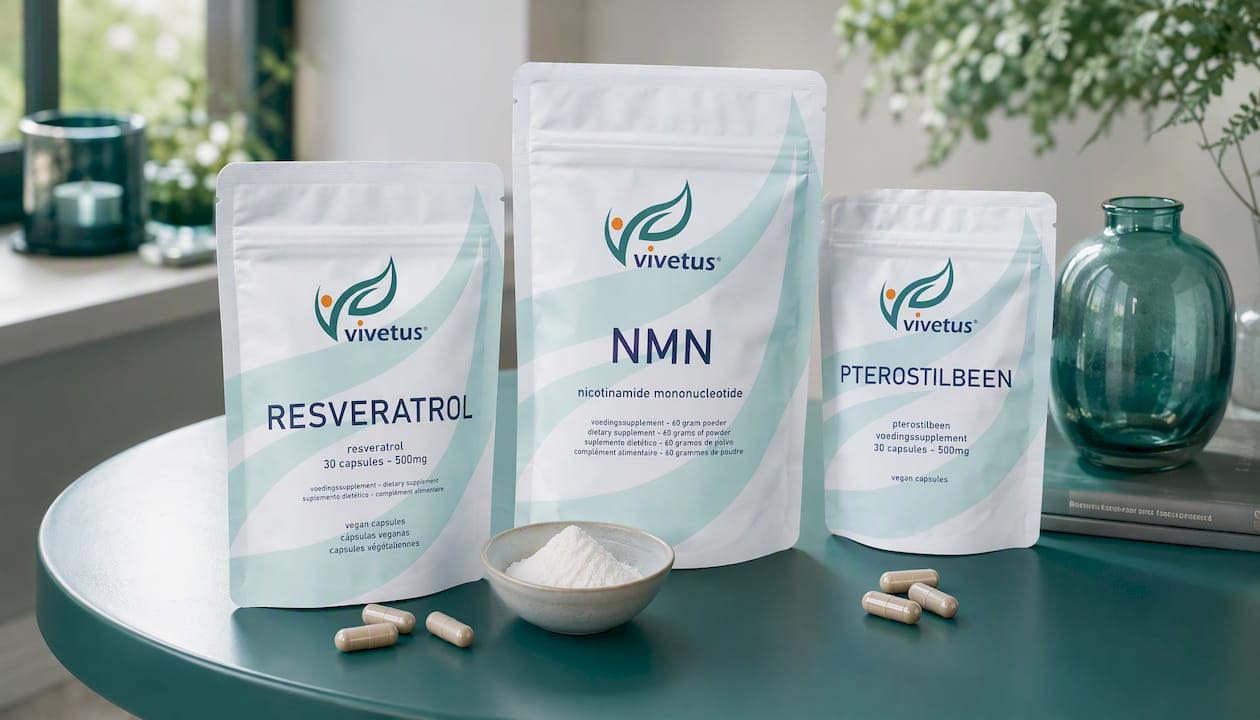
If you’re ready to try resveratrol with a bioenhancer approach in mind, Vivetus® Resveratrol – 30 capsules – 500mg is the core product to start with. For readers building a broader longevity stack, the 🔬 Vitaal Basis bundel pairs resveratrol with complementary ingredients at a bundled entry point, while the 🛡 CelBescherming bundel focuses specifically on cellular protection compounds for readers prioritising that angle. Vivetus also offers NMN for cellular energy, quercetin, pterostilbene, fisetin, apigenin, and TMG and berberine formulations for readers researching adjacent longevity ingredients. All orders over €50 ship free, and subscription purchasing is available if you’d rather not reorder manually every few months. Browse the resveratrol collection to compare formats and get started.
Selected primary literature and reviews
For readers who want to check the science directly rather than take any summary at face value, the core references behind this article are the Johnson 2011 mouse pharmacokinetic study, the Wightman 2014 human cerebral blood flow trial, a 90-day clinical study on inflammatory biomarkers in metabolic syndrome patients, and a Nutrients review on bioavailability enhancement strategies for stilbenoids more broadly. Each is peer-reviewed and freely accessible for anyone wanting the full methodology behind the numbers cited throughout.
This article is general information, not a substitute for advice from a qualified doctor. Consult a qualified healthcare professional about your own circumstances before acting on anything here.
Sources
- Enhancing the bioavailability of resveratrol by combining it with piperine
- Effects of resveratrol alone or in combination with piperine on cerebral blood flow parameters and cognitive performance in human subjects
- Enhancing Bioavailability of Nutraceutically Used Resveratrol and Other Stilbenoids
FAQ
What does piperine actually do in the body?
Piperine inhibits UGT enzymes and efflux transporters like P-glycoprotein, which slows how quickly compounds such as resveratrol get broken down and pumped out of intestinal cells, potentially allowing more of the parent compound to reach circulation.
What does resveratrol do once it’s absorbed?
Resveratrol acts primarily as an antioxidant compound studied for its role in cellular ageing pathways, with the human cerebral blood flow trial specifically linking it to improved blood flow during cognitive tasks when combined with piperine.
What are the side effects of resveratrol?
Short-term clinical trials, including a 90-day study in metabolic syndrome patients, have generally reported good tolerability at studied doses, though data on long-term use at higher intakes remains limited. Anyone on prescription medication should check with a pharmacist first, since resveratrol and piperine both affect glucuronidation pathways involved in drug clearance.
What do people report when combining resveratrol and piperine?
Controlled trial data, rather than anecdotal reports, shows the clearest signal in the Wightman 2014 study: participants experienced improved cerebral blood flow with the combination, even though plasma resveratrol levels didn’t rise significantly.
How much piperine is typically paired with resveratrol?
Human trials have generally used piperine doses between 5 mg and 20 mg per dose, with the cerebral blood flow trial specifically pairing 20 mg piperine with 250 mg trans-resveratrol in a single dose.