

How to Choose Nutritional Products for Healthy Aging: 5 Steps
TL;DR:
- Assess individual nutrient gaps through blood tests and dietary analysis before supplementing.
- Choose high-quality supplements with third-party verification and appropriate nutrient forms.
- Focus on evidence-backed nutrients like vitamin D, B12, calcium, omega-3s, and magnesium for healthy ageing.
The supplement aisle can feel overwhelming when you are over 40 and every product promises dramatic results. Misleading labels, exaggerated claims, and an endless parade of new ingredients make confident decision-making genuinely difficult. Yet the choices you make here carry real consequences for bone density, cognitive sharpness, immune function, and long-term vitality. Getting it wrong means wasting money at best and risking harm at worst. This guide cuts through the noise with clear, evidence-backed steps so you can select nutritional products that actually match your body’s needs.
Table of Contents
- Assessing your nutritional needs after 40
- Step-by-step: How to evaluate supplements
- Selecting evidence-backed nutrients for healthy aging
- Safety, interactions, and monitoring progress
- A fresh take: Why less can be more with supplements after 40
- Support your healthy ageing journey with trusted resources
- Frequently asked questions
Key Takeaways
| Point | Details |
|---|---|
| Prioritise food-first approach | Focus on improving diet quality before turning to supplements to fill nutritional gaps. |
| Check supplement labels carefully | Review daily values, forms of nutrients, and third-party verification for safe choices. |
| Choose evidence-backed nutrients | Select only those nutrients with proven benefits for healthy ageing, such as vitamin D and B12. |
| Monitor safety and interact wisely | Consult your healthcare professional and regularly assess for interactions and effectiveness. |
Assessing your nutritional needs after 40
Before purchasing any supplement, you need a clear picture of what your body actually requires. This sounds obvious, yet most adults over 40 skip this step entirely and buy products based on advertising rather than evidence. A personalised dietary assessment is the only reliable starting point.
After 40, absorption of several key nutrients declines naturally. Stomach acid production drops, which reduces uptake of vitamin B12 and calcium. Skin synthesis of vitamin D slows. Dietary variety often narrows. These changes create predictable gaps that differ from person to person depending on diet, health history, and lifestyle.
The most common deficiencies in this age group include:
- Vitamin D — particularly in those with limited sun exposure or darker skin tones
- Vitamin B12 — especially in vegans, vegetarians, and those taking acid-reducing medications
- Calcium — critical for postmenopausal women facing accelerated bone loss
- Omega-3 fatty acids — often low in those who rarely eat oily fish
- Magnesium — frequently under-consumed even in otherwise balanced diets
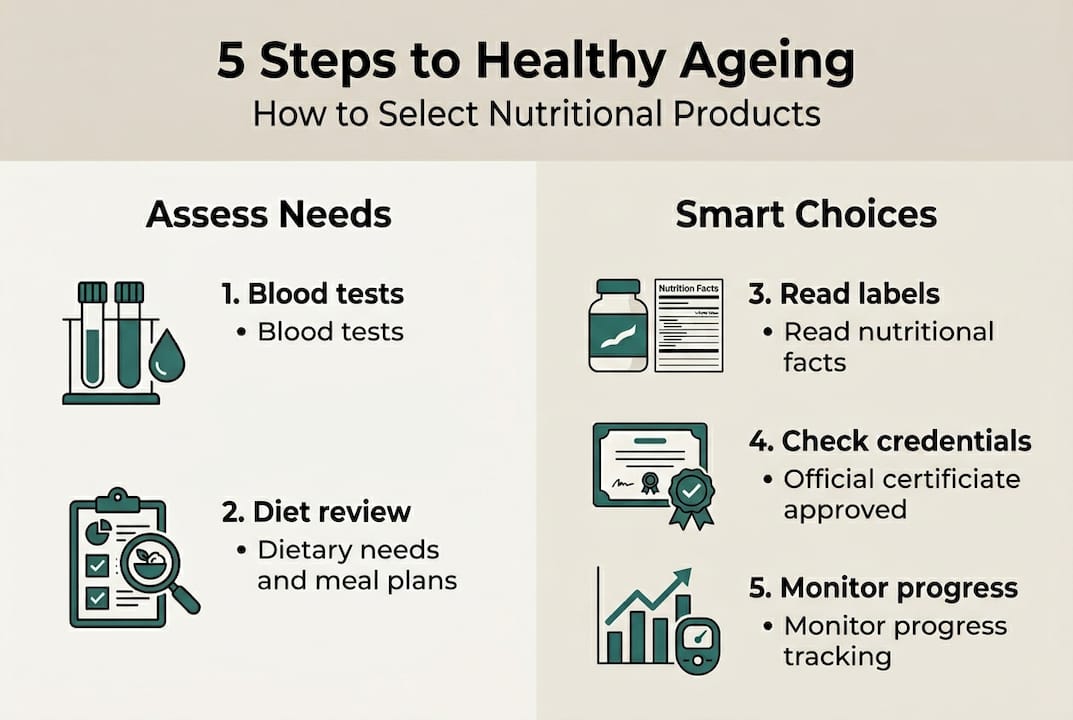
The most reliable way to identify your specific gaps is through blood tests ordered by your GP. Diet analysis tools, including food diary apps and registered dietitian consultations, also provide useful data. Assessing personal dietary gaps using these methods before supplementing is especially important for older adults, whose absorption capacity is already reduced.
Special populations require extra attention. Postmenopausal women face higher calcium and vitamin D needs. Vegans are at elevated risk for B12, iron, zinc, and iodine shortfalls. Those with coeliac disease or inflammatory bowel conditions may absorb far less than their intake suggests.
| Nutritional gap | Common at-risk group | Recommended assessment method |
|---|---|---|
| Vitamin D | Most adults over 40 | Blood test (25-OH-D) |
| Vitamin B12 | Vegans, acid reducer users | Blood test (serum B12) |
| Calcium | Postmenopausal women | Diet analysis plus bone density scan |
| Omega-3 | Low fish consumers | Diet diary |
| Magnesium | General adult population | Diet analysis |
Critically, food sources should be prioritised over supplements for vitamins and minerals wherever possible. Whole foods deliver fibre, phytonutrients, and co-factors that isolated supplements cannot replicate. Explore food sources and nutrition as your primary strategy, and use supplements to address confirmed gaps rather than as a general safety net. Understanding diet quality after 40 is equally essential before reaching for any product.
Pro Tip: If you follow a restricted diet such as vegan or low-dairy, schedule blood tests every six to twelve months. Early detection of deficiencies allows you to correct them before symptoms appear.
Step-by-step: How to evaluate supplements
Knowing what your body needs, you are ready to check the quality and suitability of nutritional products. Not all supplements are created equally, and the label is your primary tool for separating reliable products from questionable ones.
Follow these steps when evaluating any supplement:
- Check for third-party verification. Look for seals from USP, NSF International, or ConsumerLab. Selecting supplements with third-party verification confirms that what is on the label is actually in the product, at the stated dose, without harmful contaminants.
- Read the Supplement Facts label carefully. Check the elemental amount of each nutrient, not just the compound weight. Reviewing the true elemental amounts and safe daily values prevents accidental overdosing.
- Identify the form of each nutrient. Forms vary significantly in bioavailability. Magnesium glycinate absorbs better than magnesium oxide. D3 (cholecalciferol) raises blood levels more effectively than D2.
- Spot red flags immediately. Proprietary blends that list ingredients without individual amounts are a warning sign. Dosages exceeding 200% of the daily value for most nutrients are rarely justified and may carry risk.
- Compare products side by side. Use the table below as a quick reference.
| Feature | Reputable supplement | Less transparent supplement |
|---|---|---|
| Third-party seal | Present (USP, NSF, ConsumerLab) | Absent |
| Ingredient amounts | Clearly stated per nutrient | Hidden in proprietary blend |
| Nutrient form | Bioavailable form specified | Generic or unspecified form |
| Daily value percentage | At or near 100% DV | Frequently exceeds 300% DV |
| Manufacturer contact | Clearly listed | Difficult to find |
For further guidance on avoiding common pitfalls, review these supplement safety tips before committing to any product.
Pro Tip: For B12, look for methylcobalamin rather than cyanocobalamin. For vitamin D, choose D3. Both forms are better absorbed and more biologically active, which matters more as absorption efficiency declines with age.
Selecting evidence-backed nutrients for healthy aging
With label-reading skills in hand, focus now turns to the nutrients with proven impact for healthy aging. Not every supplement on the market has strong evidence behind it. The following nutrients stand out because they have been studied extensively in adults over 40.
The core list supported by current research includes:
- Multivitamin (50+ formula): Provides broad micronutrient coverage and fills multiple gaps simultaneously
- Vitamin D3: Supports bone density, immune function, and mood regulation
- Vitamin B12: Essential for nerve function and red blood cell production, with absorption declining sharply after 50
- Calcium (with vitamin D): Critical for bone maintenance, particularly in postmenopausal women
- Omega-3 fatty acids (EPA and DHA): Support cardiovascular health and reduce systemic inflammation
- Magnesium: Involved in over 300 enzymatic reactions, including muscle function and sleep regulation
For adults over 40, these core nutrients represent the most evidence-supported starting points, though individual needs always take priority over general lists.
The evidence for multivitamins has strengthened considerably in recent years. The COSMOS trial found that daily multivitamin use reduced cognitive decline by approximately 60% in memory-related measures over a three-year period. This is a landmark finding for adults concerned about brain health as they age.
“Nutritional support for ageing works best when it is targeted, evidence-based, and regularly reassessed. Broad supplementation without testing often adds cost without adding benefit.”
For those specifically interested in brain health, exploring top supplements for brain health provides a focused breakdown of cognitive support options. For a broader view, evidence-based choices for ageing covers the full landscape of what current science supports.
One important caution: supplement only what testing or a clear dietary gap confirms you need. Taking nutrients you already obtain adequately from food rarely adds benefit and occasionally causes harm.

Safety, interactions, and monitoring progress
After choosing products, it is vital to ensure your routine remains safe and supportive of your health. Supplements are not risk-free, and interactions with prescription medications are more common than many people realise.
Key interactions to be aware of include:
- Calcium and antibiotics: Calcium can bind to tetracycline and fluoroquinolone antibiotics, reducing their absorption significantly
- B12 and acid reducers: Proton pump inhibitors and metformin both impair B12 absorption, increasing deficiency risk
- Vitamin K and blood thinners: Vitamin K supplements can interfere with warfarin dosing
- High-dose vitamin E and anticoagulants: May increase bleeding risk when combined
- Iron and thyroid medication: Iron supplements taken close to levothyroxine reduce its effectiveness
Excessive intake carries its own risks. Too much calcium, for example, has been associated with increased cardiovascular risk in some studies. Fat-soluble vitamins including A, D, E, and K accumulate in the body and can reach toxic levels with prolonged high dosing.
Before starting any supplement, particularly alongside medications, consult a healthcare provider and schedule follow-up blood tests to monitor levels and adjust doses accordingly.
“Always disclose all supplements to your healthcare provider, including those you consider natural or harmless. Many interactions are dose-dependent and easily managed when your provider has the full picture.”
Monitoring progress is straightforward. Schedule a blood test three to six months after starting a new supplement routine. Track how you feel, but do not rely on subjective experience alone. Objective data from blood results gives you and your GP the clearest basis for continuing, adjusting, or stopping supplementation. For detailed guidance on safe dosing limits, review safety and daily limits.
A fresh take: Why less can be more with supplements after 40
The supplement industry profits from the idea that more is better. More nutrients, higher doses, broader formulas. This logic feels intuitive but the evidence does not support it for most adults over 40.
Targeted supplementation based on confirmed deficiencies consistently outperforms broad, high-dose approaches in clinical outcomes. Taking 15 supplements daily without testing is not a health strategy; it is expensive guesswork. The body has limited capacity to use many nutrients, and excess amounts are either excreted or, in the case of fat-soluble vitamins, stored to potentially harmful levels.
An individualised plan built on dietary assessment, blood testing, and evidence-based product selection will serve you better than any trending formula or influencer recommendation. Modest, necessary supplementation paired with genuine improvement in nutrition for ageing is the approach most supported by current research. The goal is to plug real gaps, not to chase an imaginary ceiling of optimal health through pills alone.
Support your healthy ageing journey with trusted resources
If you are ready to take the next steps with confidence, explore these expert resources. Making informed decisions about nutritional supplementation becomes significantly easier when you have access to clear, science-backed guidance rather than marketing copy.

At Vivetus, you will find curated nutritional products selected for quality, transparency, and evidence of efficacy. Whether you are building a supplement routine from scratch or refining an existing one, the expert guides available cover everything from specific nutrients to full healthy ageing strategies. For a structured starting point, explore further reading on healthy ageing and take the next step with clarity.
Frequently asked questions
Is food really better than supplements for healthy ageing?
Yes, food sources provide broader nutrients and lower disease risk more effectively than supplements, except when addressing confirmed deficiencies that diet alone cannot correct.
Which supplements are most often recommended for over 40s?
Multivitamins, vitamin D, B12, calcium, omega-3, and magnesium are most commonly recommended, with choices based on individual needs and dietary assessment rather than a one-size-fits-all approach.
How can I be sure a nutritional supplement is safe and effective?
Choose products carrying third-party verification seals such as USP or NSF, and check that labels clearly state nutrient amounts, daily values, and specific forms rather than hiding them in proprietary blends.
Can supplements interact with my prescription medicines?
Yes, several supplements including calcium and B vitamins interact with common medications, so always consult your healthcare provider before starting any new supplement routine.
Do I need to take supplements all year or can I take breaks?
Regular reassessment is recommended; some nutrients such as vitamin D may require year-round supplementation, while others depend on seasonal diet changes and your most recent blood test results.