

60 Second Supplement Purity Check: Confirm Batch CoA (Dutch Buyers)
Supplement purity means the ingredient on the label matches what’s actually in the capsule, at the stated dose, with no heavy metals, microbes, or undeclared drugs mixed in. The single most useful rule for checking it: never buy without a batch-specific Certificate of Analysis (CoA) plus at least one independent verification mark, such as GMP paired with NSF, USP, or Informed Sport. Everything else in this guide supports that one habit.
TL;DR:
- Only buy supplements with a batch-specific Certificate of Analysis that matches your product, and verify that the lab is accredited and listed by a recognized certification body.
- Ensure the supplement has verified independent marks such as GMP combined with NSF, USP, or Informed Sport to confirm content accuracy and contaminant screening.
- Be cautious with high-dose nutrients exceeding 100% of the Reference Intake, as they may lack clinical backing and pose safety concerns.
- Avoid products from non-EU or anonymous sellers that lack traceability, especially those with vague claims or no batch-specific testing documentation.
- Use a simple five-step checklist: confirm batch number, verify independent mark, read active ingredient details, prefer EU sellers, and walk away if CoA or proof is withheld.
Table of Contents
- What supplement purity actually covers
- Common contaminants and adulterants to watch for
- How independent testing and quality marks work
- The one-minute checklist to verify purity before buying
- When to be extra cautious with certain products
- Where reputable sellers show their proof
- Regulatory standards for supplement purity across regions
- How to verify a certificate or lab is genuine
- What the purity checklist actually protects you from
- Vivetus products built around this same checklist
- Sources
- FAQ
What supplement purity actually covers
Three separate things hide inside the word “purity”, and confusing them is how people get misled by clean packaging.
Identity means the compound named on the label is chemically what it claims to be, not a cheaper look-alike. Potency means the dose stays accurate from the day it’s bottled to the day it expires, not just at manufacture. Purity in the narrow sense means the absence of heavy metals, pesticide residue, microbial contamination, or pharmaceutical adulterants that were never declared.
These distinctions matter because a product can pass on one and fail on another. Fish oil can be correctly identified as omega-3 yet already oxidised past a useful potency. A herbal extract can be free of heavy metals yet contain the wrong plant species entirely.
Active form matters too. Folate sold as methylfolate behaves differently in the body than synthetic folic acid, even though both appear under “folate” on a label. And “natural” tells you nothing about purity. Arsenic and lead are natural. Contamination from soil, water, or processing equipment is often the natural, unintentional kind, which is exactly why testing exists rather than trust.
- Identity: is this the correct molecule?
- Potency: is the dose accurate today, not just at manufacture?
- Purity: is it free of contaminants and undeclared substances?
Common contaminants and adulterants to watch for
Heavy metals top the list of chronic risks. Lead, mercury, arsenic, and cadmium accumulate in the body over years of low-level exposure, often entering supplements through contaminated soil, water, or processing equipment rather than deliberate adulteration. Botanical ingredients grown in polluted regions carry a higher baseline risk than synthetic vitamins made in controlled reactors.
Pesticide residues and microbiological hazards follow a similar pattern for plant-based products. Herbal capsules, powders, and unrefined oils are more exposed than tablets manufactured from purified compounds, because raw plant material carries whatever was in the field or the drying shed, including organisms such as Salmonella or E. coli in poorly handled batches.
The more alarming category is undeclared pharmaceuticals. Weight-loss and performance products have been found spiked with substances like sildenafil, sibutramine, or SARMs, none of which appear on the label. The NVWA maintains a Blocklist of ingredients found to be dangerous or illegal in supplements sold in the Netherlands, and grey-market or foreign webshops account for a disproportionate share of these cases.
- Heavy metals: chronic, low-dose accumulation risk
- Pesticides and microbes: mainly botanical and oil products
- Undeclared pharmaceuticals: highest risk from anonymous or non-EU sellers
A PubMed-indexed study documenting variability between label claims and actual contents underlines why independent verification, rather than the label alone, is the safer basis for a buying decision.
How independent testing and quality marks work
A Certificate of Analysis is the single most useful transparency document a supplement seller can offer. It’s a lab report tied to one specific production batch, showing what was actually measured in that batch: identity confirmation, potency, and screening results for contaminants. A CoA that doesn’t list a batch number matching the bottle in your hand is close to meaningless.
GMP (Good Manufacturing Practice) certifies that the process used to make a product follows consistent hygiene and quality controls. It doesn’t test the finished product’s contents on its own, which is why pairing GMP with an independent content check matters more than either alone. USP and NSF fill that gap from slightly different angles: USP tends to focus on identity, potency, purity and dissolution performance, while NSF emphasises contaminant screening and safety, including its Certified for Sport programme that screens for banned athletic substances. Informed Sport serves the same anti-doping purpose for athletes who need certainty their supplement won’t trigger a failed test.
Behind all of these sits lab accreditation. A result only carries weight if the laboratory that produced it holds ISO 17025 accreditation, the standard that governs competence in testing and calibration.
Pro Tip: When you open a CoA, check three things: the batch number matches your bottle, the testing method is named (HPLC or mass spectrometry, not just “tested”), and contaminant rows read “ND” for non-detected rather than being left blank.
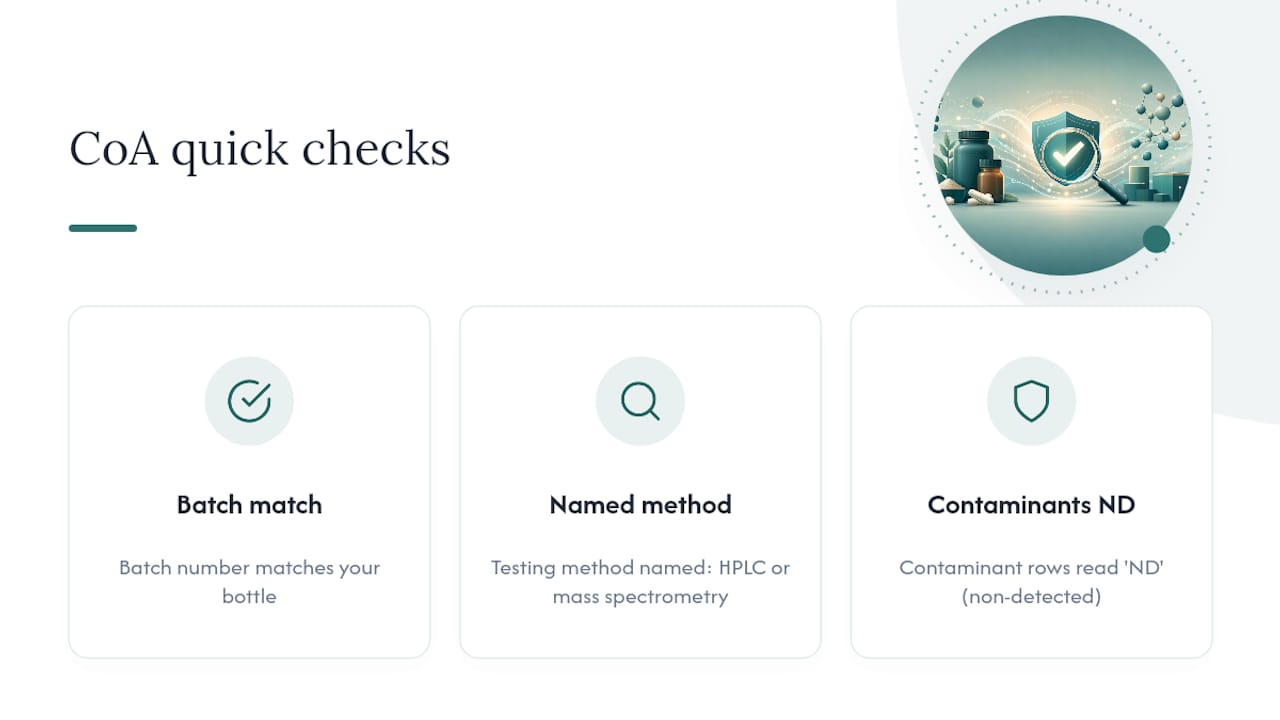
Combining GMP, an independent mark, and a matching CoA is the practical three-layer approach that gives consumers the strongest assurance currently available.
The one-minute checklist to verify purity before buying
Run through these five steps whenever you’re deciding between products, whether you’re standing in a shop or scrolling a webshop at midnight.
- Find the batch number printed on the packaging and confirm the seller can produce a CoA that lists that exact batch. A generic CoA from “a previous batch” tells you nothing about the bottle you’re buying.
- Check for GMP plus one independent mark. GMP alone confirms process discipline; NSF, USP, or Informed Sport confirm someone tested the actual contents.
- Read the label properly. Look for the active form of each ingredient, the dose per serving, the percentage of Reference Intake (%RI), and any usage warnings. Vague dosing or missing %RI figures are a poor sign.
- Favour traceable sellers based in the EU. Voedingscentrum guidance points out that oversight and traceability weaken sharply once you buy from anonymous or non-EU webshops.
- Treat refusal as a red flag. If a seller won’t provide a batch-matched CoA, or hides behind phrases like “lab-tested” with no report attached, walk away.
None of these steps takes longer than reading a product description, and together they filter out the majority of low-quality listings before you ever reach checkout.
When to be extra cautious with certain products
Some product categories deserve more scrutiny than a quick label check.
High-dose single nutrients, especially those measured in large IU or mg amounts that exceed 100% of the Reference Intake, warrant a closer look at why the dose is so high and whether that level has clinical backing. Vivetus has covered safe upper limits for specific nutrients in more detail, since “more” is not automatically safer with fat-soluble vitamins or certain minerals.
Herbal extracts carry their own risk profile. Limited safety data exists for many botanical compounds compared to well-studied vitamins, and some plant species have known toxic look-alikes. Ask specifically whether the extract is standardised and whether a CoA is available.
- Non-EU or anonymous webshops with no traceable contact details
- Products relying on vague claims like “scientifically formulated” with no linked lab report
- Formulations combining several high-dose actives without clear dosing rationale
Where reputable sellers show their proof
A trustworthy seller makes its purity evidence findable, not hidden behind a customer service request. On Vivetus product pages, batch information and testing documentation should sit alongside the product description itself, not buried three clicks deep. Readers checking a formulation like the 🔬VitaalPlus bundel should expect to find this kind of detail presented plainly.
Vivetus publishes supporting content on dietary supplement safety and on how clinical research underpins product claims, alongside its shipping policy and product bundles, as part of demonstrating how the checklist in this article applies in practice.
Regulatory standards for supplement purity across regions
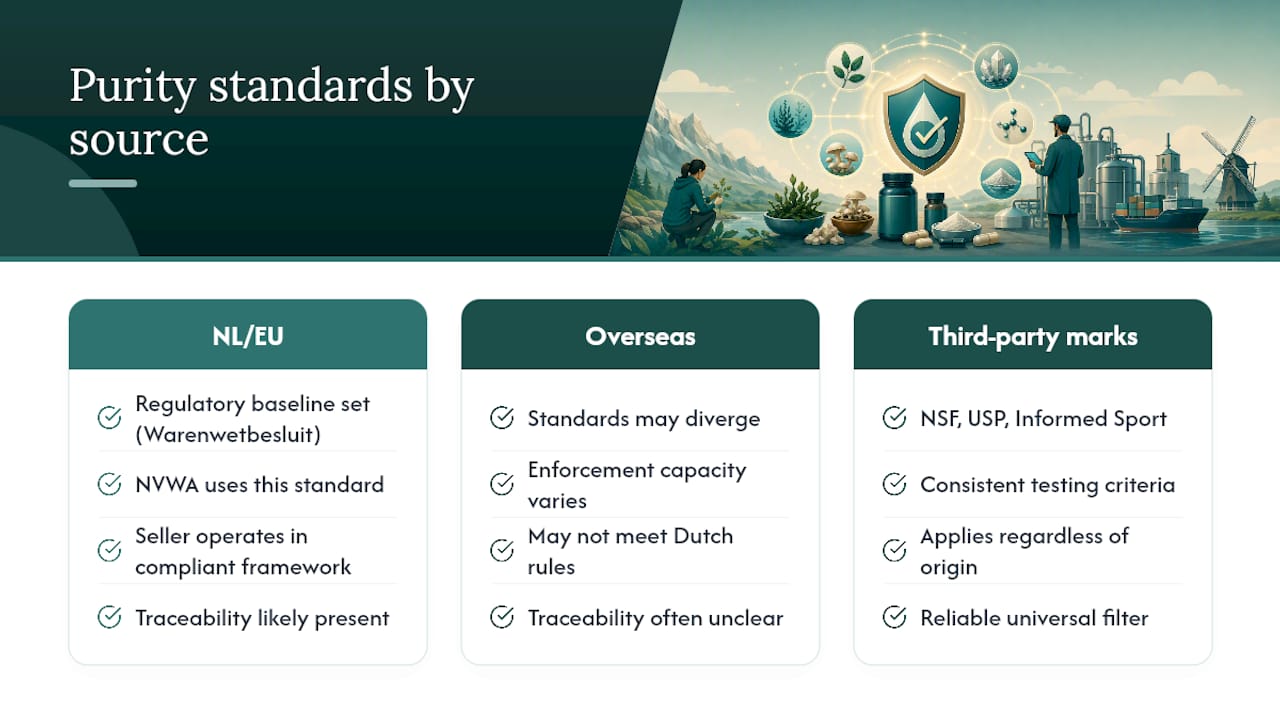
Purity expectations aren’t identical everywhere, and that gap is exactly why independent verification matters more than assuming a product is fine because it’s for sale.
Within the Netherlands, the Warenwetbesluit voedingssupplementen sets out which vitamins and minerals are permitted in supplements, along with labelling and composition requirements covering the amounts that may be included. This creates a baseline for what a compliant product sold domestically should contain, and it’s the standard the NVWA uses when it flags products through its Blocklist.
Standards diverge once you look at products entering from outside the EU. Enforcement capacity varies by country, and a product manufactured under a looser domestic framework doesn’t automatically meet Dutch composition or purity requirements just because it’s listed for sale online. This is precisely why the traceability point in the checklist above carries real weight: a Netherlands-based or EU-based seller is operating within a framework designed around composition and purity, while an anonymous overseas listing may not be.
Rather than trying to memorise every jurisdiction’s rules, the practical shortcut works better: independent marks like NSF, USP, and Informed Sport apply consistent testing criteria regardless of where the raw material originated, which makes them a more reliable universal filter than trying to judge origin-country regulation product by product.
How to verify a certificate or lab is genuine
A CoA is only as trustworthy as the entity that issued it, and a surprising number of buyers never check that the lab behind the paperwork is real.
Start with the batch number. A genuine CoA lists the exact batch printed on your product, not a generic or outdated one. If a seller sends a CoA and the batch doesn’t match what’s on your bottle, the document is irrelevant to the product you actually bought, regardless of how official it looks.
Next, check the laboratory’s accreditation status directly rather than taking a logo at face value. ISO 17025 accreditation is verifiable through public accreditation body registers, and a lab that genuinely holds it will have a listing you can look up independently of the seller’s own website.
Third-party marks deserve the same scrutiny. NSF, USP, and Informed Sport all publish searchable databases of certified products, so you can check whether a specific product actually appears on the certifier’s own list rather than trusting a badge printed on packaging. A mark that can’t be verified against the certifying body’s own records isn’t proof of anything.
For oxidisable ingredients like fish oil, a genuine CoA relevant to that product category will often include TOTOX or peroxide values alongside the standard contaminant panel, since these numbers reflect freshness in a way that a basic contamination screen doesn’t capture.
What the purity checklist actually protects you from
The conventional advice on supplement purity tends to stop at “look for a certification logo”, and that’s where most guidance underestimates the problem. A logo tells you a certifying body exists somewhere in the product’s history. It doesn’t tell you whether the bottle in your hand belongs to the batch that was actually tested, which is why the CoA, not the badge, deserves top priority in any purchasing decision.
The NVWA’s oversight is sample-based rather than exhaustive, so the absence of a public warning is not the same thing as proof of quality. Treating regulatory silence as reassurance is probably the most common mistake shoppers make, and it’s an understandable one given how official the absence of a warning feels.
What the reader should prioritise first is straightforward: batch traceability before brand reputation, and independent verification before price. A cheaper vitamin C tablet from a GMP-certified, NSF-tested manufacturer beats an expensive herbal blend with no CoA in sight, every time. Complexity of formulation, not price, is what should raise your bar for scrutiny; a simple single-nutrient capsule needs less verification than a multi-ingredient herbal stack.
— Jord
Vivetus products built around this same checklist
Some supplement providers apply the purity standards described throughout this guide to their own supplement ranges, which means the checklist above can be used to evaluate product pages rather than being taken on faith.
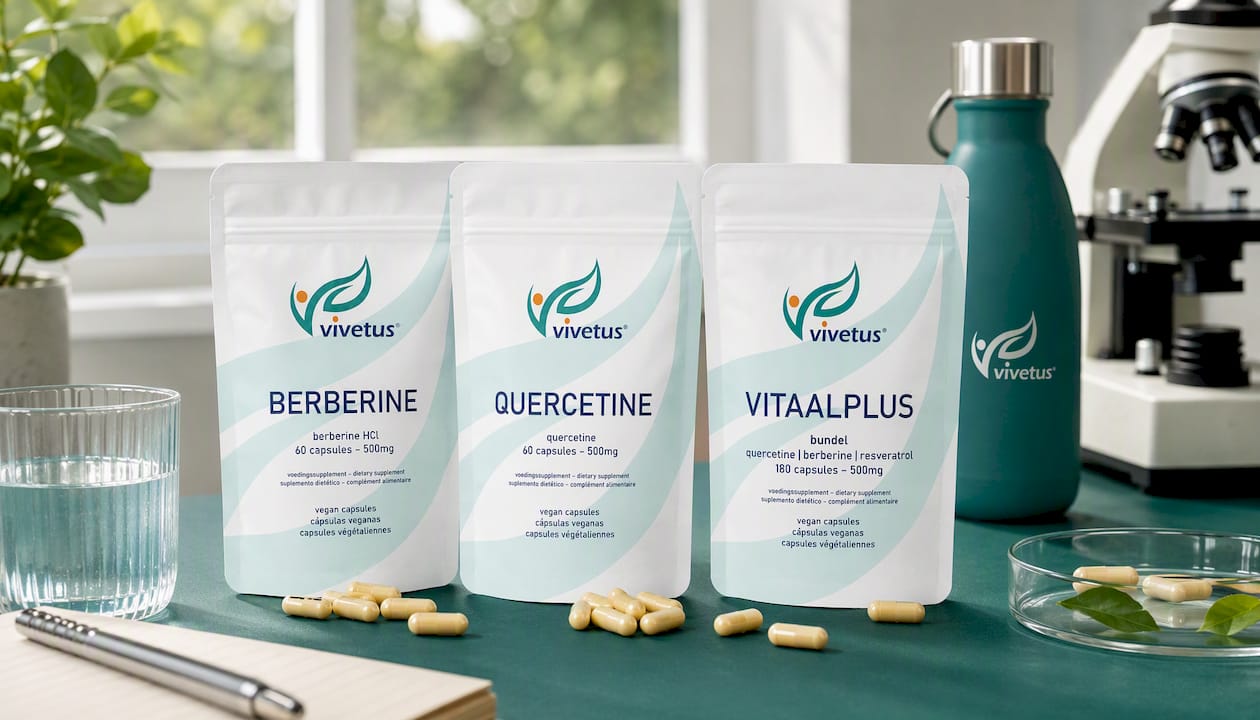
The 🔬VitaalPlus bundel combines several longevity-focused actives into one formulation, which is exactly the kind of multi-ingredient product where checking batch-specific documentation matters most. For single-nutrient options, Vivetus® Berberine and Vivetus® Quercetine are both sold at clearly stated doses per capsule, letting you compare the label against a CoA without guesswork over what “500mg” is supposed to mean.
None of these claims should be taken on trust alone, and that’s the point: check the batch number on your order against the documentation available on each product page, and look for the GMP and third-party marks discussed earlier in this guide before you decide. Visit the VitaalPlus bundel page to see how that verification looks in practice, and place your order once you’re satisfied the proof holds up.
This article is general information, not a substitute for advice from a qualified doctor. Consult a qualified healthcare professional about your own circumstances before acting on anything here.
Sources
- Warenwetbesluit voedingssupplementen (Overheid.nl)
- Voedingssupplementen (NVWA)
- PubMed: study on supplement contamination/variability
- Keurmerken & labels: how to spot quality (WellnessInDeBuurt)
FAQ
What are the top three supplements worth prioritising?
There’s no universal top three, since needs depend on age, diet, and health status, but vitamin D, omega-3, and magnesium are among the most commonly recommended for general adult use, provided each carries a batch-specific CoA and an independent purity mark.
Which supplement helps with acidity or overtraining fatigue?
Magnesium and buffering minerals are often discussed for exercise-related acidity, though the evidence varies by individual and training load, so check with a healthcare professional before adding a high-dose mineral supplement for this purpose.
Which vitamin deficiency causes constant tiredness?
Persistent fatigue is most commonly linked to low vitamin D, vitamin B12, or iron, though tiredness has many possible causes, so a blood test rather than guesswork is the reliable way to identify the actual deficiency.
Which supplements are considered a waste of money?
Products making vague claims like “scientifically formulated” without a linked lab report, mega-dose blends with no clinical rationale for the dose chosen, and anything from a seller who won’t produce a batch-matched CoA are the ones most likely to disappoint, regardless of ingredient.
How do I check if a supplement’s CoA is genuine?
Confirm the batch number on the CoA matches your product exactly, then verify the certifying body (NSF, USP, or Informed Sport) lists that specific product in its own public database rather than trusting the logo alone.