

1.0 g/day Berberine Dosing for Dutch Adults With Vivetus 500 mg
Most adult clinical studies use around 1.0 g of berberine daily, typically split into 500 mg doses taken two or three times a day. Going above 1.5 g/day rarely adds meaningful benefit but does raise the risk of stomach upset. Berberine is not suitable during pregnancy or breastfeeding, and anyone on prescription medicines should check for interactions before starting.
TL;DR:
- Most studies use about 1.0 g of berberine daily, split into doses of 500 mg or 250 mg, with higher doses offering no significant benefit.
- Dosing above 1.5 g/day increases gastrointestinal side effects without additional metabolic or cardiovascular improvements.
- Taking berberine with meals and splitting the dose helps maintain steady blood levels and reduces digestive discomfort.
- Berberine interacts with liver enzymes, potentially affecting prescription drugs, so users on medication should consult a healthcare professional first.
- Trial periods of eight to twelve weeks are recommended to assess its impact on blood markers, with higher doses unlikely to yield extra benefits.
Table of Contents
- What is berberine, and why does the dose matter so much?
- How much berberine do studies actually use?
- Does the evidence actually support these doses?
- What safety issues and drug interactions should you know about?
- When and how should you actually take berberine?
- How long should you try it, and when should you stop?
- How does Vivetus fit into your dosing plan?
- A cautious, evidence-led take on berberine dosing
- Buying berberine: what to check before you order
- Sources
What is berberine, and why does the dose matter so much?
Berberine is a bitter yellow compound extracted from plants such as Berberis vulgaris (barberry) and goldenseal, used for centuries in traditional Chinese and Ayurvedic preparations. Its modern appeal lies in its effects on blood sugar and cholesterol metabolism, which is why it has become a staple in the supplement routines of health-conscious adults.
The dosing question matters because of how berberine behaves once swallowed. It has a short half-life and famously poor bioavailability, meaning the body absorbs and clears it quickly. A single large dose spikes and then drops off fast, which is precisely why most protocols split the daily amount rather than taking it all at once.
- Short half-life means blood levels fall quickly between doses
- Low bioavailability limits how much reaches circulation from any single dose
- Divided dosing keeps levels steadier through the day
- Steadier levels appear to reduce the gastrointestinal irritation seen with large single doses
Splitting the dose is not a minor tweak. It is the mechanism that makes berberine tolerable at all.
How much berberine do studies actually use?
Trial doses cluster tightly. Most research on metabolic outcomes uses 0.5 g to 1.5 g per day, with 1.0 g/day the figure that shows up most consistently across the literature.
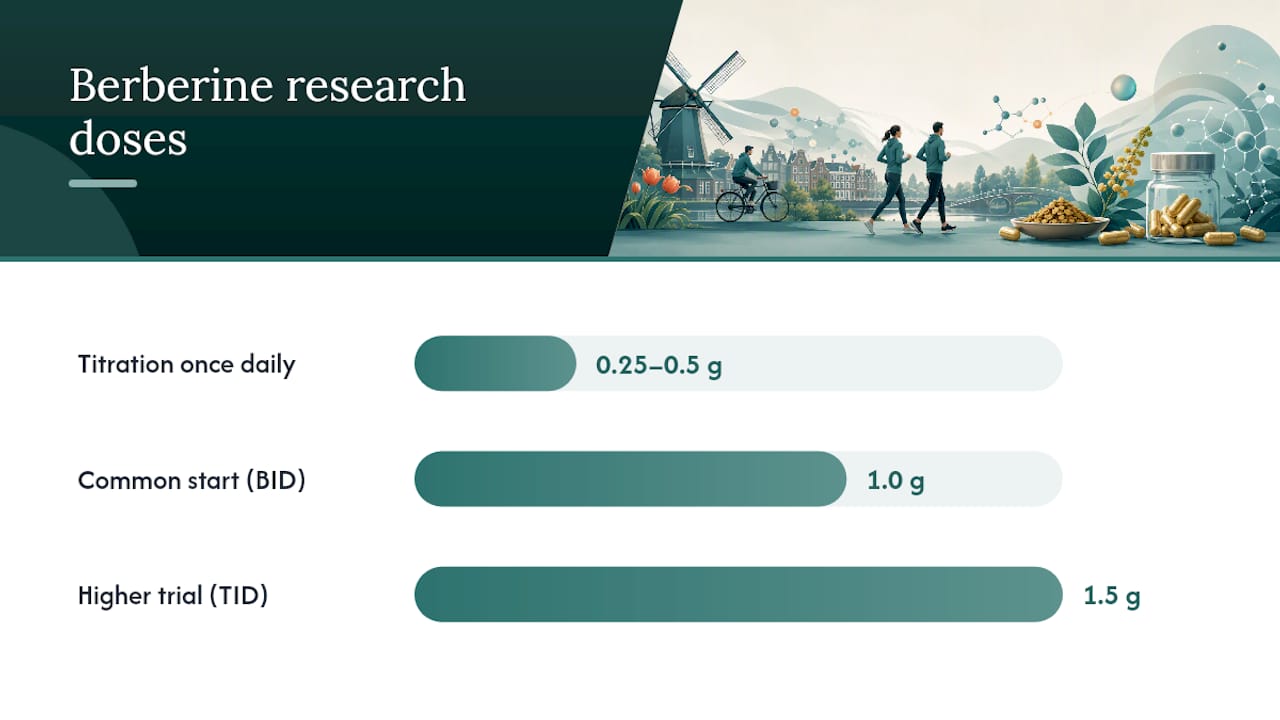
A 2022 dose-response meta-analysis found that 1.0 g/day produced benefits for several cardiovascular and metabolic markers that were broadly comparable to higher doses, but with noticeably fewer gastrointestinal complaints. That is a genuinely useful finding for anyone choosing where to start, because it suggests the extra 500 mg some protocols recommend buys little and costs comfort.
Three regimens dominate in practice:
- 500 mg twice daily — the most common starting point, typically morning and evening
- 500 mg three times daily — used in some trials targeting 1.5 g/day, generally alongside main meals
- 250 mg to 500 mg once daily — an initial titration step for people who are sensitive to new supplements
Statistic callout: A dose-response meta-analysis found 1.0 g/day delivered improvements in cardiovascular and metabolic markers that were largely on par with higher intakes, while producing fewer gastrointestinal side effects.
Starting low and titrating up over one to two weeks is the pragmatic approach Cleveland Clinic recommends, and it mirrors what most people report anecdotally: the gut needs time to adjust, and rushing to 1.5 g/day in week one is a common reason people abandon berberine altogether.
Does the evidence actually support these doses?
The short answer is yes, with caveats worth taking seriously. Meta-analyses link berberine supplementation to improvements in triglycerides, total cholesterol, LDL cholesterol, fasting glucose, and HbA1c, alongside modest reductions in body weight in some populations.
The dose-response relationship is the interesting part. Several outcomes plateau around 1.0 g/day, meaning higher doses buy little extra benefit while increasing the chance of nausea, diarrhoea, or abdominal discomfort. That trade-off is central to how Vivetus frames its own dosing guidance.
- Lipid markers (triglycerides, LDL, total cholesterol) show consistent improvement across trials
- Fasting glucose and HbA1c improvements appear in multiple meta-analyses
- Weight effects are present but generally modest, not dramatic
- Gastrointestinal side effects rise noticeably above 1.0 to 1.5 g/day
A six-month multicentre randomised trial published in JAMA Network Open used exactly 1.0 g/day, split into two 500 mg doses, in diabetes-free adults with obesity. Tolerability was good and some exploratory lipid and inflammation markers improved, though the trial found no significant change in liver fat or visceral fat compared with placebo.
Statistic callout: The JAMA Network Open trial deliberately chose 1.0 g/day as its working dose, explicitly to balance tolerability against measurable benefit, over a six-month period.
That result matters because it tempers expectations. Berberine is not a substitute for a weight-loss programme, and trials with differing populations, durations, and formulations still make a single universal dose impossible to state with total certainty. What the data supports is a working range, not a precise number carved in stone.
What safety issues and drug interactions should you know about?
Certain groups should not take berberine at all. Pregnancy and breastfeeding sit firmly in that category, linked to risks of neonatal jaundice and potential neurological harm to infants. People with significant liver or heart disease should also avoid it without direct clinician oversight.
Side effects that do occur tend to be dose-related and gut-focused: nausea, diarrhoea, and abdominal cramping are the most reported complaints, almost always more common at higher intakes.
- Pregnancy and breastfeeding: avoid entirely
- Serious liver or cardiac disease: avoid without medical supervision
- Nausea, diarrhoea, abdominal pain: common, usually dose-dependent
- Rare but reported: dizziness or more severe symptoms at excessive intakes
The interaction risk deserves particular attention. Berberine inhibits CYP3A4, CYP2D6 and CYP2C9, the liver enzymes responsible for breaking down a huge share of prescription medicines. That inhibition can raise blood levels of drugs metabolised through these pathways, including certain anticoagulants, some cardiac medicines, immunosuppressants, and metformin. The consequences range from reduced drug efficacy to increased side effects, depending on the medication involved.
Regulatory reviewers examining plant preparations containing berberine have also flagged uncertainty around long-term safety, pointing to genotoxicity signals in laboratory data that warrant a cautious approach to prolonged, high-dose use.
Pro Tip: If you take any prescription medicine regularly, especially blood thinners, statins, or drugs for heart rhythm or immune suppression, speak to a pharmacist before adding berberine. The interaction risk is real enough that a five-minute conversation is worth having.
When and how should you actually take berberine?
Timing is not an afterthought with berberine. Taking it with or just before meals appears to support both absorption and its effect on post-meal blood sugar, and splitting the daily total keeps blood levels more consistent than one large dose ever could.
- Twice-daily protocol: 500 mg with breakfast, 500 mg with dinner
- Three-times-daily protocol: 500 mg with breakfast, lunch, and dinner, totalling 1.5 g/day
- Titration phase: start with one dose daily for a week, then add the second and third as tolerated
- Tracking: note digestive symptoms daily and consider monitoring relevant blood markers such as fasting glucose or a lipid panel every few months
Consistency matters more than precision here. Taking 500 mg roughly with each main meal, day after day, beats an erratic schedule chasing an exact clock time. For deeper detail on how the timing affects blood sugar and cholesterol, it’s worth reading how meal proximity changes the metabolic response.
How long should you try it, and when should you stop?
A reasonable trial window runs eight to twenty-four weeks before judging whether berberine is doing anything measurable for you. Shorter than that, and you are unlikely to see meaningful shifts in blood markers.
- Consider fasting glucose, HbA1c, and a lipid panel as baseline and follow-up tests
- Liver function tests are sensible if you have any pre-existing liver concern
- Stop immediately and seek medical advice for severe gastrointestinal upset, yellowing of the skin or eyes, fainting, rash, or signs of unusually low blood pressure
- Reassess with a clinician if you start a new prescription medicine partway through your trial
Those red flags are rare, but they are not ones to shrug off. Persistent GI upset alone is a reasonable enough reason to stop and reconsider your dose.
How does Vivetus fit into your dosing plan?
Matching a dosing plan to an actual product is where most people get stuck. Vivetus® Berberine comes in 500 mg capsules, 60 per bottle, which maps neatly onto the regimens covered above: two capsules a day (1.0 g/day, morning and evening) covers the most commonly used clinical dose, while three capsules a day (1.5 g/day) suits the higher end some trials tested.
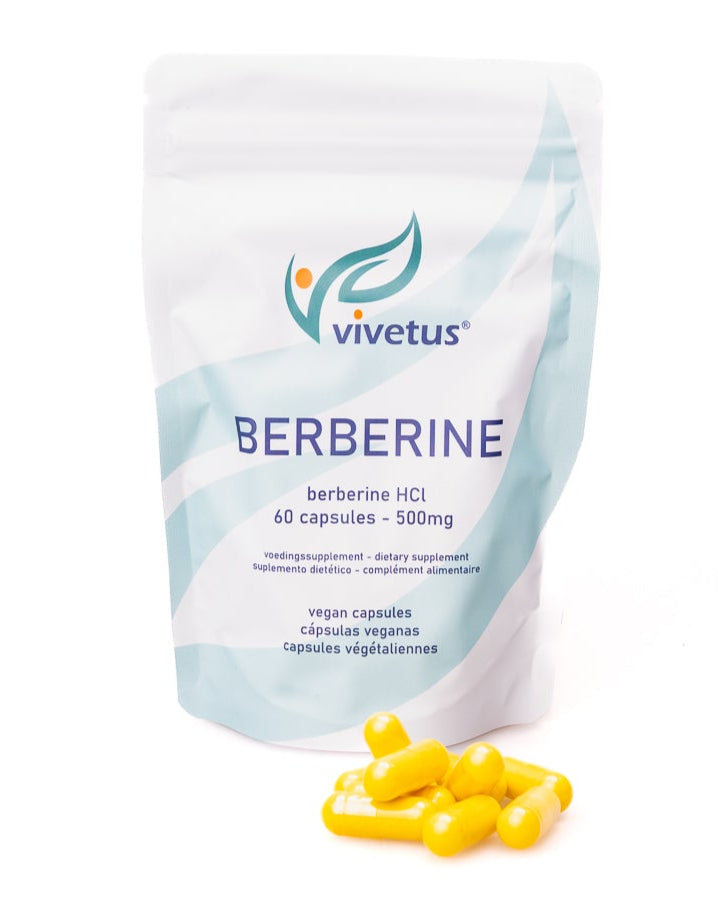
At two capsules daily, a 60-capsule bottle lasts 30 days. At three capsules daily, it lasts 20 days, which is worth factoring in if you set up a subscription rather than one-off orders. Vivetus tests its formulations for purity, which matters given how much dosing guidance depends on knowing exactly what milligram amount you are actually swallowing.
For adults building a broader healthy-ageing routine rather than targeting berberine in isolation, the Energy & Vitality bundle pairs berberine with complementary support formulated for daily vitality. Some readers also combine berberine with Vivetus® Apigenine, a 100 mg capsule supplement explored for its own metabolic and cellular health properties, though anyone stacking supplements alongside prescription medicines should still run the combination past a pharmacist first given berberine’s enzyme interactions covered above.
Whatever regimen you settle on, start at the lower end, track how your body responds over the first fortnight, and adjust from there rather than assuming more is automatically better.
A cautious, evidence-led take on berberine dosing
Berberine attracts hype it does not entirely need. The actual evidence points to a modest, useful supplement at 1.0 g/day, not a miracle at 3 g/day, and the temptation to chase higher doses because “more must be better” is where most people run into unnecessary stomach trouble for no extra benefit.
What gets underestimated is the tracking piece. Most people start berberine, feel nothing dramatic in week one, and quietly stop. Give it the full eight to twelve weeks, note your symptoms, and check a lipid panel or fasting glucose before and after. That is the difference between guessing and actually knowing whether it works for you. For more on how it interacts with everyday metabolism, the Vivetus resource on berberine’s effects on blood sugar and cholesterol is worth a closer read.
— Jord
Buying berberine: what to check before you order
Vivetus sells its berberine in 500 mg capsules precisely because that strength lines up with the regimens covered throughout this guide, so there’s no awkward maths converting an odd milligram count into your daily target. Every batch is tested for purity, which matters given how much of the dosing guidance above depends on knowing exactly how much active compound is in each capsule.
If you are building a fuller healthy-ageing stack rather than taking berberine alone, the Energy & Vitality bundle groups it with complementary formulas at a more convenient checkout than ordering each product separately. Anyone already on prescription medicines should still have that pharmacist conversation before combining anything.
Ready to start? Order Vivetus® Berberine, begin at 500 mg twice daily with meals, and track your symptoms and bloodwork over the following eight to twelve weeks to see whether it earns a permanent place in your routine.
Sources
- Frontiers | The effects of berberine supplementation on cardiovascular risk factors in adults: A systematic review and dose-response meta-analysis
- Berberine and adiposity in diabetes-free individuals with obesity and MASLD: A randomized clinical trial | JAMA Network Open
- Berberine: What It Is, Benefits & Side Effects — Cleveland Clinic
- Draft scientific opinion on the safety of plant preparations containing berberine — UK Committee on Toxicity
- Berberine interactions — InteractSafe