

International shipping of supplements: rules, risks and checklist
Yes, you can ship dietary supplements internationally, but the rulebook splits sharply in two: intra-EU parcels move freely with no import duties, while non-EU shipments require customs declarations, EORI numbers and duty payments. Before sending anything, check the product’s composition against banned ingredients, confirm whether the destination sits inside or outside the EU, and, for non-EU routes, make sure pre-notification and an EORI number are in place with your carrier, such as PostNL or DHL.
TL;DR:
- Shipping supplements within the EU avoids customs and import duties, but national labeling and notification rules still vary by member state.
- Non-EU shipments require customs declarations, commodity codes, EORI registration, and payment of duties and VAT, with extra scrutiny for botanical or animal-based ingredients.
- Preparing accurate commercial invoices, attaching necessary certificates, and using digital pre-notifications streamline customs clearance and reduce delays.
- Additional insurance for loss or damage should be declared, as standard liability coverage often falls short for higher-value or sensitive shipments.
- Proper packaging with moisture and impact protection, batch/expiry visibility, and documentation are essential for safe and compliant international transit.
Table of Contents
- Why intra-EU and non-EU shipments follow different rules
- What paperwork do you need for customs declarations?
- What causes supplement shipments to get stopped at customs?
- How do you prepare a shipment that clears customs smoothly?
- How does Vivetus handle international supplement orders?
- What insurance covers lost or damaged supplement shipments?
- How should supplements be packaged for international transit?
- How do you submit a customs declaration step by step?
- Deciding when to hire a customs broker or freight forwarder
- Where to buy the Longevity Plus bundel and check shipping to your destination
- Should you use a carrier’s customs service or handle it yourself?
- Sources
Why intra-EU and non-EU shipments follow different rules
The European Union operates as a single market for goods, which means a parcel of NMN capsules travelling from Amsterdam to Lisbon crosses no customs border and attracts no import duty. That freedom of movement is real, but it isn’t unconditional. National authorities still set their own notification and labelling expectations, and compliance in one member state doesn’t automatically carry over to another.
Non-EU imports work on entirely different logic. Bringing supplements in from the United Kingdom, the United States or Asia means filing a customs declaration, and commodity codes (known as TARIC or HS codes) determine the duty rate applied. Import VAT usually applies too, calculated on the goods value plus shipping and any duty owed.
A handful of product types face extra scrutiny regardless of origin:
- Botanical ingredients sourced from certain countries, which sometimes need veterinary or plant-health certification.
- Products containing animal-derived components, which can trigger inspection under food-safety controls.
- Formulations close to pharmaceutical thresholds, where dosage or ingredient combinations raise regulatory flags.
Knowing which category a shipment falls into before it leaves the warehouse saves far more time than untangling a hold at the border. The distinction between shipping within the EU and importing from outside the EU is the single biggest factor in whether a parcel arrives on schedule or sits in a bonded warehouse for a week.
What paperwork do you need for customs declarations?
An EORI number (Economic Operators Registration and Identification) is the reference code customs authorities use to track who is importing or exporting goods. Any business bringing supplements in from outside the EU needs one, and it’s tied to the company, not the individual shipment.
Most merchants never file a customs declaration themselves. The typical workflow looks like this:
- The seller prepares a commercial invoice with full product and value details.
- The carrier or a dedicated customs broker submits the import declaration on the seller’s behalf.
- The carrier often advances the duties and VAT owed to release the parcel quickly, then invoices the merchant or recipient for that amount plus a handling fee.
- The merchant stays legally responsible for the accuracy of what was declared, even though someone else filed the paperwork.
That last point catches people out constantly. Handing the declaration to a courier doesn’t transfer the legal risk. EORI registration and carrier-filed declarations speed things up, but the exporter still owns any mistake in the description or value.
Pro Tip: Create your international shipping label digitally through the carrier’s own platform rather than a generic printed form. Digital pre-notification attaches the required data to the parcel automatically, and it has been the standard route for cross-border parcels since 2020.
What causes supplement shipments to get stopped at customs?
The NVWA states that importers carry full legal responsibility for making sure a supplement doesn’t contain prohibited or undeclared substances. That responsibility doesn’t shift to the carrier, the platform, or the customer. If a shipment gets flagged, it’s the seller’s problem to solve.
Enforcement tends to focus on a small set of recurring issues:
- Undeclared pharmaceutical compounds hidden in “natural” formulations.
- Botanical ingredients that are restricted or banned outright in the destination market.
- Labels missing required nutritional or allergen information.
- Marketing language that strays into medical claims a supplement isn’t licensed to make.
Certain plant-origin ingredients face an additional layer. Products sourced from countries such as India sometimes need pre-notification through a common health entry document, alongside a lab analysis confirming what’s actually in the product. Without those documents attached before the parcel ships, customs will often hold or return it rather than wait for paperwork to catch up.
The safest mitigation isn’t a legal trick. It’s supplier testing and a documented food-safety plan, which insight from the NVWA identifies as the most effective control against seizure. A detailed labelling guide is worth reviewing before finalising packaging for any new market.
How do you prepare a shipment that clears customs smoothly?
Turning regulation into a repeatable process is what separates merchants who ship reliably from those who fight customs every month. Work through this sequence before a single box leaves the building:
- Confirm product compliance against destination labelling rules and banned-ingredient lists.
- Identify the correct commodity code. Duty rates vary meaningfully between codes such as 21069092 and 21069098, and requesting binding tariff information from customs removes the guesswork when a product’s classification isn’t obvious.
- Register for an EORI number if shipping to non-EU destinations as a business.
- Choose a carrier suited to the route. PostNL handles EU parcels efficiently and offers economy tiers for lower-value shipments; DHL and DPD tend to offer stronger next-day coverage for higher-value or time-sensitive non-EU consignments, generally at a higher cost bracket.
- Prepare the commercial invoice with a full ingredient list, batch numbers, HS code, declared value, and sender/recipient EORI numbers where relevant.
- Keep certificates accessible. Lab reports and supplier certification should travel with the shipment documentation, not sit in a filing cabinet.
- Generate the shipping label digitally to satisfy pre-notification requirements automatically.
- Add tracking and insurance before dispatch, not as an afterthought once something goes missing.
Pro Tip: Keep one master template for your commercial invoice with every required field pre-filled except the order-specific details. Missing fields are one of the most common reasons a parcel gets held for manual review rather than cleared automatically.
Cost brackets differ sharply by route: domestic parcels are cheapest, EU cross-border sits in the middle with no duty component, and non-EU shipments carry the added weight of duty, VAT and carrier handling fees on top of postage.
How does Vivetus handle international supplement orders?
Vivetus ships across a wide range of countries, with multi-currency checkout and free shipping on orders over €50. Subscription customers get their NAD+ boosters, resveratrol or berberine formulations dispatched on a recurring schedule without re-entering shipping details each time.
The 🔬 Longevity Plus bundel is one of the products regularly sent internationally, combining several of the vegan, clinically-backed formulations Vivetus is known for into a single order. Anyone with questions about import requirements for their specific country can reach Vivetus customer service directly, or check the shipping terms published on the site before checkout.
| What you get | Detail |
|---|---|
| Free shipping threshold | Orders over €50 |
| Order flexibility | One-time purchase or subscription |
| Currency and country options | Multi-currency checkout, wide country coverage |
| Support for import questions | Direct customer service contact |
For label interpretation on any Vivetus order, the guide to reading supplement labels covers the fields worth checking on arrival.
What insurance covers lost or damaged supplement shipments?
Most carriers include a basic level of liability cover in their standard shipping rate, but it’s usually capped at a modest fixed amount per parcel, regardless of what the contents are actually worth. For anything beyond a small trial order, that baseline cover often falls short of the shipment’s real value.
Additional insurance is typically offered as an add-on at checkout or through the carrier’s business account portal. Declared-value insurance is the most common option: you state what the parcel contains and its value, pay a small percentage as premium, and the carrier compensates up to that declared figure if the shipment is lost or arrives damaged.
Filing a claim generally follows a similar pattern across major carriers. You’ll need the original tracking number, proof of value (the commercial invoice works well here), and photographic evidence of damage where relevant. Claims for lost parcels usually can’t be filed until a set number of days have passed with no delivery confirmation, since a delayed scan isn’t the same as a genuinely missing item.
Temperature-sensitive or degraded products present a different problem: standard insurance covers loss and physical damage, but not spoilage from a delayed transit that exceeded a product’s stability window. If a formulation is particularly sensitive to heat or humidity, that risk sits with the shipper unless a specific clause covers it. Building the cost of insurance into cross-border pricing from the outset avoids an unpleasant surprise the first time a parcel genuinely goes missing.
How should supplements be packaged for international transit?
Capsules and powders both need protection against three things: moisture, temperature swings, and physical impact. A shipment that spends four days in transit, possibly through a hot distribution hub, needs packaging that assumes rough handling as the default, not the exception.
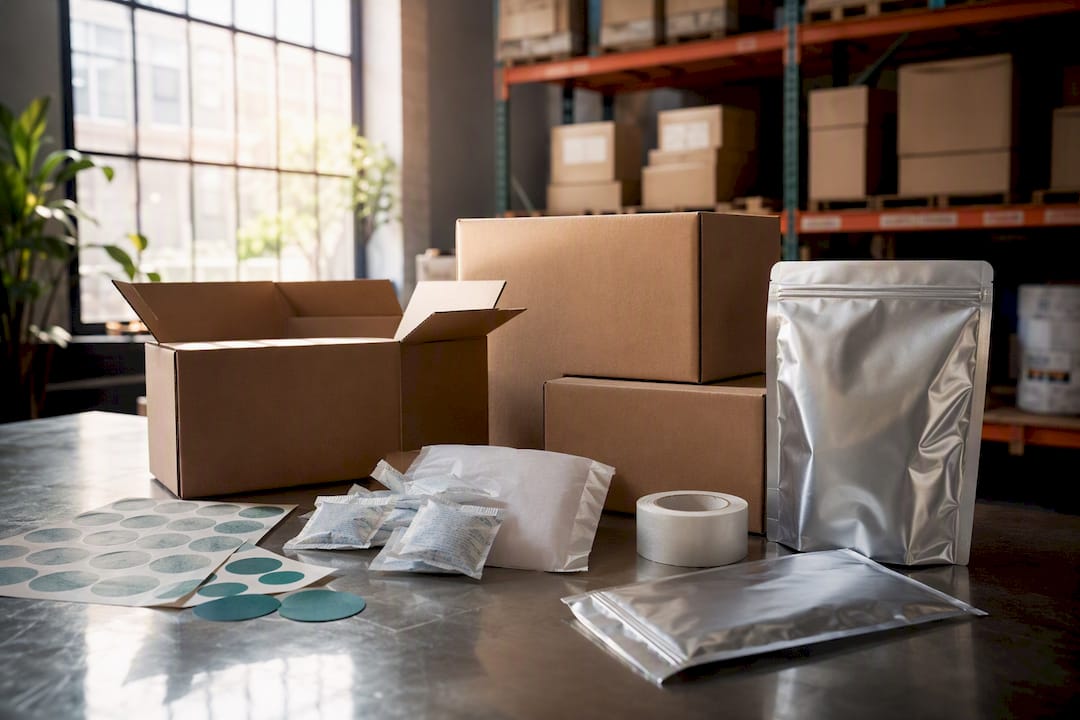
Rigid outer packaging matters more for supplements than for most consumer goods, because a crushed box can compromise blister packs or crack powder tubs, exposing the contents to air. Sealed inner pouches or tubs with tamper-evident seals give a second layer of protection if the outer box does get compressed.
Moisture-sensitive formulations, particularly powders like NMN or TMG, benefit from a desiccant sachet included in the packaging. It’s a small addition, but it protects against condensation build-up when a parcel moves between climate zones, such as a cold warehouse to a humid delivery van.
Batch numbers and expiry dates should be visible on both the outer packaging and any accompanying paperwork, not just the product label itself. Customs officials and, in some cases, receiving-country inspectors will check that the physical batch matches what’s declared on the invoice. A mismatch, even an innocent one, can trigger a hold while the discrepancy gets resolved.
For products where the clinical testing and quality control process plays a role in the value proposition, keeping that documentation accessible during transit reinforces the same standards the product was tested against.
How do you submit a customs declaration step by step?
Preparing a customs declaration isn’t complicated once you’ve done it a few times, but the sequence matters. Skipping a step early on tends to surface as a delay much later.
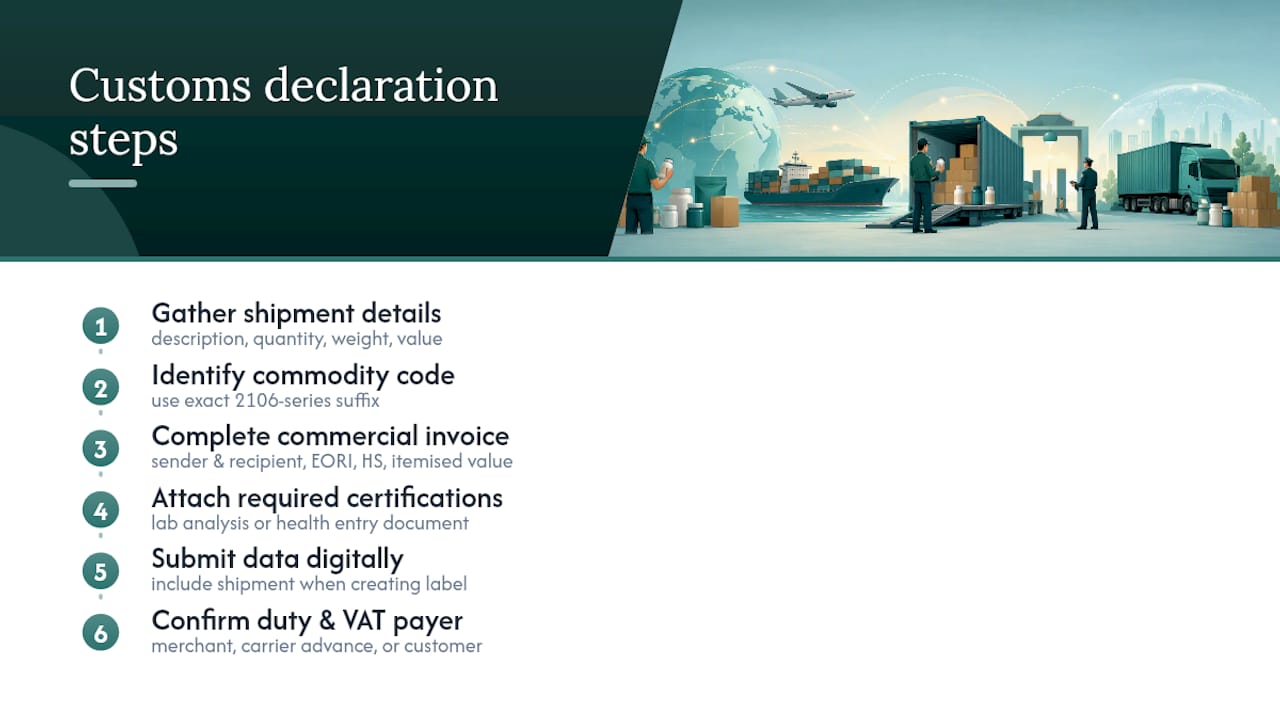
Step one: gather the shipment details, including the full product description, quantity, weight and declared value in the currency of sale.
Step two: identify the correct commodity code for each product. Supplements often fall under codes in the 2106 series, but the exact suffix changes the duty rate, so verify it rather than assume it from a previous shipment.
Step three: complete the commercial invoice with sender and recipient details, EORI numbers where applicable, HS code, itemised value, and a description specific enough that a customs officer doesn’t need to guess what’s inside.
Step four: attach any product-specific certification the shipment needs, such as lab analysis for certain plant-origin ingredients or a health entry document where a common health entry document applies.
Step five: submit the shipment data digitally when creating the shipping label. This is the pre-notification step carriers now require, and it’s what allows customs systems to pre-screen a parcel before it physically arrives.
Step six: confirm who is paying the duties and VAT, whether that’s the merchant, the carrier’s advance service, or the end customer, and make that clear on the invoice to avoid a dispute at delivery.
Consistency across shipments, using the same commodity codes and invoice format each time, is what makes this process fast rather than a fresh negotiation every time a parcel ships.
Deciding when to hire a customs broker or freight forwarder
A carrier’s built-in advance service handles most low-value, straightforward B2C parcels perfectly well. Where it starts to strain is high shipment volume, complex product mixes needing multiple commodity codes, or anything touching veterinary and plant-health checks.
Run a quick check before deciding: how many parcels ship monthly, what’s the average declared value, does the product range include botanicals or animal-derived ingredients, and how often do shipments get held? If the answer to two or more of those points towards complexity, a dedicated broker’s fee usually costs less than the delays and seized stock a carrier’s generic process can’t always prevent.
Where to buy the Longevity Plus bundel and check shipping to your destination
Vivetus ships the 🔬 Longevity Plus bundel to a wide range of destinations, with the same free shipping threshold applying once an order clears €50, and a subscription option available for anyone who wants it arriving on a set schedule rather than reordering each time. That combination of coverage and convenience is exactly what makes Vivetus a practical direct source for readers who’ve just worked through what intra-EU and non-EU shipping actually involves, rather than piecing it together from a courier’s generic terms.
For anything specific to your country, whether that’s a labelling question or an import query for a non-EU destination, the shipping terms published on the Vivetus site cover the detail, and customer service is there for anything that falls outside the standard cases. Start by checking the 🔬 Longevity Plus bundel product page for current shipping coverage to your country before placing an order.
Should you use a carrier’s customs service or handle it yourself?
Most individuals and small merchants overestimate how complicated this actually gets, right up until the first parcel gets held. Then they overcorrect and assume every shipment now needs a broker, which is just as wrong in the other direction.
The realistic middle ground is this: if you’re shipping standard capsule or powder formulations at modest volume, a reputable carrier’s built-in customs service handles the paperwork perfectly well. The friction shows up specifically with botanical ingredients, animal-derived components, or anything close to a pharmaceutical dosage threshold, where a generic carrier process wasn’t built to catch the nuance a dedicated broker would flag immediately.
What gets underestimated is how much of this risk sits with documentation quality rather than the product itself. A perfectly legal supplement with a vague invoice description gets held just as often as a genuinely problematic one. Fix the paperwork discipline first. The broker-versus-carrier decision matters far less than most guides suggest, right up until volume or product complexity actually justifies it.
— Jord