






500 mg to 4 g TMG Dosing for Dutch Users: Match Dose to Your Goal
For most adults, effective TMG dosering falls between 500 mg and 2 g daily for general support, 1.5 to 3 g for homocysteine management, and up to 4 to 6 g in clinical settings for the largest measurable biomarker shifts. The main risk at the top end is a rise in blood lipids, so anyone pushing past 4 g daily should get a lipid panel done. Vivetus offers a 500 mg capsule that fits neatly into the lower bands, and anyone on medication or managing a chronic condition should check with a clinician before starting.
TL;DR:
- Most adults should start with 500 mg to 1 g daily, as this supports methylation pathways effectively without risking lipid increases.
- Doses for homocysteine reduction typically range from 1.5 to 3 g per day, reaching up to 4 to 6 g only in clinical settings under close monitoring.
- Higher doses above 4 g daily require lipid panels before and during use, especially because of potential cholesterol increases and digestive side effects.
- TMG doses should be adjusted gradually over several weeks, with baseline lipid and homocysteine tests used to guide appropriate titration.
- Powder form becomes more economical and precise for doses above 2 g daily, but capsules are suitable for beginners and smaller doses.
Table of Contents
- How much TMG should you take per day?
- What does the trial evidence actually show?
- What side effects and risks come with higher doses?
- How do you start and measure your TMG dose properly?
- Why Vivetus keeps its TMG guidance conservative
- Finding the right TMG dose in capsule form
- Sources
- FAQ
How much TMG should you take per day?
Choosing a TMG dose comes down to one question: what are you actually trying to achieve? The right amount for someone taking it alongside NMN as methylation insurance is not the same as the dose used in trials targeting homocysteine reduction.
Starter and maintenance: 500 mg to 1 g per day. This is where almost everyone should begin, regardless of the end goal. It is enough to support methylation pathways without asking much of your digestive system, and it gives you a baseline to judge tolerance before going higher.
Stack support with NMN or creatine: 1 to 2 g per day. Both NMN and creatine consume methyl groups during metabolism, and TMG donates methyl groups to help replenish them. There is no direct trial showing that adding TMG improves outcomes when stacking with NMN, but the biochemical logic is sound enough that many people treat it as reasonable insurance rather than a proven necessity.
Homocysteine support: 1.5 to 3 g per day, or 4 to 6 g for trial-grade effects. This is the band with the most research behind it. Clinical trials showing meaningful homocysteine reduction tend to cluster around 4 g daily, and returns diminish past that point relative to the added lipid risk.
Here is how the bands translate into capsules or powder, using 500 mg capsules as the reference:
- 500 mg to 1 g/day = 1 to 2 capsules, or a small pinch of powder
- 1 to 2 g/day = 2 to 4 capsules, still manageable in capsule form
- 1.5 to 3 g/day = 3 to 6 capsules, where powder starts becoming more practical for cost
- 4 to 6 g/day = 8 to 12 capsules, a dose almost exclusively taken as powder in practice
Powder tends to be the more economical choice once you are consistently above 2 g daily, since buying in bulk powder form works out cheaper per gram than capsules, and it lets you fine-tune the dose in smaller increments than a fixed capsule size allows.
What does the trial evidence actually show?
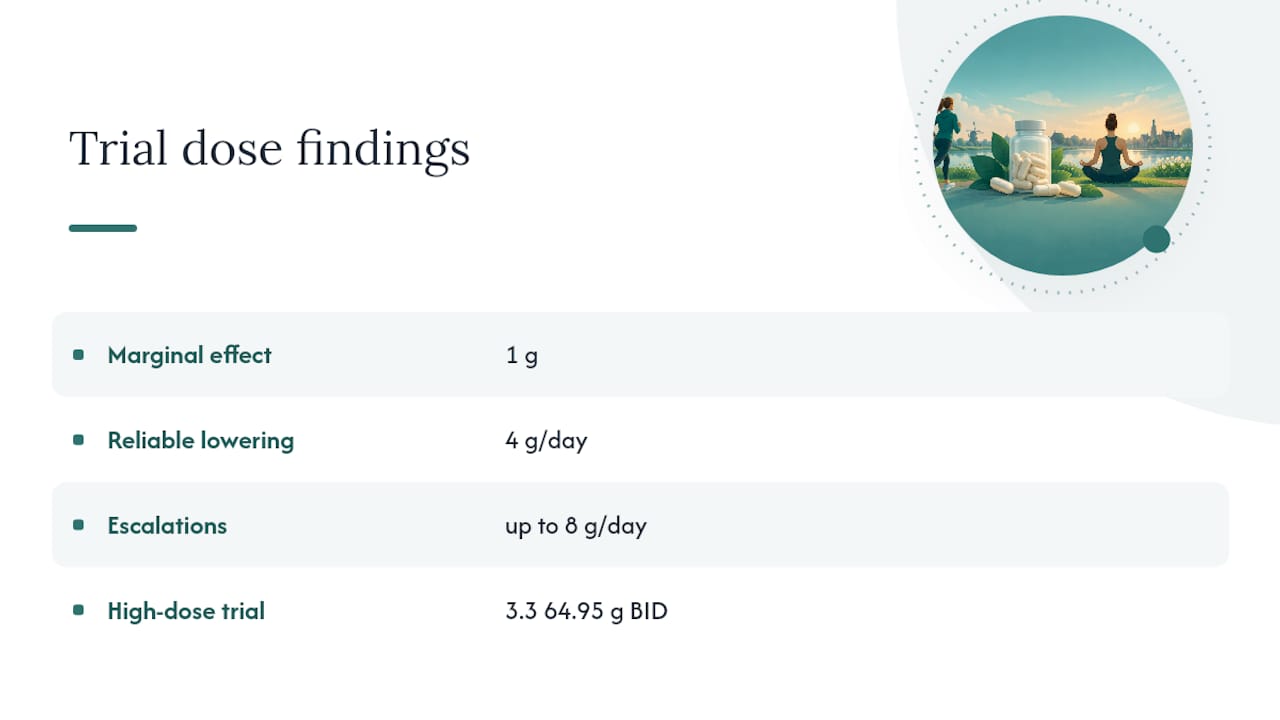
The dose-response relationship for TMG and homocysteine is reasonably linear across low-to-moderate doses. A meta-analysis of pooled trial data found that homocysteine lowering becomes more reliable and pronounced at around 4 g per day, with 1 g doses producing only a marginal effect by comparison.
Individual trials back this up with real numbers. One randomised controlled trial gave participants 4 g of trimethylglycine daily in a micronutrient drink for 12 weeks specifically to measure homocysteine reduction against a control arm. A separate betaine dosing study in NAFLD patients used 4 g/day split into two 2 g doses, with some randomisation arms escalating to 8 g/day, which shows how much higher clinical protocols can go when researchers are monitoring participants closely.
The clearest pooled result across these trials: homocysteine lowering becomes reliably measurable at roughly 4 g per day, which is why that figure shows up repeatedly as the threshold in higher-dose clinical protocols.
Timing matters if you are testing your own progress. Homocysteine and related biomarkers typically shift somewhere between two and twelve weeks after a dose change, depending on your starting levels and how consistently you take the supplement. That is a wide window, so testing at the four-week mark and again at twelve weeks gives you a much clearer picture than a single early check. A high-dose betaine trial in people with obesity and prediabetes used doses as high as 3.3 g twice daily, escalating to 4.95 g twice daily, and reported large increases in plasma dimethylglycine alongside modest metabolic effects.
What side effects and risks come with higher doses?
The most commonly reported issues are digestive: nausea, bloating, diarrhoea, and general stomach discomfort. Some users also notice a change in body odour, which becomes more likely as the dose climbs.
Lipid changes are the more serious concern at the top of the dosing range. The same high-dose betaine trial that recorded large dimethylglycine increases also found that cholesterol rose in some participants on the higher regimen. This is why anyone using 4 g/day or more should get a baseline lipid panel done and repeat it after a few months of consistent use, rather than assuming a supplement that helps one biomarker cannot affect another.
Certain groups need medical guidance before starting at all. Clinical overviews flag pregnancy, breastfeeding, kidney disease, liver disease, and existing high cardiovascular risk as reasons to speak with a clinician first, since these conditions can change how the body handles methyl donors and lipid load.
Practical points worth keeping in mind:
- Start at the lowest dose in your target band and hold there for a week before increasing.
- Take TMG with food if you notice any stomach upset.
- Get a lipid panel before and during use if you plan to go above 4 g/day.
- Stop and consult a doctor if digestive symptoms persist beyond the first week or two.
Pro Tip: If nausea shows up early, split your daily dose in half and take each portion with a meal rather than on an empty stomach. Most digestive complaints settle once the supplement is taken alongside food.
How do you start and measure your TMG dose properly?
Jumping straight to a clinical-level dose is the most common mistake people make with TMG. A staged approach gives your gut time to adjust and gives you a genuine baseline to compare against later.
- Weeks 1 to 2: Start at 500 mg to 1 g per day and note any digestive response.
- Weeks 3 to 4: If tolerance is good, step up gradually towards your target band, whether that is stack-support (1 to 2 g) or homocysteine-focused (1.5 to 3 g or higher).
- Before increasing past 4 g/day: Get a baseline lipid panel and, if homocysteine is your goal, a baseline homocysteine test too.
- Weeks 6 to 12: Re-test homocysteine to see whether your dose is producing a measurable change.
- Weeks 8 to 12 (if using 4 g/day or more): Repeat the lipid panel to check for any upward shift.
If you are using powder rather than capsules, do not trust a scoop for accuracy. Powder density varies by brand, so weighing your intended dose on a milligram scale once and recording the equivalent scoop volume saves you from under or over-dosing every time you use it afterwards. Mixing into water works fine, though the taste is mildly bitter at higher gram amounts.
Timing across the day matters less than people assume. Taking TMG with a meal at a consistent time each day beats any attempt to optimise around a specific hour, and consistency is what actually drives the biomarker changes you are testing for.
Why Vivetus keeps its TMG guidance conservative
Most of the dosing confusion around TMG comes from conflating research-grade doses with everyday maintenance use. A 4 g/day protocol used in a monitored clinical trial is a different proposition from someone self-administering the same amount at home without a lipid panel in sight, and treating them as interchangeable is where the real risk creeps in.
Vivetus frames its dosing guidance around the lower, better-tolerated bands first, because that is where most people looking for methylation and homocysteine support actually sit. The blog content on TMG and NMN stacking and the safety and monitoring guidance both exist to walk readers through exactly this distinction: what is reasonable for daily use, and what belongs in a supervised trial setting only.
— Jord
Finding the right TMG dose in capsule form
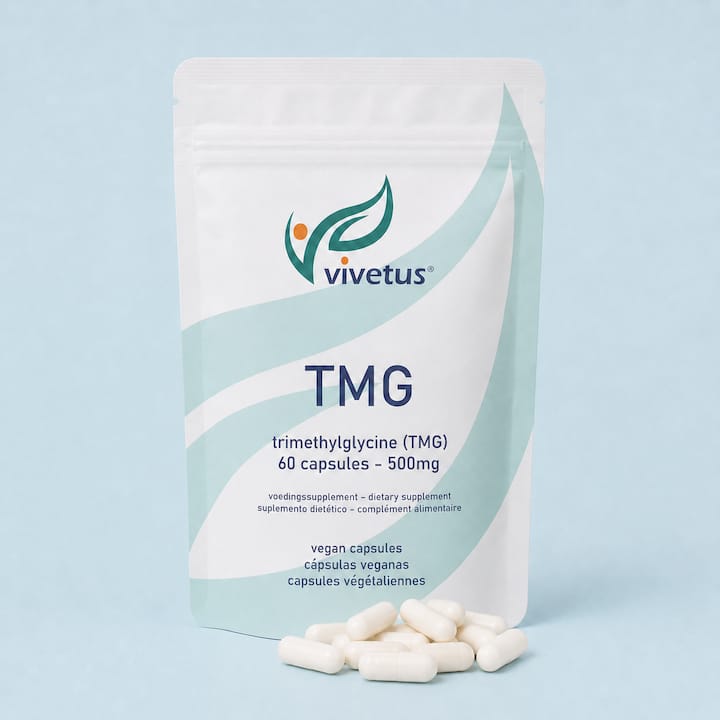
Working out your TMG dosering gets simpler once you have a fixed unit to count from. The Vivetus® Trimethylglycine (TMG) - 60 capsules - 500mg product maps directly onto the starter and maintenance bands covered above: one capsule gets you to 500 mg, two to 1 g, and four capsules lands you at 2 g, which covers the stack-support range without needing to measure powder.
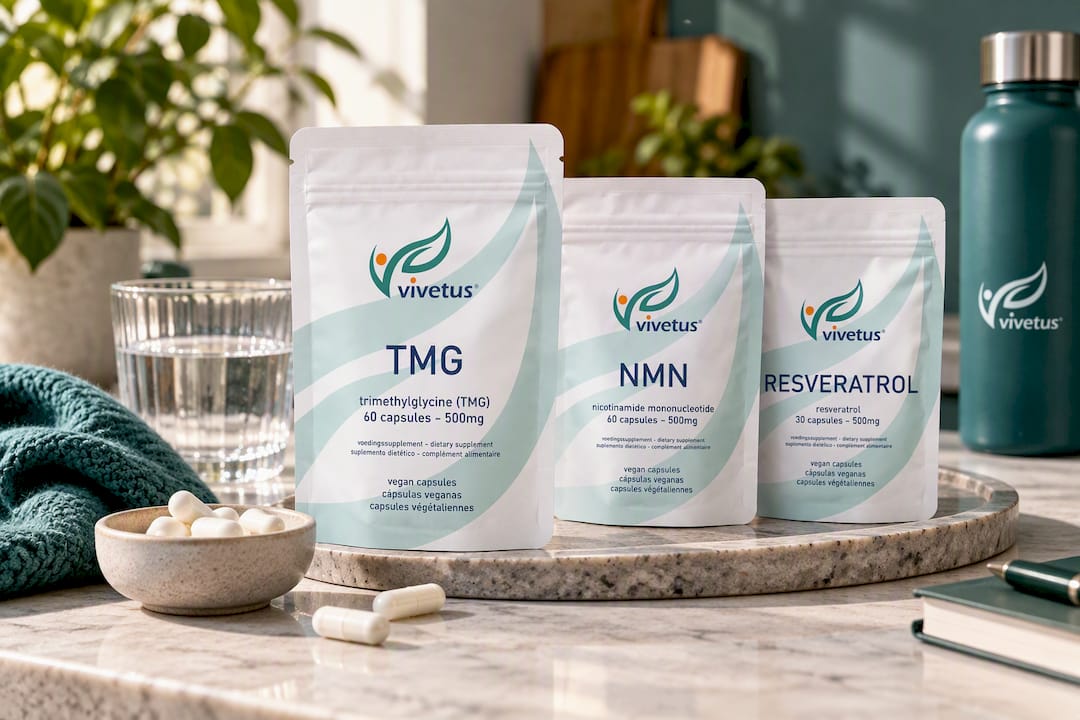
If you are already taking NMN or another NAD+ precursor and want a stacked approach without juggling separate orders, the 🔬VitaalPlus bundel groups TMG together with complementary longevity products, including options from the NMN range. For those also exploring antioxidant support alongside methylation, the resveratrol collection and quercetin range sit within the same product line. Formulations are assembled in the Netherlands with vegan, GMO-free ingredients, and orders over a certain amount may ship free. Start with the 500 mg capsules if you are new to TMG, or check the full TMG and berberine collection if metabolic support is also on your list.
This article is general information, not a substitute for advice from a qualified doctor. Consult a qualified healthcare professional about your own circumstances before acting on anything here.
Sources
- TMG Supplements: Benefits, side effects, dosage, and more
- Novel micronutrient supplement trial (NCT03431597)
- High-dose betaine trial (PubMed 29860335)
FAQ
What does TMG do to your body?
TMG, also known as betaine, acts as a methyl donor that supports your body’s methylation cycle and helps convert homocysteine back into methionine. This is why it is commonly used alongside NMN and other methyl-consuming supplements, and why higher doses are studied specifically for their effect on homocysteine levels.
What are the side effects of TMG supplements?
The most frequently reported effects are digestive, including nausea, bloating, diarrhoea, and stomach discomfort, along with occasional changes in body odour. These effects become more likely at higher doses, which is one reason to start at 500 mg to 1 g daily and increase gradually.
What does TMG stand for?
TMG stands for trimethylglycine, also called betaine, a naturally occurring compound involved in methylation and liver metabolism. It is found in foods like beetroot and spinach, though supplement doses are far more concentrated than typical dietary intake.
How much TMG should I take daily for homocysteine support?
Most trials showing meaningful homocysteine reduction use doses between 1.5 and 4 g per day, with the largest pooled effects appearing around 4 g daily. Anyone using doses at that level should get a lipid panel checked, since higher doses have been linked to increases in cholesterol in some trial participants.
Can I take TMG with NMN or creatine?
Yes, pairing TMG with NMN or creatine is common practice, since both compounds use up methyl groups during metabolism. There is no direct trial confirming that TMG improves outcomes when stacked with NMN, but a modest dose in the 1 to 2 g range is generally treated as reasonable methylation support rather than a proven requirement.