

Vitamin D benefits explained for healthy ageing
Vitamin D’s primary, evidence-backed role is musculoskeletal protection: it drives intestinal calcium absorption, supports bone mineralisation, and reduces fracture risk. For adults over 40, it also supports immunocompetence and helps control the chronic low-grade inflammation associated with ageing. Most extra-skeletal benefits, however, are threshold-dependent. They appear mainly when correcting deficiency rather than in people who are already replete. The Central and Eastern European expert consensus and a recent state-of-the-art triangulated review both confirm this pattern.
Three practical starting points:
- Test serum 25(OH)D if you are in a risk group (older adult, limited sun exposure, obesity, darker skin, or on relevant medications).
- Correct deficiency with vitamin D3 (cholecalciferol), guided by your serum result.
- Review any high-dose plan with a clinician before starting.
Pro Tip: In Central Europe, UVB synthesis is insufficient from October through March, so plan to rely on diet or supplements across those months rather than assuming sunlight will maintain your levels.
Table of Contents
- How does vitamin D actually work in the body?
- What does the science actually show?
- Who benefits most and when should you test?
- How to get enough vitamin D in Central Europe
- Dosing, safety, and monitoring for adults over 40
- How to choose a quality vitamin D supplement
- When will you notice a difference?
- Key takeaways
- A note on vitamin D and healthy ageing
- Vivetus supports your vitamin D routine
- Useful sources
How does vitamin D actually work in the body?
Vitamin D functions as a pro-hormone. Once activated to its hormonal form (1,25-dihydroxyvitamin D), it binds to the vitamin D receptor (VDR) found in virtually every tissue type, regulating hundreds of genes involved in calcium handling, immune defence, and cellular maintenance.
The key mechanisms, and what they mean for adults 40+:
- Intestinal calcium absorption and bone mineralisation. 1,25(OH)2D binds VDR in the gut to drive active calcium transport. Without adequate vitamin D, calcium absorption falls, parathyroid hormone rises, and bone is progressively demineralised. This is the most firmly established pathway, confirmed by EFSA’s dietary reference values.
- VDR signalling in immune cells → improved immunosurveillance. Monocytes, macrophages, and dendritic cells are highly vitamin D-sensitive; VDR-mediated epigenetic control shapes how these cells respond to pathogens and self-antigens.
- NF-kB suppression → reduced inflammaging. Vitamin D downregulates NF-kB signalling by stabilising IκBα and impairing p65 nuclear translocation, which lowers expression of pro-inflammatory cytokines. Chronic low-grade inflammation is a driver of age-related decline, so this pathway matters.
- Muscle function and fall prevention. VDR in muscle tissue supports contractile function. Deficiency is associated with myopathy, poor physical performance, and increased fall risk in older adults.
- Mitochondrial and cellular homeostasis. Emerging mechanistic evidence links vitamin D to mitochondrial function and DNA integrity, though clinical trial confirmation here remains limited.
“Vitamin D influences immunosenescence and helps maintain immunocompetence — mechanisms directly relevant to mitigating hallmarks of ageing in older adults.” Vitamin D and health outcomes: state-of-the-art review
Where mechanisms are well established in randomised controlled trials (RCTs), this article says so. Where evidence is primarily mechanistic or observational, that is noted in the next section.
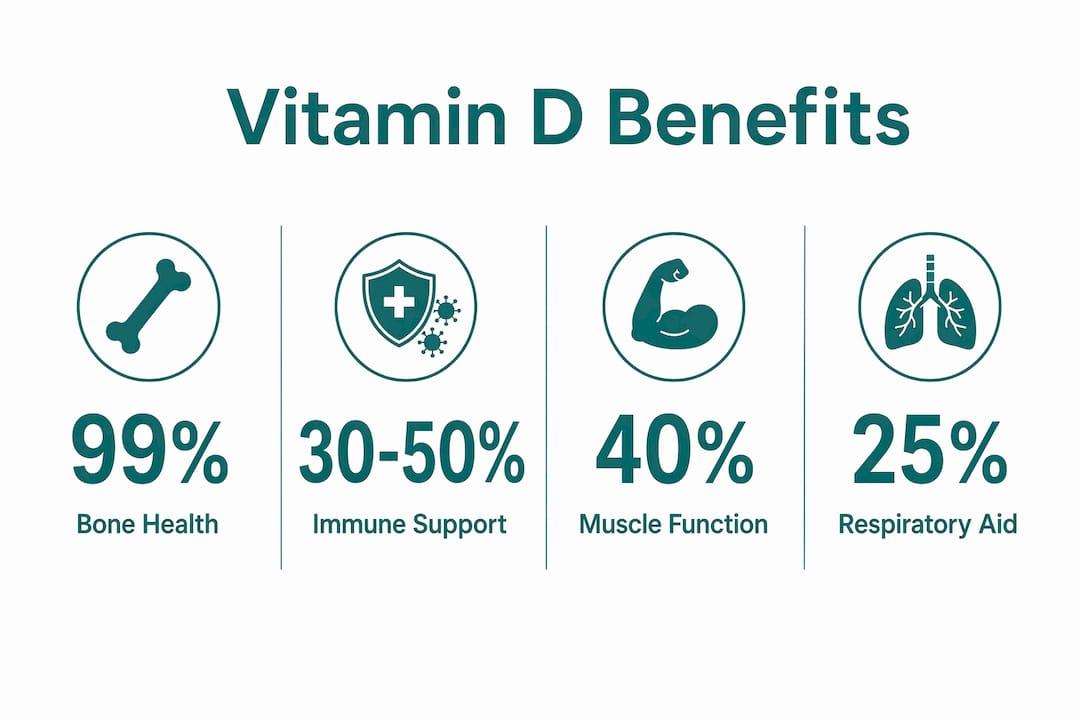
What does the science actually show?
Strong causal evidence supports skeletal outcomes. Extra-skeletal effects are real but mostly threshold-dependent, appearing most clearly when deficiency is corrected in older or at-risk populations.
Evidence tiers, based on triangulated evidence combining observational data, Mendelian randomisation, and RCTs:
- Skeletal health (high evidence). Consistent across study designs. Fracture risk, bone mineral density, and muscle-related fall risk all respond to adequate vitamin D, particularly when combined with calcium.
- Respiratory infections and some autoimmune outcomes (moderate, threshold-dependent). Benefits are most pronounced in deficient groups. RCTs enrolling already-replete populations frequently show no effect, which explains conflicting headlines.
- Cardiovascular, metabolic, and neuropsychiatric outcomes (weak or inconsistent). Observational associations exist, but RCT evidence is not consistent. The Endocrine Society’s 2024 clinical practice guideline notes that for adults aged 75 and older, empiric supplementation may lower mortality risk, though evidence quality remains moderate.
A key design issue: many RCTs enrol vitamin D-replete participants, which reduces the observed supplementation effect and makes results harder to interpret. Baseline 25(OH)D status matters when reading any trial.
The practical implication is straightforward: test first, correct if deficient, and do not assume high-dose supplementation adds benefit when levels are already adequate.
Who benefits most and when should you test?
Testing is most useful for older adults, people with limited sun exposure, obesity, darker skin, malabsorption conditions, chronic kidney disease, or those taking medications that affect vitamin D metabolism (anticonvulsants, some glucocorticoids, and weight-loss drugs that reduce fat absorption).
| Risk group | Primary reason for low vitamin D | Recommended action |
|---|---|---|
| Adults over 65 | Reduced skin synthesis, less time outdoors | Test; supplement if deficient |
| Obesity (BMI >30) | Sequestration in adipose tissue | Test; may need higher correction dose |
| Darker skin | Reduced UVB-driven synthesis | Test; supplement if deficient |
| Malabsorption (e.g. coeliac, IBD) | Impaired fat-soluble vitamin uptake | Test; discuss with clinician |
| Housebound or institutionalised | Minimal sun exposure | Supplement; test periodically |
| On anticonvulsants or glucocorticoids | Accelerated vitamin D catabolism | Test; discuss dose with clinician |
The Central and Eastern European consensus defines deficiency as serum 25(OH)D below 20 ng/mL (50 nmol/L) and sets the optimal target at 30–50 ng/mL (75–125 nmol/L). Reaching the lower threshold avoids acute deficiency; reaching the optimal range is associated with broader physiological benefit in at-risk adults.
Pro Tip: Re-test serum 25(OH)D after 8–12 weeks of corrective dosing. Earlier re-testing is warranted if symptoms are severe or a clinician advises it.
How to get enough vitamin D in Central Europe
For many adults in Central Europe, supplements and dietary sources are the reliable route from October through March, when UVB synthesis is insufficient at these latitudes.

Sunlight. From April to September, 10–20 minutes of midday sun on arms and legs can contribute meaningfully. From October onwards, this route is largely unavailable in Central Europe regardless of how much time you spend outdoors.
Dietary sources. Fatty fish (salmon, mackerel, herring) are the most concentrated natural source. Eggs and some fortified foods (dairy products, spreads, certain cereals) contribute smaller amounts. Diet alone rarely achieves optimal levels for adults 40+.
Supplement forms:
- Vitamin D3 (cholecalciferol): the preferred form for prevention and maintenance. More effective than D2 at raising and sustaining serum 25(OH)D. Traditionally derived from lanolin but now also available from lichen, making it suitable for vegans.
- Vitamin D2 (ergocalciferol): plant-derived, less potent at raising 25(OH)D. Suitable where D3 is not tolerated, but D3 is generally preferred.
- Calcifediol (25-hydroxyvitamin D): bypasses hepatic conversion; useful for faster repletion or in people with liver conditions. Discuss with a clinician before use.
Practical steps for supplementation:
- Take vitamin D3 with a meal containing fat to maximise absorption.
- Use a maintenance dose through winter (see dosing section below).
- If deficient, follow a corrective regimen under clinical guidance, then switch to maintenance.
- Choose vegan-labelled D3 (lichen-derived) if needed.
A simple seasonal plan: April–September, aim for moderate sun exposure plus dietary sources; October–March, rely on a daily D3 supplement.
Dosing, safety, and monitoring for adults over 40
The widely referenced upper limit for unsupervised use is 4,000 IU per day for most adults. The Central and Eastern European consensus suggests 800–2,000 IU daily for prevention, with individual variability acknowledged. Test before starting high-dose therapy; do not exceed 4,000 IU without clinical supervision. More detail on safe upper limits is available from Vivetus.
Safety points:
- Hypercalcaemia is the primary risk of excessive dosing. Symptoms include nausea, confusion, excessive thirst, and kidney stones.
- Medication interactions: anticonvulsants, some glucocorticoids, and orlistat can all reduce vitamin D levels or alter metabolism. Check with a pharmacist or clinician.
- Calcium monitoring: if you are on high-dose vitamin D, periodic serum calcium checks are advisable.
“Targeted supplementation for groups with physiological demand — ageing, deficiency — is preferable to indiscriminate high-dose population-wide strategies.” Central and Eastern European expert consensus
Warning: Seek medical attention promptly if you experience confusion, severe nausea, or signs of kidney stones while taking high-dose vitamin D. These may indicate hypercalcaemia.
How to choose a quality vitamin D supplement
Prefer vitamin D3 (cholecalciferol) for both prevention and repletion unless a clinician advises otherwise. The vitamin D status overview for Europe confirms D3 is more effective than D2 at raising serum 25(OH)D.
Checklist for selecting a product:
- D3 vs D2: choose D3 unless there is a specific clinical reason for D2.
- IU per dose: match the dose to your need (maintenance vs correction).
- Third-party purity testing: look for batch-level certificates of analysis.
- Form: oil-based capsules generally absorb better than dry tablets.
- Vegan labelling: lichen-derived D3 is the vegan-appropriate option.
- Manufacturer transparency: clear expiry date, lot number, and contact information.
Calcium combined with vitamin D benefits institutionalised or frankly deficient older adults, but is not necessary for everyone. The role of calcium in ageing is covered in detail separately.
Pro Tip: For rapid correction, discuss calcifediol formulations with a clinician. For standard maintenance, a certified vitamin D3 supplement from a transparent supplier is the practical choice.
When will you notice a difference?
Serum 25(OH)D typically begins rising within weeks of starting supplementation. Meaningful repletion is usually seen at 8–12 weeks, which is why re-testing at that point is the standard recommendation.
Timeline of expected changes:
- Weeks 2–12: serum 25(OH)D rises. The rate depends on baseline level, dose, body weight, and formulation.
- Months 3–6: muscle strength and fall-risk markers may improve in previously deficient adults. Bone turnover markers begin to normalise.
- Months to years: fracture risk reduction in deficient populations, particularly when combined with calcium and exercise. Multimodal approaches combining vitamin D with exercise and omega-3 show additive effects on biological ageing markers.
Outcomes likely to change with correction: bone markers, muscle function, and fewer respiratory infections in deficient groups. Outcomes unlikely to change quickly: cardiovascular endpoints, which require longer follow-up and show inconsistent RCT results.
Measure biochemical response (serum 25(OH)D) at 8–12 weeks. Clinical signs such as reduced muscle pain or improved physical performance may follow, but are harder to attribute to vitamin D alone.
Key takeaways
Vitamin D’s proven skeletal benefit is the foundation; targeted correction of deficiency in adults 40+ also supports immune function and reduces inflammaging, making testing and appropriate supplementation the practical priority.
| Point | Details |
|---|---|
| Bone health is primary | Vitamin D drives calcium absorption and bone mineralisation — the most consistently proven benefit across study designs. |
| Extra-skeletal benefits need deficiency correction | Immune and inflammation benefits are observed mainly when vitamin D deficiency is corrected. |
| Test, then supplement | Check serum 25(OH)D before high-dose therapy; re-test at 8–12 weeks to confirm response. |
| Choose D3, check the label | Vitamin D3 (cholecalciferol) is the preferred form; look for third-party batch testing and clear dosing information. |
| Vivetus vitamin D3 | Vivetus offers certified, clearly labelled vitamin D3 options suited to maintenance dosing for adults 40+. |
A note on vitamin D and healthy ageing
Vitamin D sits at the centre of Vivetus’s healthy-ageing range because the evidence for its skeletal and immune roles in adults 40+ is clearer than for almost any other single micronutrient. The threshold-dependent nature of its extra-skeletal effects is precisely why Vivetus emphasises testing and targeted correction over blanket high-dose use. The guidance in this article reflects current Central European consensus and peer-reviewed evidence, but individual needs vary. A clinician or pharmacist familiar with your health history is the right person to personalise your plan.
Vivetus supports your vitamin D routine
Knowing the evidence is one step. Acting on it is another. The Vivetus Energy & Vitality bundle includes certified, clearly labelled vitamin D3 formulated for adults focused on maintenance dosing and long-term vitality. Every product carries transparent batch information so you can verify purity before you buy. Free shipping applies on orders over €50 across Central Europe and beyond.

For standard winter maintenance, the bundle gives you a straightforward, tested option. For high-dose correction or complex health situations, discuss your plan with a clinician first, then use a certified supplement to support it.
Useful sources
- Central and Eastern European expert consensus on vitamin D deficiency (Pludowski et al.)
- Vitamin D and health outcomes: state-of-the-art triangulated review
- Vitamin D and ageing: central role of immunocompetence (MDPI Nutrients)
- Vitamin D as a shield against ageing (MDPI IJMS)
- EFSA Scientific Opinion on Dietary Reference Values for vitamin D
- Vitamin D status in Central Europe (PMC)
- Vitamin D deficiency in Europe: pandemic? (PubMed)
- Multimodal interventions and biological ageing markers