

What is a multivitamin? Benefits, risks, and how to choose
TL;DR:
- Multivitamins are dietary supplements that provide a combination of vitamins and minerals to fill nutritional gaps. They are most beneficial for pregnant women, older adults, vegans, and individuals with absorption issues, but offer limited benefits for healthy, well-nourished adults. Choosing verified products and consulting professionals ensures safe and effective supplementation tailored to individual needs.
A multivitamin is a dietary supplement that combines three or more vitamins and minerals to help fill nutritional gaps in your daily diet. The formal term used in clinical practice is multivitamin/mineral supplement, often abbreviated to MVM. These products are among the most widely used supplements in the world, yet the science behind them is more nuanced than most people realise. This article covers what multivitamins contain, who genuinely benefits from them, what the evidence says about their effects, and how to choose a product that is actually worth taking.
What do multivitamins typically contain?

A multivitamin generally includes a broad range of nutrients, though no standardised definition exists for exactly which vitamins or minerals must be present or at what levels. That lack of standardisation matters. Two products labelled “multivitamin” can differ substantially in their formulas.
Most MVMs include the following nutrients:
- Vitamins: A, C, D, E, K, and the full B-complex (B1, B2, B3, B5, B6, B7, B9, B12)
- Minerals: Calcium, magnesium, zinc, iron, selenium, iodine, and manganese
- Trace elements: Chromium, molybdenum, and copper in smaller amounts
Some products contain up to 13 essential vitamins and 15 minerals. That breadth sounds reassuring, but it does not mean every product delivers meaningful amounts of each nutrient.
Multivitamins vs megavitamins
The distinction between a standard multivitamin and a megavitamin is significant. A standard MVM aims to deliver nutrients close to recommended daily amounts. A megavitamin, by contrast, contains doses hundreds of times the daily nutritional requirement. That scale creates real toxicity risk, particularly for fat-soluble vitamins. Megavitamins offer no proven benefit over standard formulations and carry considerably more risk.
| Feature | Standard multivitamin | Megavitamin |
|---|---|---|
| Nutrient doses | Close to recommended daily amounts | Hundreds of times the daily requirement |
| Toxicity risk | Low when used as directed | High, especially for fat-soluble vitamins |
| Evidence of benefit | Modest for specific populations | No proven additional benefit |
| Recommended use | Targeted nutritional support | Not recommended without medical supervision |
Are multivitamins necessary for most adults?
The honest answer is: not for everyone. Clinical reviews of over 390,000 participants found no reduction in all-cause mortality from routine multivitamin use in well-nourished adults. That is a significant finding. It means that if your diet is broadly adequate, a daily MVM is unlikely to extend your life or prevent major disease.
That said, certain groups have a well-documented need for supplementation:
- Pregnant women: Folate (vitamin B9) is critical for fetal neural tube development. Supplementation before and during early pregnancy is strongly supported by evidence.
- Adults over 50: Absorption of vitamin B12 and vitamin D declines with age. Older adults are among those most likely to benefit from targeted supplementation. The Vivetus guide on vitamins after 50 covers this in detail.
- Vegans and strict vegetarians: Plant-based diets commonly lack vitamin B12, vitamin D, iron, zinc, and omega-3 fatty acids.
- People with malabsorption conditions: Conditions such as Crohn’s disease, celiac disease, or post-bariatric surgery significantly impair nutrient absorption.
- Those taking certain medications: Proton pump inhibitors block absorption of vitamin B12, meaning long-term users may need supplementation even with an otherwise adequate diet.
Within clinical practice, targeted nutrient therapy is preferred over broad-spectrum MVMs when a specific deficiency is identified. A blood test revealing low vitamin D calls for a vitamin D supplement, not necessarily a full multivitamin.
Pro Tip: Ask your GP for a full nutrient panel before starting any supplement. Knowing your actual levels removes the guesswork and helps you choose what you genuinely need.
What are the benefits and limitations of multivitamins?
Multivitamin benefits are real but modest, and they are not evenly distributed across all people. The strongest evidence points to cognitive function. Clinical trials show improved memory and cognitive fitness scores in multivitamin users compared to placebo groups, particularly in middle-aged and older adults. That is a meaningful finding for anyone concerned about brain health as they age.
“Decisions about multivitamin use should be individualised, considering age, dietary patterns, health status, and emerging evidence.” — Harvard Health
The picture is less encouraging for cardiovascular disease and cancer prevention. Clinical evidence does not support the idea that routine MVM use reduces the risk of heart disease or cancer in otherwise healthy adults. That does not make multivitamins useless. It means they work best as a nutritional safety net, not as a substitute for a healthy diet or medical care.
Multivitamins fit most sensibly within a broader lifestyle strategy. Regular physical activity, a diet rich in vegetables, whole grains, and lean protein, and adequate sleep all contribute more to long-term health than any supplement. An MVM fills specific gaps; it does not replace the foundation. For a deeper look at the clinical evidence, the Vivetus article on why use multivitamins is worth reading.
What risks and side effects should you consider?
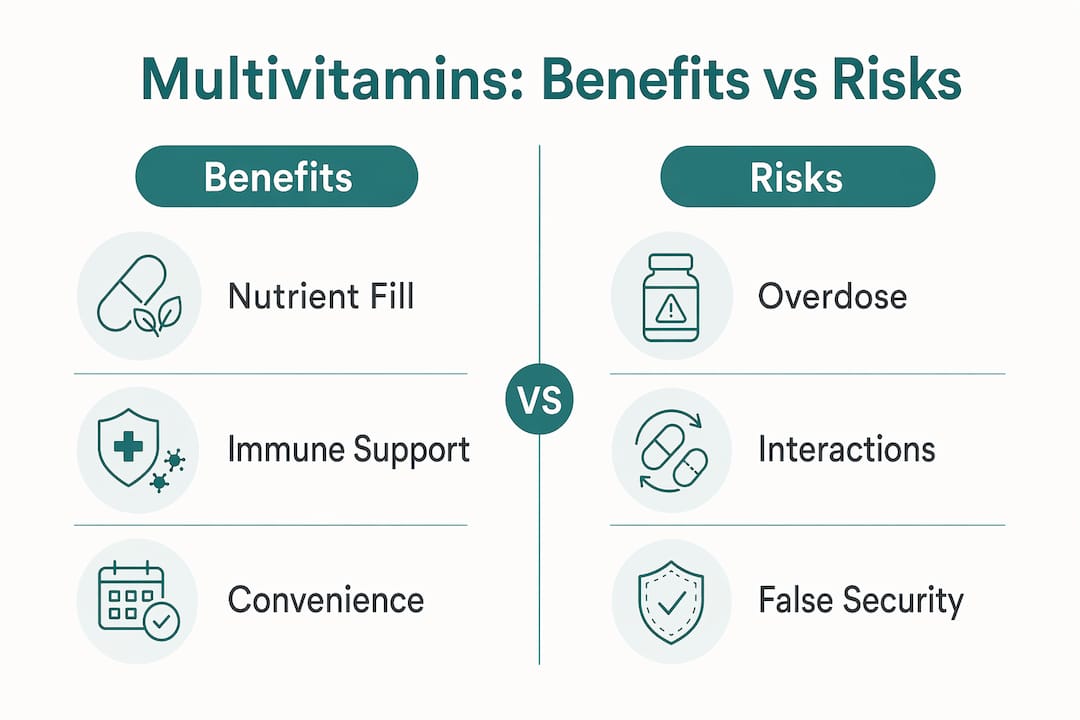
Multivitamins are generally safe at standard doses, but several risks deserve attention.
- Fat-soluble vitamin accumulation: Vitamins A, D, E, and K are stored in body tissues rather than excreted. High doses build up over time and can cause toxicity. Vitamin A excess, for example, is linked to liver damage and bone loss.
- Drug interactions: Blood thinners such as warfarin interact with vitamin K. Certain antibiotics interact with calcium and iron. Polypharmacy in older adults makes these interactions particularly common and worth discussing with a doctor.
- Behavioural displacement: Relying on supplements can lead people to pay less attention to diet quality. Over time, this worsens overall nutrition rather than improving it.
- The “natural equals safe” assumption: The American Medical Association notes that many people underestimate supplement risks because they assume natural products carry no harm. That assumption is incorrect.
Pro Tip: Check the percentage of the nutrient reference value (NRV) on the label before buying. Anything significantly above 100% NRV for fat-soluble vitamins warrants caution.
How to choose and use multivitamins effectively
Choosing a quality multivitamin requires more than picking the most popular product on the shelf. These steps make the process more reliable.
- Look for verified products. The USP Dietary Supplement Verification Programme mark indicates that a product meets safety and ingredient standards. Equivalent third-party testing marks from NSF International or Informed Sport serve the same purpose.
- Check nutrient amounts. Aim for products that deliver nutrients close to 100% of the recommended daily amount. Avoid products with very high doses of fat-soluble vitamins unless a doctor has advised otherwise.
- Match the product to your life stage. Formulations for adults over 50 differ meaningfully from general adult products. Prenatal formulas prioritize folate and iron. Choose a product designed for your specific needs.
- Consult a healthcare professional. A GP or registered dietitian can identify actual deficiencies through testing and recommend personalized supplement use rather than guesswork.
| Selection criterion | What to look for |
|---|---|
| Third-party verification | USP, NSF International, or Informed Sport mark |
| Nutrient doses | Close to 100% NRV; avoid excessive fat-soluble vitamin levels |
| Life stage match | Age and condition-specific formulation |
| Ingredient transparency | Full label disclosure with no proprietary blends |
Use multivitamins as a complement to a nutritious diet, not a replacement for one. The supplement fills gaps; food provides the full matrix of fiber, phytonutrients, and compounds that no pill replicates.
Key takeaways
A multivitamin works best as a targeted nutritional safety net for people with documented gaps, not as a daily insurance policy for everyone.
| Point | Details |
|---|---|
| Definition | A multivitamin contains three or more vitamins and minerals to fill dietary gaps. |
| Who benefits most | Pregnant women, older adults, vegans, and those with malabsorption conditions have the clearest need. |
| Cognitive benefit | Clinical trials show modest memory and cognitive improvements in middle-aged and older adults. |
| Key risk | Fat-soluble vitamins accumulate in tissues; megadoses carry real toxicity risk. |
| Selection advice | Choose third-party verified products and match the formula to your life stage and health status. |
My honest view on multivitamins after years of reading the evidence
The most common mistake I see is treating a multivitamin as a daily ritual that compensates for a poor diet. The evidence does not support that. An analysis of over 390,000 people found no mortality benefit from routine use. That should give anyone pause before buying a large tub on autopilot.
What the evidence does support is targeted use. If you are over 50, following a plant-based diet, pregnant, or taking medications that deplete specific nutrients, a well-chosen supplement makes genuine sense. The cognitive data for older adults is also more encouraging than many people realize, and worth factoring in.
My practical advice is to get tested first. A blood panel costs relatively little and tells you exactly where your levels sit. From there, you can choose a product that addresses a real gap rather than a theoretical one. Broad-spectrum MVMs are not harmful at standard doses, but they are often unnecessary for people eating a reasonably varied diet.
The supplement industry is not short of products making large claims. The gap between what the label implies and what the clinical evidence shows is often wide. Approach any product with that in mind, and always discuss significant supplementation with a qualified health professional before starting.
— Jord
Vivetus Energy & Vitality bundle: nutrition support worth considering
For adults who want a well-formulated option to support daily energy and vitality, the Vivetus Energy & Vitality bundle brings together evidence-backed nutrients in amounts aligned with recommended daily intakes.
The bundle is designed for health-conscious adults who want nutritional support without excessive doses or unnecessary fillers. It reflects the principle that supplementation works best when it is targeted, transparent, and built around what the evidence actually supports. Free shipping applies on orders over €50, and the product page includes full ingredient and dosage information so you can assess it against your own needs before purchasing.
FAQ
What is a multivitamin supplement?
A multivitamin is a dietary supplement containing three or more vitamins and minerals, formulated to fill nutritional gaps that diet alone may not cover.
Should I take multivitamins every day?
Daily use is most justified for people with documented deficiencies, older adults, pregnant women, or those on restrictive diets. Healthy adults eating a varied diet have limited evidence supporting routine daily use.
What are the main multivitamin side effects?
At standard doses, side effects are rare. High doses of fat-soluble vitamins (A, D, E, K) can accumulate in body tissues and cause toxicity, so avoiding megadose products is advisable.
Can multivitamins replace a healthy diet?
No. Multivitamins fill specific nutrient gaps but cannot replicate the full range of fiber, phytonutrients, and compounds found in whole foods. They complement a healthy diet rather than substitute for one.
How do I know if a multivitamin is good quality?
Look for products carrying a third-party verification mark such as USP or NSF International. These marks confirm that the product contains what the label states and meets safety standards.