

Supplement Certificate of Analysis: How to Read a COA
A supplement certificate of analysis (COA) is a laboratory document. It lists the tests run on one batch or sample, the method used for each test, the limit the product had to meet and the result found. To read one, match the batch number to your pack, check who tested it, then compare each result with its specification and unit. This guide explains each step in the order a buyer in the Netherlands would follow it.
TL;DR
- A COA reports measurements on one sample at one moment. It is useful only when its batch number matches the number printed on your container.
- Read every row as five items: parameter, method, specification, result, unit. A bare “pass” without numbers is incomplete.
- Check the laboratory name, report number, date and signature. For Dutch laboratories, the accreditation body’s public register shows what a lab is accredited for.
- “Not detected” has meaning only next to the detection limit of the method.
- A COA supports a purchase decision. It does not replace a good label, sensible dosing or advice from a doctor or pharmacist.
Table of Contents
- What a supplement COA is
- The anatomy of a COA, section by section
- Contaminant results: how to think about them
- Is the COA genuine, current and about your product?
- Red flags and green flags
- What a COA cannot tell you
- A 60-second routine before you buy
- Perspective
- Where to find Vivetus products
- FAQ
- Sources
What a supplement COA is
A COA is issued by a laboratory, or by a quality department, for a specific production batch. It records which tests were performed and what they found. Typical content for a capsule or powder includes identity, the amount of the active ingredient (assay), contaminants such as heavy metals, and microbiological counts.
Three points define the document:
- It is batch-specific. A certificate for lot A says nothing about lot B.
- It is a snapshot. It describes the sample as tested. It does not describe storage or transport after the test.
- It is a quality record. It is not a medical approval, and it does not state that a product is effective or suitable for any person.
Keeping these three points in mind prevents most misreadings. A COA is evidence about what is in a batch. It is not a verdict on what the product will do for you.
COA from the raw material supplier versus the finished product
Two kinds of COA circulate. The first covers a raw material, such as a bulk powder delivered to a manufacturer. The second covers the finished product, such as the capsule in your hand. Raw material certificates are useful in the supply chain, but they do not confirm what ended up in the final capsule after blending, encapsulation and packing.
For a buyer, the finished-product report is the more informative one. When a brand shows only a raw material certificate, the document answers a narrower question than the one a buyer usually has.

The anatomy of a COA, section by section
Layouts differ between laboratories, but most certificates contain the same blocks. Work through them from top to bottom.
1. Product and batch details
The header should name the product, the sample stage (raw material, bulk blend or finished product), the exact lot or batch number, a report or sample ID, and dates for receipt and analysis.
The lot number is the anchor of the whole document. It must match exactly the number on your container, character for character. If it does not match, the certificate cannot be linked to your product and tells you little about it.
2. Laboratory identification
Look for the laboratory name, address, a report number and a signature or authorised release. A document with no laboratory name, or with data that cannot be traced to a real facility, offers little assurance.
Two questions matter here: who tested, and was the lab independent of the brand? A manufacturer’s own laboratory can produce sound data. An independent laboratory adds a second pair of eyes. Both are worth knowing about when you read the certificate.
3. The results table
The core of the document is a table. Each row should give:
| Column | What it tells you | Example of a good entry |
|---|---|---|
| Parameter | What was measured | Assay of the active ingredient; lead; total yeast and mould |
| Method | How it was measured | HPLC for assay; ICP-MS for elements; a standard microbiological method |
| Specification | The limit or range the batch had to meet | 95.0 to 105.0% of label claim; a numerical maximum |
| Result | The measured value | A number with a decimal precision that fits the method |
| Unit | The scale of the number | mg per capsule, mg/kg, CFU/g |
The method should suit what is being measured. Liquid chromatography (HPLC or UPLC) is a common choice for assay and for marker compounds, while ICP-MS or ICP-OES is typically used for elements such as lead and cadmium, and microbiology uses culture-based methods. A heavy metal result produced by a method that cannot measure elements would be a warning sign.
4. Specification versus result
The specification is the acceptance criterion, for example a minimum purity. The result is the value found in this batch. Words such as “conforms” or “complies” are only as informative as the requirement behind them. Always look at the number.
A worked example: a capsule labelled 500 mg of an ingredient has an assay specification of 90 to 110% of label claim. The result reads 98.4%. That means the lab found about 492 mg per capsule in the sample, within the range. If the result had read 71%, the row should be marked as failing, and a certificate that nonetheless says “conforms” should not be trusted.

5. “Not detected” and detection limits
“ND” or “not detected” does not mean zero. It means the amount was below what the method can detect. Look for the limit of detection (LOD) or limit of quantification (LOQ) next to the entry. A result of “not detected” with an LOD of 0.01 mg/kg says more than the same words with an LOD of 5 mg/kg.
6. Dates and signature
Check the analysis date and the release date. A certificate dated long before the product was made, or after the batch was already sold, needs an explanation. The document should also carry a signature or an equivalent release mark from a responsible person.
Contaminant results: how to think about them
The contaminant block is where many readers get lost. Typical entries are lead, cadmium, mercury and arsenic, along with microbiology such as total aerobic count, yeast, mould and specified organisms.
A few practical points:
- Read the unit. Heavy metals are normally given in mg/kg or µg/kg. A value of 0.02 mg/kg is not the same as 0.02 µg/kg.
- Compare with the stated specification on the certificate, not with a number remembered from elsewhere. Limits differ between product categories, so a figure that suits one product type may not suit another.
- Look at the pattern. A certificate where every parameter lands exactly on its specification limit is unusual and deserves a second look. Real measurements vary.
Why do these rows matter at all? Official inspection work shows that contaminants do turn up in supplements. In 2023 the Dutch food authority NVWA examined 61 herbal supplements from traditional Chinese and Ayurvedic medicine and found too much lead, cadmium or mercury in 7 of them. That inspection concerned a specific herbal category, not all supplements. It does illustrate why a contaminant block on a COA is worth reading rather than skipping.
Is the COA genuine, current and about your product?
Reading the numbers is half of the job. The other half is confirming that the document belongs to what you bought.
A five-step check
- Match the batch number. Compare the lot on the certificate with the lot on your container. They must be identical.
- Ask for the original PDF. A screenshot is easy to edit. An original file with a report number is easier to trace. A brand with a lot-search page or a customer service team can normally supply it.
- Check the laboratory. Find the name, address and report number. Confirm the laboratory exists and works in the field it reports on.
- Check accreditation within its scope. ISO/IEC 17025 accreditation applies to defined tests. A lab accredited for one method or sample type is not automatically accredited for every test on the certificate.
- Check the dates. The analysis date should precede the release of the batch and fit the shelf life.
Using the Dutch accreditation register
In the Netherlands, laboratory accreditation is handled by the Raad voor Accreditatie (RvA). The RvA publishes its requirements for test laboratories in a document called ASR105, accreditation of test laboratories under EN-ISO/IEC 17025. For a report from a Dutch laboratory, the lab name, accreditation number and scope can be compared with the RvA register, which the Netherlands food-control information identifies as the Dutch accreditation body. If the report comes from a laboratory abroad, the national accreditation body of that country keeps a comparable register.
A match in the register shows that the laboratory is recognised for the listed methods. It does not make every result on a certificate correct, so continue with the other steps.
Why a brand’s own report is not the end of the story
Consumer testing organisations point out that manufacturer reports can be based on an unsuitable test, the wrong product or lot, or an analysis carried out incorrectly. ConsumerLab recommends independent testing of the specific product, ideally the same lot. For a buyer, the practical lesson is to treat a COA as strong evidence when it is complete, traceable and tied to the batch, and as weak evidence when any of those links is missing.
Red flags and green flags
| Red flag | Green flag |
|---|---|
| No batch or lot number | Lot number identical to the one on the pack |
| No laboratory name or report number | Named laboratory, report number, signature |
| Only “pass” or “conforms”, no figures | Result, unit, method and specification in every row |
| Every result equals its limit exactly | Realistic variation between parameters |
| Method does not fit the parameter | Method suited to the analyte and sample type |
| “Not detected” with no detection limit | LOD or LOQ stated |
| Raw material certificate shown as proof of the final product | Finished-product report for the lot you hold |
| Undated or unsigned document | Dated, signed, original PDF available |
No single red flag proves a problem. Several together justify asking the brand for clarification before you buy or keep using the product.
What a COA cannot tell you
A COA has clear limits, and knowing them keeps expectations realistic.
- It reports on one sample. A batch is assumed to be uniform, but the certificate does not measure every capsule.
- It does not describe how the product was stored or transported afterwards.
- It does not state that a product is safe or effective for you personally. Questions about medicines, medical conditions, pregnancy or dosing belong with a doctor or pharmacist.
- It does not replace the label. The label tells you the serving, the ingredient amounts and the use-by date. Our guide to reading supplement labels covers that side.
For caregivers buying for an older relative, the same logic applies. Use the COA to confirm quality, then check the product with the relative’s doctor or pharmacist, especially when medicines are involved.
A 60-second routine before you buy
Shoppers in the Netherlands who want a quick routine can follow this order:
- Find the lot number on the pack and on the certificate.
- Confirm the laboratory name and report number.
- Scan the assay row: does the result sit inside the specification, with a unit that fits the label?
- Scan the contaminant rows: are numbers given, with methods and detection limits?
- Note the date.
Our separate guide, the 60-second supplement purity check, walks through this routine for Dutch buyers.
Perspective
We make supplements for people who want to age well, and we think a buyer should be able to ask hard questions about what is in a capsule. A certificate of analysis is the most direct answer a brand can give, because it puts numbers, methods and a batch number on the table.
Our range is built around ingredients with clinical backing: NMN, resveratrol, fisetin, quercetin, pterostilbene, apigenin, TMG and berberine. Our products are vegan, assembled in the Netherlands and tested for purity. We design our formulations to be transparent, so that what is on the label and what is in the capsule can be compared.
We encourage every reader to apply the checks in this article to any supplement, ours included: match the lot, read the method, look at the unit. A brand that welcomes that kind of reading is working in the right spirit. Longevity ingredients are bought for the long term, and long-term trust rests on documents that can be read and verified.
Jord
Where to find Vivetus products
Vivetus offers vegan dietary supplements for healthy ageing and vitality, tested for purity and shipped internationally, with free shipping on orders over €50 and subscription options. The range covers NMN, resveratrol, quercetin and other ingredients, along with bundles for specific goals.
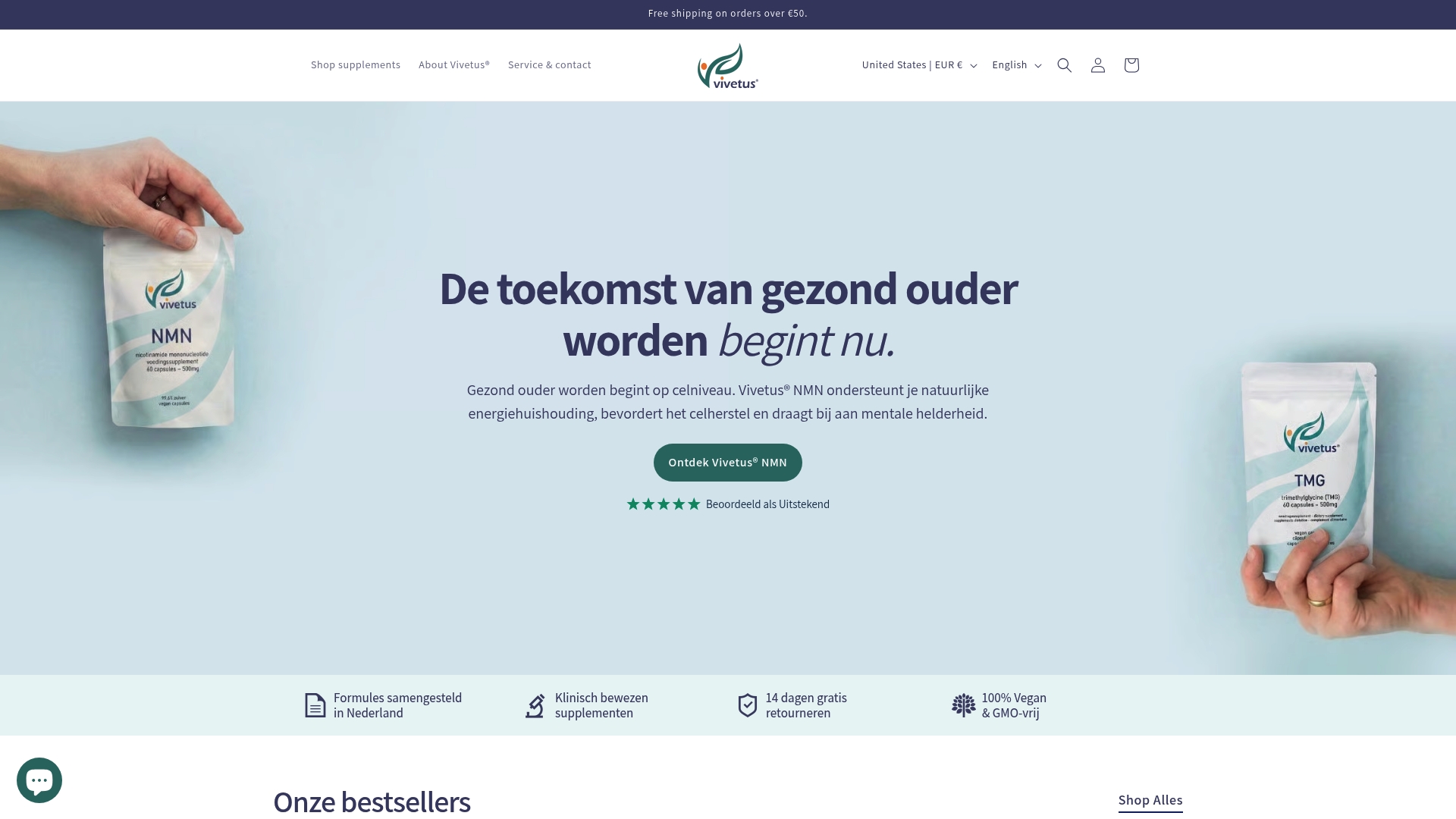
The full overview of products is on the Vivetus website. For research on how ingredients are studied, see our article on clinical research in supplements.
FAQ
What does a certificate of analysis show for a supplement?
It shows the tests run on one batch or sample, the method for each test, the specification and the measured result. Typical rows cover identity, assay of the active ingredient, heavy metals and microbiology. It describes the sample at the time of testing.
How do I read a supplement COA quickly?
Start with the lot number and check it against your pack. Then read each row as parameter, method, specification, result and unit. Finally check the laboratory name, report number and date. A result without a number or unit is incomplete.
Does “not detected” mean a contaminant is absent?
Not exactly. It means the amount was below the detection limit of the method used. Look for the LOD or LOQ on the certificate, because a low limit makes the statement more meaningful than a high one.
How can I check that a COA is real?
Ask the brand for the original PDF, match the lot number and confirm the laboratory and report number. For a Dutch lab, compare its name and accreditation scope with the RvA register. If a brand cannot supply any of these details, treat the certificate with caution.
Is a COA the same as a safety guarantee?
No. A COA is a quality record for one sample. It does not state that a product is safe, effective or suitable for a particular person. Ask a doctor or pharmacist about suitability, particularly when you take medication.
Sources
- NVWA: inspection results for metals in TCM and Ayurvedic herbal supplements, 2023
- RvA: ASR105, accreditation of test laboratories (EN-ISO/IEC 17025)
- USDA FAS: Food and Agricultural Import Regulations and Standards, The Hague
- ConsumerLab: trusting certificates of analysis from supplement manufacturers