

Chemical structure of resveratrol: identifiers and lab guide
Resveratrol is 3,5,4’-trihydroxy-trans-stilbene, a stilbenoid polyphenol with molecular formula C₁₄H₁₂O₃. The trans (E) isomer is the pharmacologically relevant form and the standard reference compound in research. Key identifiers at a glance:
- IUPAC name: 5-[2-(4-hydroxyphenyl)ethenyl]benzene-1,3-diol
- Molecular formula: C₁₄H₁₂O₃
- CAS Registry Number: 501-36-0
- PubChem CID: 445154
- InChIKey: LUKBXSAWLPMMSZ-OWOJBTEDSA-N
- Average molecular mass: 228.247 Da
Sections below cover downloadable 2D/3D files, computed descriptors, stability data, and spectral reference values for trans-resveratrol.
Table of Contents
- What does the chemical structure of resveratrol look like?
- Where can you find canonical names and registry identifiers?
- What are the molecular formula and computed descriptors?
- Trans vs cis: which isomer matters for research?
- Solubility, stability, and safe handling in the laboratory
- Spectral data for identification and purity assessment
- Where can you obtain crystallographic data and 3D coordinates?
- Key takeaways
- A practical note on sourcing and quality assurance
- Useful sources
What does the chemical structure of resveratrol look like?
Trans-resveratrol consists of two phenolic rings connected by a trans-configured ethylene bridge: a resorcinol ring (bearing hydroxyl groups at positions 3 and 5) and a 4-hydroxyphenyl ring. This trihydroxylated stilbene scaffold is planar in the trans configuration, which enables extended conjugation across the molecule and underpins its UV absorption and redox properties.
2D depiction and structure strings
A labelled 2D vector image (SVG or PNG) should show the stilbene backbone with hydroxyl substituents clearly marked at C-3, C-5, and C-4’. Alt text: “2D structural diagram of trans-resveratrol showing the stilbene core with hydroxyl groups at positions 3, 5, and 4’.”
Canonical SMILES:
OC1=CC(=CC(=C1)/C=C/C2=CC=C(O)C=C2)O
InChI:
InChI=1S/C14H12O3/c15-12-5-3-10(4-6-12)1-2-11-7-13(16)9-14(17)8-11/h1-9,15-17H/b2-1+
InChIKey: LUKBXSAWLPMMSZ-OWOJBTEDSA-N
The /b2-1+ layer in the InChI string encodes the E (trans) double-bond geometry. When you import a structure file, confirm this layer is present; its absence indicates the cis isomer or an unspecified geometry.
Where can you find canonical names and registry identifiers?
The compound is registered under several systematic names across databases. Knowing the full synonym list prevents missed hits when searching older literature or non-English databases.
Primary IUPAC name: 5-[2-(4-hydroxyphenyl)ethenyl]benzene-1,3-diol (as recorded in ChEBI CHEBI:27881)
Common synonyms and legacy names:
- 3,4’,5-trihydroxy-trans-stilbene
- (E)-5-(2-(4-hydroxyphenyl)vinyl)-1,3-benzenediol
- (E)-5-[2-(4-hydroxyphenyl)ethenyl]benzene-1,3-diol
- trans-3,5,4’-trihydroxystilbene
- Resveratrol (INN / common name)
ChemSpider ID 392875 lists the stereochemical name string (E)-5-(2-(4-hydroxyphenyl)ethenyl)-1,3-benzenediol and confirms average mass 228.247, useful for cross-referencing older literature that may use non-IUPAC naming conventions.
Registry cross-reference table
| Database | Identifier | Direct link |
|---|---|---|
| PubChem | CID 445154 | pubchem.ncbi.nlm.nih.gov |
| ChEBI | CHEBI:27881 | ebi.ac.uk/chebi |
| ChemSpider | 392875 | chemspider.com |
| ChEMBL | CHEMBL28 | ebi.ac.uk/chembl |
| CAS Registry | 501-36-0 | scifinder.cas.org |
What are the molecular formula and computed descriptors?
Molecular formula: C₁₄H₁₂O₃ Average mass: 228.247 Da (ChEBI CHEBI:27881) Monoisotopic mass: 228.079 Da
The monoisotopic mass (228.079 Da) is the value to use when setting precursor ion windows in high-resolution MS experiments; the average mass (228.247 Da) applies to bulk stoichiometric calculations.
Computed physicochemical descriptor table
| Descriptor | Value | Source |
|---|---|---|
| Molecular formula | C₁₄H₁₂O₃ | ChEBI / PubChem |
| Average mass | 228.247 Da | ChEBI |
| Monoisotopic mass | 228.079 Da | PubChem |
| logP (calculated) | 2.97 | LipidMaps LMSD |
| TPSA | 60.69 Ų | LipidMaps LMSD |
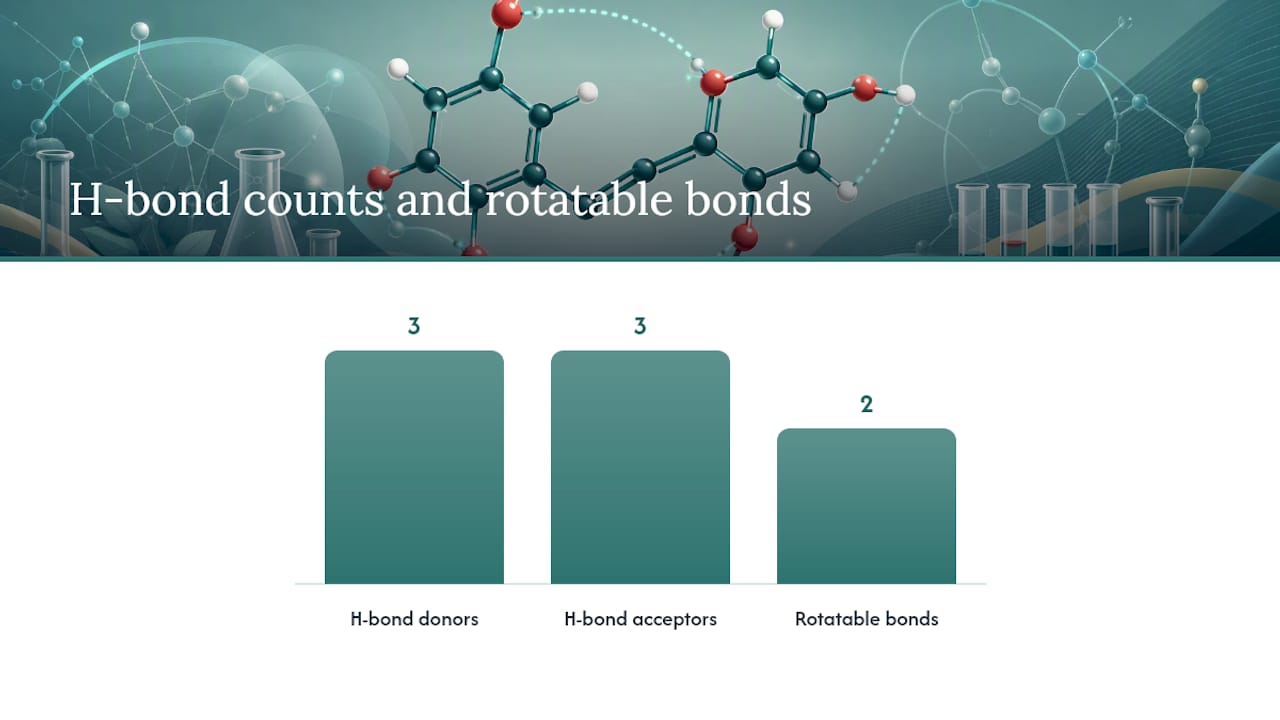
| H-bond donors | 3 | LipidMaps LMSD |
| H-bond acceptors | 3 | LipidMaps LMSD |
| Rotatable bonds | 2 | LipidMaps LMSD |
| Van der Waals volume | — | LipidMaps LMSD |
A logP of 2.97 places resveratrol in the moderately lipophilic range, consistent with its poor aqueous solubility and preference for organic solvents in stock preparation. The TPSA of 60.69 Ų falls below the 140 Ų threshold associated with poor passive membrane permeability, which partly explains its intestinal absorption despite low aqueous solubility. Three H-bond donors (the three hydroxyl groups) contribute to its antioxidant activity and also to its tendency to bind polar stationary phases in reversed-phase HPLC.
Trans vs cis: which isomer matters for research?
Trans-resveratrol (E-isomer) is the predominant form in plant tissues and the isomer with established biological activity. The cis (Z) form occurs at lower concentrations and is generally considered a photodegradation product rather than a target compound. The Linus Pauling Institute notes that the pharmacological literature focuses on the trans isomer.
Solubility, stability, and safe handling in the laboratory
Trans-resveratrol is lipophilic with poor water solubility, a consequence of its logP of 2.97. Aqueous stock solutions are not practical above low micromolar concentrations without co-solvents. The compound is rapidly conjugated after absorption (glucuronidation and sulfation), which is relevant context when designing in vitro assays intended to model in vivo conditions.
Stability considerations
Photosensitivity is the primary stability concern. Research published in the Journal of Agricultural and Food Chemistry documents that trans-resveratrol remains stable for months when protected from light, whereas the cis isomer is considerably less stable and degrades further at alkaline pH. Temperature and oxygen also accelerate degradation; storage under an inert atmosphere (argon or nitrogen) at −20 °C is standard for long-term reference standards.
Storage and handling checklist:
- Store in amber glass vials or opaque containers to block UV and visible light
- Keep at −20 °C for long-term storage; −80 °C for reference standards requiring maximum stability
- Use inert atmosphere (argon or nitrogen blanketing) for extended storage
- Avoid alkaline conditions; pH 7 or below is preferable for aqueous preparations
- Aliquot stock solutions to minimise freeze-thaw cycles
Solvent guide for stock preparation
| Solvent | Approximate solubility | Recommended use |
|---|---|---|
| DMSO | ~50 mg/mL | Cell-based assays (dilute before use) |
| Ethanol | ~20 mg/mL | Spectroscopic and stability studies |
| Methanol | ~15 mg/mL | HPLC mobile-phase preparation |
| Acetonitrile | ~10 mg/mL | LC-MS/MS sample preparation |
| Water | <0.05 mg/mL | Not recommended as sole solvent |
Pro Tip: Prepare DMSO stocks at ≥10 mM, then dilute into aqueous buffer immediately before use. Pre-warming the buffer to 37 °C before adding the DMSO aliquot reduces precipitation at the point of mixing.
Spectral data for identification and purity assessment
UV-Vis absorption
Trans-resveratrol shows a strong absorption band at λmax ≈ 308 nm in ethanol, with a molar absorptivity (ε) of approximately 30,000 L·mol⁻¹·cm⁻¹. The cis isomer absorbs at λmax ≈ 288 nm with ε ≈ 12,600 L·mol⁻¹·cm⁻¹, as reported in the Journal of Agricultural and Food Chemistry. The approximately 20 nm bathochromic shift for the trans isomer reflects the greater conjugation of the planar E configuration. This difference is sufficient for quantification by UV detection in HPLC and for rapid isomer screening by UV-Vis spectrophotometry.
NMR reference shifts
| Nucleus | Key signals | Assignment |
|---|---|---|
| ¹H (400 MHz, DMSO-d₆) | — | Phenolic OH protons |
| — | H-2’/H-6’ (4-hydroxyphenyl) | |
| — | Vinyl H (trans) | |
| — | Vinyl H (trans) | |
| — | H-3’/H-5’ | |
| — | H-2/H-6 (resorcinol) | |
| — | H-4 (resorcinol) | |
| ¹³C (100 MHz, DMSO-d₆) | — | Oxygenated aromatic carbons |
| — | Vinyl carbons | |
| — | Aromatic CH carbons |
The vinyl coupling constant of J ≈ 16 Hz confirms the trans configuration. Consult primary literature for complete ¹³C assignments and solvent-dependent shift corrections.
IR and MS key markers
IR (KBr disc) key bands:
- Broad O-H stretch: 3200–3500 cm⁻¹
- Aromatic C=C stretch: 1590–1610 cm⁻¹
- Trans C=C (vinyl): 960–970 cm⁻¹ (strong out-of-plane deformation, diagnostic for E geometry)
- C-O stretch (phenolic): 1230–1260 cm⁻¹
MS fragmentation (ESI negative mode, [M-H]⁻ = 227.07):
- m/z 227.07 → 185.06 (loss of CO₂, 42 Da)
- m/z 227.07 → 143.05 (loss of two CO₂ units)
- m/z 227.07 → 107.05 (4-hydroxyphenyl fragment)
These fragments are standard reference ions for LC-MS/MS multiple reaction monitoring (MRM) methods targeting resveratrol in plant extracts or biological matrices.
Where can you obtain crystallographic data and 3D coordinates?
X-ray crystal structures of trans-resveratrol are deposited in multiple repositories. The PDBj STL entry provides composition data (formula C₁₄H₁₂O₃, formula weight 228.243 Da), model coordinate viewers, and links to external crystallographic databases for CIF download.
Repository comparison
| Repository | Entry | Best use |
|---|---|---|
| PDBj (PDB component STL) | STL | Quick coordinate viewer; links to CIF |
| CCDC (Cambridge Structural Database) | Search by CAS 501-36-0 | Full CIF with R-factor and thermal parameters |
| PubChem 3D Conformer | CID 445154 | Computed conformer for docking/modelling |
| COD (Crystallography Open Database) | Search by formula C14H12O3 | Open-access CIF downloads |
When evaluating a CIF file, check:
- R-factor: values below 0.05 indicate high-quality refinement
- Resolution and temperature: room-temperature vs. low-temperature (100 K) structures differ in thermal displacement parameters
- Hydrogen positions: confirm whether H atoms were located from difference Fourier maps or placed geometrically
- Space group and Z’: multiple molecules in the asymmetric unit (Z’ > 1) can indicate polymorphism
Modelling import notes:
- Convert CIF to PDB using Mercury (CCDC) or OpenBabel before loading into GROMACS or AMBER
- Assign partial charges (e.g. AM1-BCC via Antechamber) after conversion; CIF files do not carry force-field parameters
- Match protonation state to your target pH: all three hydroxyl groups are protonated at physiological pH (pKa values > 8)
Purification and analytical verification
- Recrystallisation: ethyl acetate/hexane mixtures give colourless needles of the trans isomer with high purity
- Column chromatography: silica gel with ethyl acetate/hexane gradients (typically 1:3 to 1:1 v/v) separates trans from cis and by-products
- HPLC verification: C18 column, acetonitrile/water gradient, UV detection at 306 nm; trans-resveratrol elutes at a characteristic retention time that should match a certified reference standard
- Melting point: trans-resveratrol melts at 253–255 °C; a depressed or broad melting point indicates impurity or cis-isomer contamination
Avoiding photoisomerisation during work-up:
- Conduct all evaporation and chromatography steps under subdued yellow light or in a darkened fume hood
- Use amber glassware throughout
- Confirm trans-isomer content by ¹H NMR (vinyl J ≈ 16 Hz) and UV-Vis (λmax ≈ 308 nm) before storing the final product
Key takeaways
Trans-resveratrol (C₁₄H₁₂O₃, CAS 501-36-0, PubChem CID 445154) is the pharmacologically relevant isomer, identifiable by its vinyl coupling constant of J ≈ 16 Hz and UV λmax at 308 nm, and must be stored in the dark at −20 °C to maintain integrity.
| Point | Details |
|---|---|
| Canonical identifiers | Formula C₁₄H₁₂O₃, CAS 501-36-0, PubChem CID 445154, InChIKey LUKBXSAWLPMMSZ-OWOJBTEDSA-N. |
| Trans isomer is the target | The E-isomer (vinyl J ≈ 16 Hz, λmax 308 nm) is the research standard; cis presence indicates photodegradation. |
| Solubility and stock prep | logP 2.97; use DMSO (~50 mg/mL) or ethanol (~20 mg/mL) for stocks; water alone is not viable. |
| Spectral signposts | UV λmax 308 nm (ε ≈ 30,000); ESI [M-H]⁻ = 227.07; IR vinyl band at 960–970 cm⁻¹ confirms E geometry. |
| Structure file sources | Download SDF/MOL from PubChem CID 445154; CIF from CCDC (CAS 501-36-0) or PDBj STL entry. |
A practical note on sourcing and quality assurance
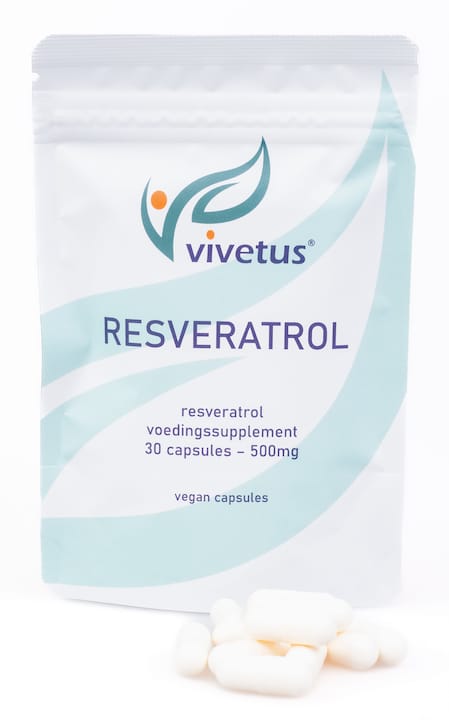
Structural purity on paper and structural purity in the vial are two different things. When Vivetus evaluates trans-resveratrol for its supplement formulations, the specification checklist goes beyond a simple purity percentage. The trans-isomer content matters as much as overall purity: a batch that is 98% pure by total polyphenol content but contains 10% cis-resveratrol is not fit for purpose in research or in a quality supplement.
The minimum vendor documentation worth requesting includes an HPLC chromatogram with baseline separation of trans and cis peaks, a certificate of analysis stating trans-isomer percentage explicitly, packaging details confirming amber or opaque containers with inert-gas blanketing, and a stated storage temperature from manufacture to delivery. Certificates that list only “purity ≥98%” without isomer breakdown should prompt further questions.
For researchers cross-referencing structural data with supplement-grade material, Vivetus publishes its resveratrol product specification and applies the same analytical standards described in its clinical research approach. The compound’s comparison with structurally related stilbenoids such as pterostilbene is also covered in the Vivetus knowledge base for those working across the stilbene class.
Useful sources
The databases and literature below are the primary destinations for raw files, spectra, and deposition records.
- Resveratrol | C14H12O3 | CID 445154 - PubChem - NIH
- resveratrol (CHEBI:27881)
- Resveratrol | Linus Pauling Institute
- Resveratrol: Isomeric molar absorptivities and stability | Journal of Agricultural and Food Chemistry
- Structure database (LMSD) — Resveratrol
- PDB chemical components / STL — resveratrol | PDBj
- Natural occurrence and concentrations of resveratrol | PMC
- trans-resveratrol | C14H12O3 — ChemSpider
For publication-grade data, always cite the original crystal structure paper and the primary spectral reference rather than a database record alone. Database entries aggregate and may lag behind corrected depositions.