

Lower Homocysteine: TMG 3–6 g Cuts Levels 10–14%
Yes, TMG (trimethylglycine, also called betaine) lowers plasma homocysteine, with trials showing reductions of roughly 10% to 14% at doses of 3 to 6 grams per day. If your homocysteine is elevated beyond normal levels, TMG supplementation alongside adequate folate and B12 is a reasonable, evidence-backed step. The sensible starting point is a blood test, not a supplement order.
TL;DR:
- TMG doses of 3 to 6 grams daily reliably lower plasma homocysteine by about 10% to 14%, with effects visible within three weeks.
- TMG works independently of folate and B12, making it especially beneficial for MTHFR variant carriers and those with elevated homocysteine despite adequate B-vitamin intake.
- Combining TMG with folate and B12 supplements produces a modest, additive reduction in homocysteine but does not yet show proven improvements in vascular health markers.
- Side effects are typically gastrointestinal and dose-dependent, with high doses potentially raising methionine levels, requiring cautious escalation under medical supervision.
- Long-term effects and the impact on cardiovascular outcomes remain unconfirmed, so testing and monitoring are essential for targeted, responsible use.
Table of Contents
- What is TMG homocysteine metabolism, and how does betaine lower it?
- What do clinical trials show about TMG and homocysteine?
- Who actually benefits from TMG supplementation for homocysteine?
- How much TMG should you take, and how do you monitor it?
- Is TMG safe, and what side effects should you expect?
- How does Vivetus approach TMG for methylation support?
- What questions about TMG and homocysteine remain unanswered?
- Where to find Vivetus TMG and what to check before you start
- Primary sources and further reading
- Sources
- FAQ
What is TMG homocysteine metabolism, and how does betaine lower it?
Betaine, also sold as TMG, lowers homocysteine through a single, well-mapped enzymatic reaction. The enzyme betaine-homocysteine methyltransferase, known as BHMT, sits in your liver and kidneys and does one job: it strips a methyl group off betaine and hands it to homocysteine. That reaction converts homocysteine into methionine, a useful amino acid your body needs for building proteins and regenerating SAMe, the compound behind hundreds of methylation reactions. The leftover betaine molecule becomes dimethylglycine, which is harmlessly cleared.

This is what separates TMG from folate and B12. Those two vitamins support a different route, the folate-dependent remethylation pathway, where the enzyme methionine synthase (MTR) uses 5-methyltetrahydrofolate and a vitamin B12 cofactor to do essentially the same conversion. Homocysteine sits at the junction of both routes, and your body normally clears it through whichever pathway has the most capacity available at that moment. A review of betaine’s role in homocysteine metabolism notes that betaine’s independence from folate status is precisely why it works even when someone has a genuinely impaired folate cycle.
That independence matters for anyone carrying a common variant in the MTHFR gene, particularly the C677T polymorphism, which reduces the activity of the enzyme that produces active folate. If your folate-dependent remethylation is running below capacity, the BHMT pathway becomes a second lane on the same road, one that does not care what your folate levels are doing. TMG will not fix a folate deficiency, but it can pick up methylation demand that the folate route cannot handle alone.
Practically, this creates a few useful implications:
- TMG works additively alongside methylfolate and B12 rather than competing with them, so combining the three is common practice rather than redundancy.
- Anyone with a confirmed MTHFR variant and persistently elevated homocysteine has a mechanistic reason to consider TMG specifically, rather than simply raising folate intake further.
- People taking NAD+ precursors like NMN consume methyl groups during the metabolism of nicotinamide. TMG is often used as a low-cost way to help replenish that methyl-donor supply, though this application has not been directly tested in trials.
- The dimethylglycine by-product has no known negative effects at typical supplemental doses.
None of this means TMG is a universal fix. It is one lane of methylation traffic, and if your homocysteine is elevated for reasons unrelated to methyl-donor supply, such as poor kidney clearance or thyroid dysfunction, TMG will do little on its own.
What do clinical trials show about TMG and homocysteine?
The evidence for TMG lowering homocysteine is genuinely solid, built on repeated dose-response data rather than a single flattering study. The clearest picture comes from a controlled trial in healthy volunteers testing 1, 3, and 6 grams of betaine daily against homocysteine levels.
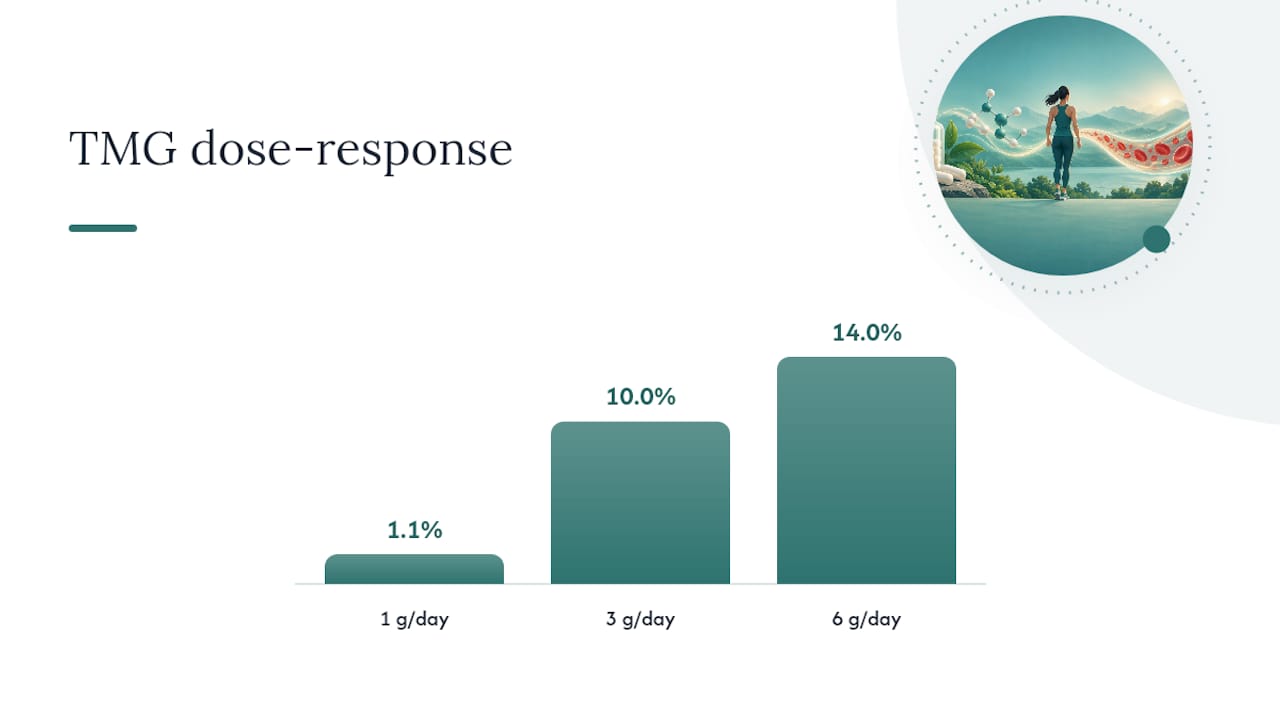
Dose-response snapshot: in that trial, 1 g/day produced a statistically insignificant 1.1% drop, 3 g/day produced a 10.0% reduction, and 6 g/day produced a 14.0% reduction in plasma total homocysteine, according to the dose-response study published in the British Journal of Nutrition. Combining folic acid with betaine produced additional modest reductions, confirming the two pathways work in parallel rather than in competition.
That dose-response curve is the single most useful number in this whole topic, because it tells you that below roughly 3 g/day, TMG’s homocysteine-lowering effect is barely distinguishable from noise. This is a threshold effect, not a linear one.
Separate research backs the magnitude and speed of the response. A randomised trial in young, physically active men found that several weeks of betaine supplementation reduced homocysteine levels meaningfully, a meaningful shift achieved in a relatively short window, and one that came with no detrimental effect on lipid profile in that group. A separate crossover study comparing betaine directly against folic acid found betaine lowered homocysteine moderately, while folic acid produced a somewhat larger reduction, according to research on folic acid and betaine supplementation and vascular function.
That last trial also delivers the most important caveat in the entire evidence base: betaine and folic acid supplementation did not improve vascular function measures, a standard measure of how well blood vessels dilate in response to increased blood flow, despite both agents lowering homocysteine substantially. This is the gap between a surrogate marker and a hard outcome. Homocysteine is easy to measure and reliably responds to betaine. Whether that biochemical change translates into a measurably healthier blood vessel, let alone fewer cardiovascular events, is a separate question the trial evidence has not yet answered convincingly.
A further trial combining low-dose B vitamins with 1 gram of betaine daily for 12 weeks in adults with elevated homocysteine (hyperhomocysteinemia) found around a 10% reduction, reinforcing that combined approaches perform reliably in people who actually start with a problem to fix, according to research on B vitamins plus betaine for lowering homocysteine. That is a meaningfully different population from healthy volunteers with normal baseline levels, and it is worth remembering that most trials measure homocysteine as a surrogate endpoint rather than tracking heart attacks or strokes directly. Long-term outcome data, spanning years rather than weeks, simply does not exist yet for TMG specifically.
Who actually benefits from TMG supplementation for homocysteine?
Not everyone needs this. TMG is a targeted tool, and matching it to the right person is where most of the practical value lies.
The clearest candidates are people with a blood test showing homocysteine above roughly 15 µmol/L despite already eating adequately and taking standard B-vitamin support. If your folate and B12 status looks fine on paper and your homocysteine is still raised, you have a methylation bottleneck that folate alone will not fix, and TMG addresses that gap directly through the BHMT route.
Carriers of the MTHFR C677T variant, particularly those homozygous for it, form the second clear group. Reduced enzyme activity in the folate-dependent pathway means the BHMT route matters more for this group than for people with normal MTHFR function, and it is a specific, testable reason to prioritise TMG over simply increasing folate dose.
A third group is more precautionary than corrective: people using NAD+ precursors such as NMN. Nicotinamide metabolism consumes methyl groups, and some practitioners recommend TMG as a form of methyl-donor insurance for heavy NMN users, though this specific use case has not been tested in a dedicated clinical trial. It is a reasonable, low-risk hypothesis rather than a proven necessity.
- Elevated homocysteine (above roughly 15 µmol/L) on a recent blood panel, despite adequate B-vitamin intake.
- Confirmed MTHFR C677T variant, especially homozygous carriers, with any degree of homocysteine elevation.
- Regular use of NMN or other NAD+ precursors, as precautionary methyl-donor support.
- Family history of early cardiovascular disease combined with a borderline homocysteine reading.
If your last homocysteine test came back within the normal range and you have no specific methylation demand, TMG will not offer a meaningful additional benefit. Supplementing a system that already has plenty of methyl-donor capacity rarely moves the needle.
Pro Tip: Ask your GP or lab for a plasma total homocysteine test specifically, not a general metabolic panel. Many standard blood panels do not include it by default, so it has to be requested.
How much TMG should you take, and how do you monitor it?
The trial evidence gives you an unusually clear dosing map, which is rare in the supplement world.
A pragmatic approach, rather than jumping straight to trial-level doses, looks like this:
- Test first. Get a plasma total homocysteine reading before starting anything. Without a baseline, you cannot tell whether a supplement is doing anything at all.
- Start conservatively. Begin at 500 mg to 1 g per day for one to two weeks to check tolerance, particularly gastrointestinal comfort, before increasing.
- Move toward the effective range gradually. If tolerated well, step up toward 1 to 3 g per day, the range where meaningful effects begin to appear in the dose-response data.
- Reassess at 4 to 8 weeks. Repeat the homocysteine test after roughly a month to two months. The 21-day trial in healthy men showed a measurable drop within three weeks, so a two-month checkpoint should reveal whether your dose is working.
- Adjust with supervision, not guesswork. Only push toward the higher end of the trial range, 6 g per day, with clinical input and repeat testing, rather than assuming more is automatically better.
- Keep folate and B12 in the picture. Combining TMG with adequate methylfolate and B12 covers both remethylation routes simultaneously, which the dose-response data suggests produces a modestly larger effect than betaine alone.
The practical lesson from the trial data is that patience matters more than dose escalation. Jumping straight to 6 g per day without testing wastes the one piece of information, your actual homocysteine number, that tells you whether the supplement is worth taking at that dose at all. A clinician becomes particularly useful if your baseline homocysteine is markedly high (above 30 µmol/L), since that level of elevation often warrants investigation beyond simple methyl-donor supplementation.
Is TMG safe, and what side effects should you expect?
TMG has a reassuring safety profile at the doses used in trials, but it is not free of side effects, and they scale with dose. The most common issues are gastrointestinal: diarrhoea, indigestion, bloating, cramping, nausea, and occasionally vomiting, and these become more frequent as the dose climbs toward the higher end of the trial range, according to a breakdown of TMG side effects and dosage.
What the safety data actually shows: in the 21-day betaine trial in young, physically active men, supplementation produced no detrimental effect on lipid profile, based on that group’s blood biomarker results. That is a reassuring finding, but it comes from one population over three weeks, not a long-term, broadly representative sample.
Other research on betaine, drawn largely from its clinical use in the inherited disorder homocystinuria at much higher therapeutic doses, flags a different concern: excessive betaine intake can raise methionine levels, the very amino acid homocysteine converts into. This is rarely relevant at typical supplemental doses of 1 to 6 g per day, but it is a reason not to self-escalate far beyond trial-tested amounts without guidance.
Points worth keeping in mind before starting:
- GI symptoms are dose-dependent and usually improve by starting low and increasing gradually.
- Lipid effects across the research are mixed rather than uniformly reassuring, so anyone with existing dyslipidaemia should monitor lipids alongside homocysteine.
- Excessive, sustained high-dose intake can raise methionine, a concern mainly relevant at doses well above the typical supplemental range.
- Those who are pregnant or have severe liver conditions should consult a healthcare provider before using TMG., since methionine and homocysteine handling both involve liver-dependent pathways.
How does Vivetus approach TMG for methylation support?
Vivetus positions TMG as a methylation support supplement rather than a standalone cardiovascular treatment, reflecting exactly what the trial evidence supports. The Vivetus TMG (Betaine) collection offers a straightforward 500 mg capsule format designed to make dose titration manageable, since building up gradually from a low starting point is the approach the dose-response research favours.
Vivetus’s own guidance material, including its post on TMG and NMN together, addresses the specific question of methyl-donor demand in NAD+ precursor users, and its companion piece on TMG’s mechanism and a 3 g starting dose walks through the practical dosing logic that mirrors the clinical dose-response data covered above.
The consistent message across this guidance is the same one the trials support: TMG is a complement to folate and B12, not a replacement, and dosing decisions should follow testing rather than guesswork.
What questions about TMG and homocysteine remain unanswered?
The uncomfortable truth in this field is that lowering homocysteine and improving cardiovascular health are not automatically the same thing. Trials repeatedly show betaine and folic acid dropping homocysteine by double digits, yet flow-mediated dilation, a real measure of vascular function, stays unchanged. That gap matters because homocysteine is a marker, not a mechanism proven to cause vascular damage on its own. It is entirely possible that elevated homocysteine is a signal of something else going wrong metabolically, rather than the direct culprit, in which case lowering the marker without addressing the underlying driver would explain the disconnect between biochemical improvement and unchanged vascular function.
Three gaps stand out. First, nobody has run a long-term trial tracking actual cardiovascular events, heart attacks, strokes, mortality, in people using TMG specifically over years rather than weeks. Second, genotype-specific response data is thin. We know MTHFR carriers have a mechanistic reason to respond differently to TMG, but head-to-head trials confirming a larger benefit in that group are still lacking. Third, safety at sustained high doses over months or years, rather than the three-week windows most trials use, remains underexplored.
None of that makes TMG a bad choice. It makes it a targeted, evidence-supported intervention for a measurable biochemical marker, used most sensibly by testing first, treating genuinely elevated levels, and monitoring the response rather than assuming a downstream cardiovascular benefit that the current evidence has not yet confirmed.
— Jord
Where to find Vivetus TMG and what to check before you start
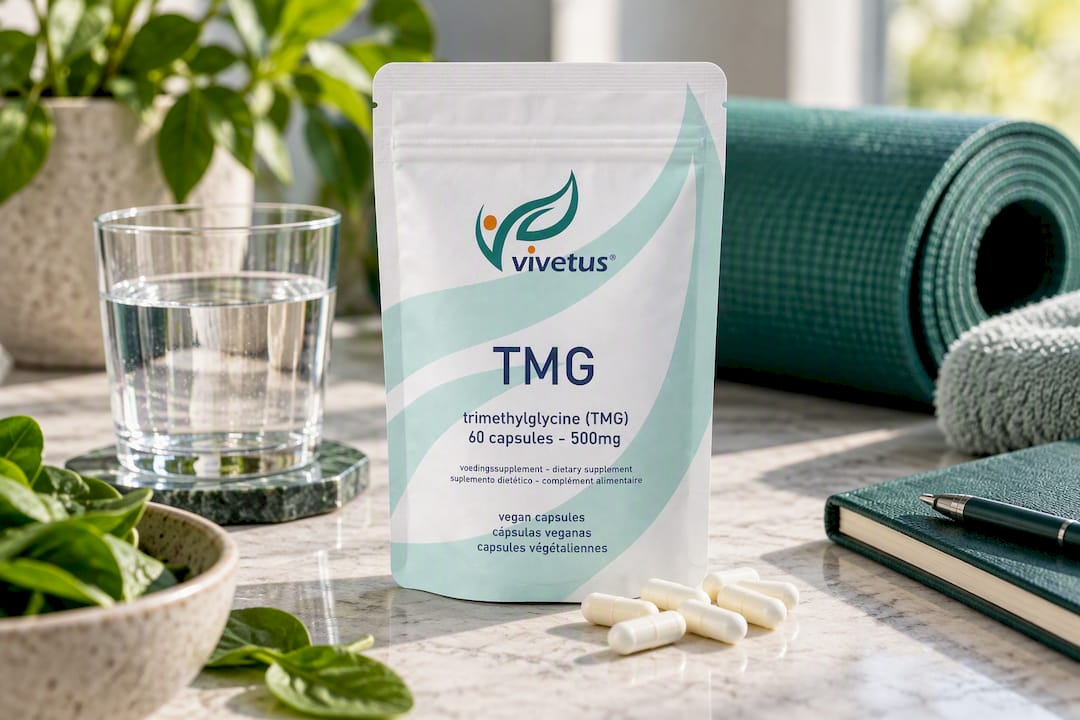
Vivetus sells its methylation support as a straightforward, no-frills product: Vivetus® Trimethylglycine (TMG), 60 capsules at 500 mg each, formulated to let you build up from a low dose the way the dose-response trials suggest rather than starting at the top of the range.
Where a generic TMG tub gives you a number on a label and nothing else, Vivetus pairs the capsule with its own dosing guidance built directly from the trial data, so you are not left guessing how many capsules equal a meaningful 3 g dose. If you are already taking NMN for cellular energy support, that pairing is exactly what Vivetus’s methylation guidance addresses. Readers weighing up broader antioxidant support alongside methylation might also look at Vivetus® Resveratrol, Vivetus® Fisetin, or Vivetus® Quercetin, all part of the same vegan, clinically-backed product range. Free shipping applies on orders over €50 across the Vivetus catalogue.
Before you order, get a plasma homocysteine test done so you have a real baseline to compare against in four to eight weeks. Then visit the TMG product page to check the current capsule count and starting-dose guidance, and reach out to Vivetus customer support if you have questions about combining TMG with other supplements in your routine.
Primary sources and further reading
The dosing and effect-size claims in this article rest primarily on the British Journal of Nutrition dose-response trial, which established the 1, 3, and 6 g/day response curve, and the three-week betaine trial in physically active men, which confirmed both the speed of the response and the absence of adverse lipid effects. The crossover trial on folic acid and betaine supplies the key caveat about vascular function, while the review of betaine in homocysteine metabolism grounds the BHMT mechanism explained throughout. Safety details draw on a consumer-facing dosage and side-effect summary.
This article is general information, not a substitute for advice from a qualified doctor. Consult a qualified healthcare professional about your own circumstances before acting on anything here.
Sources
- Dose�response study of betaine on plasma homocysteine in healthy volunteers — British Journal of Nutrition
- Effect of folic acid and betaine supplementation on flow-mediated dilation — PLOS Clinical Trials
FAQ
Does TMG reduce homocysteine levels?
Yes. Controlled trials show betaine (TMG) reduces plasma homocysteine, with a clear dose-response relationship: 1 g/day produces little effect, while 3 and 6 g/day produce roughly 10% and 14% reductions respectively. Response can appear within three weeks of consistent use.
What are the negative effects of TMG?
The most common side effects are gastrointestinal, including diarrhoea, nausea, bloating, and indigestion, and these become more frequent at higher doses. Sustained excessive intake can raise methionine levels, and lipid effects across studies are mixed rather than consistently neutral.
What is the best supplement to reduce homocysteine?
There is no single best option; folate, vitamin B6, and B12 support one remethylation pathway, while TMG (betaine) supports a separate, folate-independent route through the BHMT enzyme. Trial evidence shows folic acid can produce a somewhat larger reduction than betaine alone, which is why combining B vitamins with TMG is common practice rather than choosing one over the other. Vivetus sells its own TMG (Betaine) capsules formulated for this combined approach.
Is TMG good for people with MTHFR issues?
TMG is particularly relevant for people with MTHFR variants, since it lowers homocysteine through the BHMT pathway, which does not depend on the folate-processing step that MTHFR affects. This gives people with reduced MTHFR enzyme activity a working alternative route for methylation support, though genotype-specific response trials are still limited.