

Fish oil for elderly: what older adults and carers need to know
TL;DR:
- Most older adults can safely take low-to-moderate doses of fish oil to manage triglycerides, with limited evidence for broad cardiovascular prevention.
- Benefits are strongest for triglyceride reduction and depend on baseline omega-3 status, while risk of atrial fibrillation increases above 1 g/day.
Most older adults can safely use fish oil at low-to-moderate doses for triglyceride control, and there are emerging signals for cognitive and frailty outcomes. The evidence is strongest for triglyceride reduction and weakest for broad cardiovascular prevention. The dose and your medical history matter considerably.
Before starting, check these three points:
- You take warfarin, a direct oral anticoagulant, or an antiplatelet medicine: speak to your GP first, as fish oil can increase bleeding tendency.
- You have a history of atrial fibrillation or unexplained palpitations: doses above low moderate levels carry a dose-dependent AF signal in pooled trial data.
- You have no recent lipid results: a baseline triglyceride and omega-3 index test helps you decide whether supplementation is likely to produce a measurable benefit.
Table of Contents
- What does the evidence say about benefits for older adults?
- Who is most likely to benefit from omega-3 supplements?
- What dose of fish oil is right for older adults?
- Safety concerns and drug interactions older adults should know
- How to choose a quality fish oil supplement in Central Europe
- How to take fish oil and when to expect results
- When should you discuss fish oil with your GP?
- What recent European guidance means for older adults in Central Europe
- Key takeaways
- A practical note on fish oil and what Vivetus prioritises
- Vivetus supplements for older adults who want clarity, not guesswork
- Useful sources and further reading
What does the evidence say about benefits for older adults?
The picture is mixed, and the strength of evidence varies considerably by outcome. Triglyceride lowering is the most consistent finding across trials. Cardiovascular event prevention is far less clear, and the European Medicines Agency has concluded that omega-3 fatty acid medicines are no longer considered effective for primary prevention of heart disease or stroke, though they remain authorised for reducing high triglycerides.
| Outcome | Evidence strength | Key finding |
|---|---|---|
| Triglyceride reduction | Strong | Consistent across trials; EPA+DHA reliably lower triglycerides |
| Major cardiovascular events | Mixed | Large trials show inconsistent results; purified EPA products show some benefit in specific high-risk groups |
| Cognition and dementia prevention | Mixed | Benefit depends on baseline omega-3 index; no overall MMSE improvement across all trials |
| Frailty and muscle maintenance | Limited | Positive signals in some studies; not yet definitive |
Cognition note: A 2023 meta-analysis found that cognitive benefit from omega-3 supplementation was concentrated in older adults with a measurable rise in their omega-3 index after supplementation, which underlines why a baseline test changes the clinical conversation.
The OMEMI trial, which randomised older post-MI patients to 1.8 g/day of omega-3 PUFA, found no reduction in the composite primary cardiovascular endpoint versus placebo. This result illustrates why the benefits of fish oil for older adults cannot be assumed from triglyceride data alone. Prescription purified EPA products (icosapent ethyl) show a more consistent signal for reducing major cardiovascular events in specific high-risk groups, but that evidence does not transfer directly to standard over-the-counter omega-3 supplements.
Who is most likely to benefit from omega-3 supplements?
Not every older adult will see a measurable return from supplementation. The profile that tends to benefit most is specific.
Profiles more likely to benefit:
- People with confirmed high triglycerides (above 1.7 mmol/L) who are not yet on prescription therapy
- Older adults with a documented low omega-3 index (below 4%), particularly those with limited oily fish intake
- Post-MI patients under specialist supervision where prescription icosapent ethyl has been indicated
- Those with early cognitive decline and a confirmed low baseline omega-3 status
Profiles less likely to see clear benefit:
- Well-nourished older adults who eat oily fish two or more times per week
- People with no cardiovascular risk factors and normal triglyceride levels
- Those already on prescription omega-3 therapy
Quick self-screening checklist:
- How many portions of oily fish (salmon, mackerel, sardines, herring) do you eat per week?
- Do you have recent lipid results showing triglycerides above normal range?
- Are you on warfarin, a DOAC, or an antiplatelet such as aspirin or clopidogrel?
- Do you have a history of atrial fibrillation or irregular heartbeat?
If you answered yes to either of the last two questions, a GP conversation is the right first step, not a supplement purchase.
Pro Tip: Ask your GP or practice nurse for an omega-3 index test alongside your next lipid panel. It costs relatively little and removes the guesswork about whether you are already getting adequate EPA and DHA from your diet. Vivetus covers the science behind omega-3 and ageing in more detail if you want the background before your appointment.
What dose of fish oil is right for older adults?
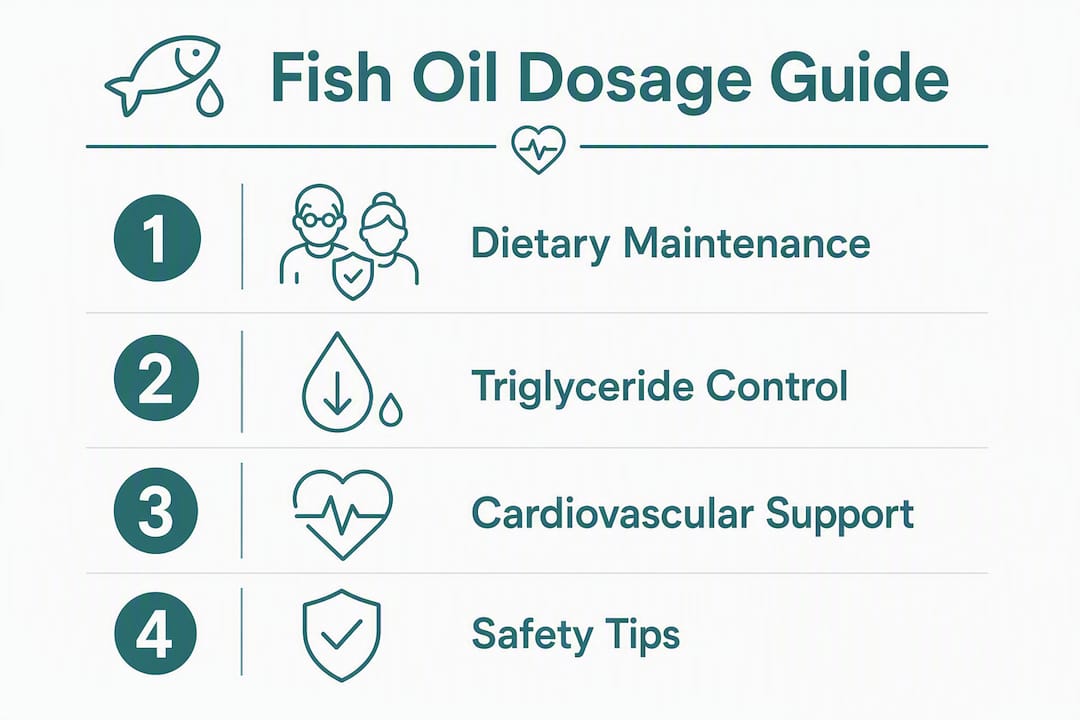
Dose ranges differ significantly depending on the goal. The table below sets out the three main tiers.

| Goal | Daily EPA+DHA dose | Notes |
|---|---|---|
| Dietary maintenance | 500 mg combined | Achievable from two portions of oily fish per week |
| General supplement maintenance | 500–1,000 mg combined | Typical OTC capsule range; suitable for most healthy older adults |
| Triglyceride lowering | 2–4 g/day | Requires clinical supervision; prescription products preferred at this level |
| Prescription icosapent ethyl (Vazkepa) | 4 × 998 mg capsules/day | No routine dose adjustment needed for older adults; specialist prescribed only |
Understanding the label: A capsule labelled “1,000 mg fish oil” does not contain 1,000 mg of EPA+DHA. The EPA and DHA content is always lower, often 300–600 mg combined per capsule depending on concentration. Always read the line that states EPA and DHA separately in milligrams, not the total fish oil weight.
Supplement forms explained simply:
- Triglyceride (TG) form: the natural form found in fish; generally absorbs well, particularly with a fatty meal.
- Ethyl ester (EE) form: a processed form used in many OTC products and all prescription omega-3 medicines; absorption is lower without dietary fat.
- Re-esterified triglyceride (rTG) form: a reprocessed form with absorption closer to natural TG; found in some premium products.
Dose caution: Meta-analyses and the EMA’s direct healthcare professional communication identify a dose-dependent increase in atrial fibrillation risk, with the highest signal at approximately 4 g/day and a detectable signal above approximately 1 g/day in some pooled analyses. At general supplement maintenance doses (500–1,000 mg/day), the risk for most healthy older adults remains low, but the signal is real and rises with dose.
Safety concerns and drug interactions older adults should know
Fish oil is well tolerated at low-to-moderate doses for most people, but older adults face specific risks worth knowing before starting.
Key safety signals:
- Gastrointestinal effects: fishy aftertaste, burping, loose stools, and mild nausea are the most common complaints, particularly at higher doses or when taken on an empty stomach.
- Bleeding tendency: fish oil has mild antiplatelet properties. At doses above 3 g/day, this effect becomes clinically relevant, particularly in people already on anticoagulants or antiplatelet medicines.
- Atrial fibrillation: the EMA’s direct healthcare professional communication confirms a dose-dependent AF risk with omega-3 ethyl ester medicines in patients with established cardiovascular disease or risk factors.
- Vitamin A and D toxicity: cod liver oil, unlike standard fish oil, contains significant amounts of vitamins A and D. Taking cod liver oil alongside other fortified foods or vitamin supplements can push fat-soluble vitamin intake above safe levels.
Drug interactions to check:
- Warfarin and vitamin K antagonists: fish oil may potentiate anticoagulant effect; INR monitoring is advisable.
- Direct oral anticoagulants (apixaban, rivaroxaban, dabigatran): theoretical additive bleeding risk; discuss with prescriber.
- Antiplatelet agents (aspirin, clopidogrel): combined use increases bleeding risk at higher fish oil doses.
- Some herbal supplements (ginkgo biloba, garlic extract): additive antiplatelet effects.
EFSA has assessed that combined EPA+DHA intakes up to 5 g/day do not raise safety concerns for healthy adults in terms of bleeding or immune function. That assessment applies to healthy adults without cardiovascular disease; the EMA’s AF signal applies specifically to patients with established cardiovascular disease or risk factors, so the two positions are not contradictory.
Contact your GP promptly if you notice: new or worsening palpitations, breathlessness at rest, unexplained bruising, or prolonged bleeding from minor cuts after starting fish oil.
How to choose a quality fish oil supplement in Central Europe
Central European packaging typically carries multilingual labels (German, Dutch, French, Polish, Czech, and English are common), and EU food supplement rules require the EPA and DHA content to be declared per serving. That declaration is your most important data point.
Purity matters: Third-party tested supplements consistently show contaminant levels well below safety thresholds, whereas high consumption of certain fish species carries a greater heavy-metal exposure risk than a refined, certified supplement.
Practical buying checklist:
- EPA and DHA stated separately in mg per serving: reject any product that only states total fish oil weight.
- Third-party certification: look for IFOS (International Fish Oil Standards), USP, or Eurofins batch-testing certificates, often verifiable on the manufacturer’s website via a lot number.
- Cod liver oil vs fish oil: if the product is cod liver oil, check the vitamin A content per daily dose. Intakes above 1,500 µg retinol/day are not recommended for older adults over extended periods.
- Allergen declaration: EU labelling requires fish to be declared as an allergen; shellfish allergy does not automatically mean fish allergy, but check with your GP if uncertain.
- Oxidation indicators: a rancid or very strong fishy smell on opening suggests oxidation; discard and choose a product with a better seal or nitrogen-flushed packaging.
- Subscription or bulk purchase: buying a three-month supply at once is cost-effective only if the product has a long remaining shelf life; check the best-before date.
For a broader look at how supplements fit into a senior nutrition plan, Vivetus has a practical dietary planning guide for seniors that covers both food sources and supplement choices.
How to take fish oil and when to expect results
Timing and administration:
- Take fish oil with a meal that contains fat. Absorption of ethyl ester forms in particular improves markedly with dietary fat present.
- If your daily dose is 2 g or more, split it across two meals rather than taking it all at once. This reduces GI side effects and may improve absorption.
- Store capsules in a cool, dark place; refrigeration after opening slows oxidation.
Realistic timelines:
- Triglycerides: measurable reduction typically appears within 4–12 weeks at doses of 2–4 g/day.
- Inflammation markers (CRP, IL-6): changes, where they occur, generally take 8–12 weeks to become detectable.
- Cognitive or frailty signals: early subjective changes, if any, are unlikely before 6–12 weeks; objective test changes in trials take longer.
Adherence tip: Fishy aftertaste is the most common reason people stop. Enteric-coated capsules, freezing capsules before swallowing, and taking them mid-meal rather than before or after all reduce this noticeably.
Monitoring: if you are taking fish oil for triglyceride control, a repeat fasting lipid panel at 8–12 weeks gives a clear read on whether the dose is working. If triglycerides have not moved, review dietary fat intake and adherence before increasing dose.
When should you discuss fish oil with your GP?
Some situations require a clinician’s input before you start, not after.
See your GP before starting if you have:
- A history of atrial fibrillation or any cardiac arrhythmia
- A current prescription for warfarin, a DOAC, or an antiplatelet medicine
- Surgery planned within the next four weeks (discuss stopping fish oil beforehand)
- A known allergy to fish or fish products
- Liver disease or a clotting disorder
Questions to bring to the appointment:
- “Do my current triglyceride or lipid results suggest I would benefit from omega-3 supplementation?”
- “Is an omega-3 index test appropriate given my diet and cardiovascular history?”
- “Does any of my current medication interact with fish oil at the dose I am considering?”
- “Would prescription icosapent ethyl be more appropriate than an OTC supplement for my lipid profile?”
- “How often should I recheck lipids or have an ECG if I start a higher dose?”
Asking specifically about monitoring intervals and stopping criteria is practical. A GP who knows you are taking fish oil can flag any new AF symptoms or bleeding signs in context.

What recent European guidance means for older adults in Central Europe
The EMA has issued two significant communications that directly affect how older adults and their clinicians should think about omega-3 products.
| Communication | Key finding | Practical implication |
|---|---|---|
| EMA DHPC on AF risk | Dose-dependent increased AF risk with omega-3 ethyl ester medicines; highest at ≈4 g/day, signal above ≈1 g/day in some analyses | Patients with cardiovascular disease or risk factors need clinician review before high-dose use |
| EMA referral on cardiovascular prevention | Prescription omega-3 medicines no longer considered effective for primary prevention of heart disease or stroke | “Heart health” marketing claims on OTC products are not backed by the same evidence as the triglyceride indication |
For Central Europe specifically: older adults on statins post-MI who are considering adding omega-3 supplementation should note that the OMEMI trial found no reduction in composite cardiovascular endpoints at 1.8 g/day in this population. The evidence for benefit in that group comes primarily from purified EPA products at prescription doses, not standard OTC fish oil.
The distinction between prescription omega-3 medicines and OTC supplements matters practically. Prescription icosapent ethyl (Vazkepa) is authorised for triglyceride reduction in adults whose triglycerides remain high despite statin therapy, at a dose of two 998 mg capsules twice daily. OTC fish oil products are food supplements, not medicines, and their EPA/DHA content, purity, and form vary considerably between brands.
A PMC review on fish oil administration in older adults notes that the evidence base for older populations specifically is thinner than for middle-aged adults, and that frailty, polypharmacy, and reduced renal function all modify the risk-benefit calculation in ways that general population trials do not capture.
Key takeaways
Fish oil for elderly adults offers clear benefit for triglyceride control at supervised doses, but cardiovascular event prevention evidence is mixed and AF risk rises dose-dependently above approximately 1 g/day.
| Point | Details |
|---|---|
| Triglycerides respond reliably | EPA+DHA at higher doses reliably lower triglycerides; this is the strongest evidence for fish oil use in older adults. |
| Cognitive benefit depends on baseline | Omega-3 supplementation improves cognition mainly in older adults with a low starting omega-3 index; test before supplementing. |
| AF risk is dose-dependent | The EMA confirms increased atrial fibrillation risk above approximately 1 g/day; people with cardiovascular disease or risk factors need clinician review. |
| Read the label carefully | Always check EPA and DHA in mg per serving, not total fish oil weight; choose third-party tested products with IFOS, USP, or Eurofins certification. |
| Vivetus for tested supplements | Vivetus offers lab-tested, purity-certified supplements with clear EPA/DHA labelling, suited to older adults who want evidence-backed options. |
A practical note on fish oil and what Vivetus prioritises
The evidence on omega-3 supplementation for older adults is genuinely nuanced. Triglyceride reduction is solid. Cognitive benefit is real but conditional on baseline status. Cardiovascular event prevention at OTC doses is not well supported by current European guidance. That complexity is why Vivetus takes the position that purity, clear labelling, and a clinician conversation matter more than marketing claims about “heart health.”
For older adults who cannot or prefer not to use fish-derived products, algal DHA is a well-established alternative that delivers DHA without the fish source, and it is the form used in most vegan omega-3 supplements. ALA from flaxseed, chia, and walnuts provides a plant-based omega-3 source, though conversion to EPA and DHA in the body is limited in older adults. Where triglycerides are significantly elevated and statin therapy has not resolved them, a clinician may prefer prescription icosapent ethyl over any OTC option.
Vivetus focuses on supplements with documented purity and transparent EPA/DHA content, which is the baseline any older adult should expect from a product they take daily. The nutritional supplements guide for healthy ageing on the Vivetus site covers the broader supplement context for older adults if you want to see how omega-3 fits alongside other evidence-backed options.
Vivetus supplements for older adults who want clarity, not guesswork
Older adults researching fish oil quickly discover that the supplement aisle offers little help: products vary in EPA/DHA content, form, and purity, and most labels bury the numbers that actually matter.

Vivetus addresses that directly. Every supplement in the Vivetus range is third-party tested for purity and states EPA and DHA content clearly per serving, so you know exactly what you are taking and at what dose. Free shipping applies to orders over €50, and subscription options make consistent daily use straightforward to manage. Whether you are a caregiver sourcing supplements for a parent or an older adult managing your own nutrition, Vivetus gives you the product information and lab-testing transparency to make an informed choice.
Browse the Vivetus supplement range and check the evidence-backed options suited to healthy ageing.
Useful sources and further reading
The sources below are the primary references used in this article. Each is authoritative for its specific area.
- EMA direct healthcare professional communication: omega-3 ethyl ester medicines and atrial fibrillation risk — the EMA’s formal safety advisory to clinicians on dose-dependent AF risk; essential reading for anyone prescribing or recommending higher-dose omega-3 products.
- EFSA safety assessment of long-chain omega-3 fatty acids — EFSA’s conclusion that intakes up to 5 g/day do not raise safety concerns for healthy adults; the reference point for OTC supplement safety boundaries.
- RSC Food & Function: omega-3 index and cognitive outcomes in older adults — the 2023 meta-analysis showing that cognitive benefit from supplementation depends on baseline omega-3 index; the key source for personalised supplementation decisions.
- PMC review: fish oil administration in older adults — a peer-reviewed clinical review covering the specific considerations for older populations, including polypharmacy and frailty.
- Merck Manual Professional Edition: fish oil — a balanced clinical summary of trial evidence, including mixed cardiovascular results and AF signals, written for healthcare professionals.
This article provides general information only and is not a substitute for professional medical advice. Confirm current guidance and your individual suitability with a qualified clinician or pharmacist before starting any supplement.