

Superaliments expliqués : ce qu’ils sont et pourquoi ils comptent
En résumé :
- Les superaliments sont des aliments à haute densité nutritionnelle, principalement promus par le marketing plutôt que par un consensus scientifique. Ils fournissent des composés bénéfiques comme des antioxydants, des bonnes graisses et des micronutriments, mais aucun aliment unique n’est une panacée. Manger régulièrement une variété d’aliments complets, peu transformés, soutient la santé à long terme plus efficacement que de se concentrer sur des produits superaliments exotiques ou emballés.
Le mot « superaliment » apparaît sur les emballages, les blogs santé et les programmes nutritionnels avec une confiance remarquable pour un terme qui n’a pas de définition scientifique formelle. Si vous voulez expliquer les superaliments avec précision, le point de départ honnête est le suivant : le concept décrit des aliments à densité nutritionnelle exceptionnellement élevée, mais le label lui-même est largement une construction marketing. Cet article fait le tri dans le bruit, expose la véritable valeur nutritionnelle derrière le terme, et vous montre comment utiliser ces aliments de manière sensée dans le cadre d’une alimentation qui soutient la santé et la vitalité à long terme.
Table des matières
- Principaux enseignements
- Les origines du label « superaliment »
- Ce qui rend un aliment exceptionnel sur le plan nutritionnel
- Mythes courants sur les superaliments
- Comment inclure les superaliments dans votre alimentation
- Mon point de vue sur la conversation autour des superaliments
- Soutenez votre nutrition avec Vivetus
- Questions fréquentes
Principaux enseignements
| Point | Détails |
|---|---|
| Aucune définition formelle n’existe | « Superaliment » est un terme marketing, pas une catégorie nutritionnelle ou scientifique reconnue. |
| La densité nutritionnelle est la véritable histoire | Les aliments obtiennent ce label grâce à de fortes concentrations de vitamines, minéraux, antioxydants et bonnes graisses. |
| Aucun aliment unique n’est une panacée | Les bienfaits des superaliments proviennent de schémas alimentaires constants, pas d’une consommation isolée. |
| Les aliments du quotidien sont aussi qualifiés | La plupart des fruits et légumes peuvent être considérés comme des superaliments en fonction de leur profil nutritionnel. |
| La variété l’emporte sur les aliments individuels | Un régime basé sur une variété d’aliments complets apporte plus de bénéfices mesurables que la recherche d’ingrédients à la mode. |
Les origines du label « superaliment »
Le mot « superaliment » circule depuis le début du XXe siècle, mais son statut actuel de mot à la mode dans l’alimentation est largement le fruit du marketing commercial plutôt que d’un consensus scientifique. Aucune définition convenue n’existe dans les sciences de la nutrition ou les cadres de santé publique. Cela importe car cela signifie que n’importe quel aliment peut techniquement être appelé superaliment par n’importe qui, à tout moment, pour n’importe quelle raison commerciale.
Les campagnes marketing ont largement contribué à cet effort. Les myrtilles, l’açaï, les baies de goji et le chou kale ont tous bénéficié d’investissements commerciaux importants pour atteindre leur statut de superaliments. Sur 76 études financées par l’industrie examinées dans une recherche sur le parrainage alimentaire, 70 favorisaient le produit promu. Ce n’est pas une raison pour rejeter la valeur nutritionnelle de ces aliments, mais c’est une raison de lire les allégations santé avec un certain scepticisme.
Les aliments les plus souvent décrits comme superaliments ont tendance à partager quelques caractéristiques :
- Concentrations exceptionnellement élevées de micronutriments par rapport à leur teneur en calories
- Profils antioxydants puissants, souvent liés à des couleurs naturelles vives
- Associations de recherche avec un risque réduit de maladies chroniques, y compris les maladies cardiaques et l'inflammation
- Disponibilité sous des formes premium ou transformées telles que poudres, capsules et boissons mélangées
« Étiqueter des aliments comme superaliments peut induire les consommateurs en erreur sur leur supériorité globale, alors que les preuves scientifiques se limitent à des propriétés nutritionnelles spécifiques. » — On Food Law
L'essentiel est que ce terme décrit un phénomène nutritionnel réel, mais sans limites standardisées. Les aliments concernés contiennent réellement des composés bénéfiques. Le problème réside dans l'écart entre ce que la science montre et ce que promet le marketing.
Ce qui rend un aliment exceptionnel sur le plan nutritionnel
Lorsque les nutritionnistes et diététiciens parlent d'aliments riches en nutriments, ils désignent des aliments qui fournissent une forte concentration de composés bénéfiques par rapport à leur teneur énergétique. C'est le cadre scientifique le plus clair pour comprendre ce que sont réellement les superaliments. Les composants nutritifs courants incluent les caroténoïdes, les flavonoïdes, les acides gras oméga-3, les probiotiques et les fibres, tous associés à une réduction de l'inflammation, une amélioration de la santé cardiaque et un renforcement du système immunitaire.
Le tableau ci-dessous vous donne un aperçu pratique de la comparaison nutritionnelle de certains des exemples les plus fréquemment cités :
| Aliment | Nutriments clés | Bénéfice principal pour la santé |
|---|---|---|
| Myrtilles | Anthocyanines, vitamine C, fibres | Protection antioxydante, santé cérébrale |
| Saumon | Acides gras oméga-3, vitamine D, protéines | Santé cardiaque, réduction de l'inflammation |
| Chou frisé | Vitamines K, A, C, calcium, fer | Santé osseuse, soutien immunitaire |
| Noix | Acides gras oméga-3, magnésium, polyphénols | Santé cardiovasculaire, fonction cognitive |
| Huile d'olive | Acides gras monoinsaturés, oléocanthal | Anti-inflammatoire, santé cardiaque |
| Lentilles | Fibres, folate, fer, protéines végétales | Santé digestive, glycémie stable |
Vous remarquerez que cette liste n'inclut rien d'exotique ou de coûteux. Les lentilles, par exemple, fournissent des fibres et des protéines végétales à une fraction du coût des poudres spécialisées, et les preuves nutritionnelles qui les soutiennent sont solides. Il en va de même pour les poissons gras, les légumes à feuilles foncées et les noix.
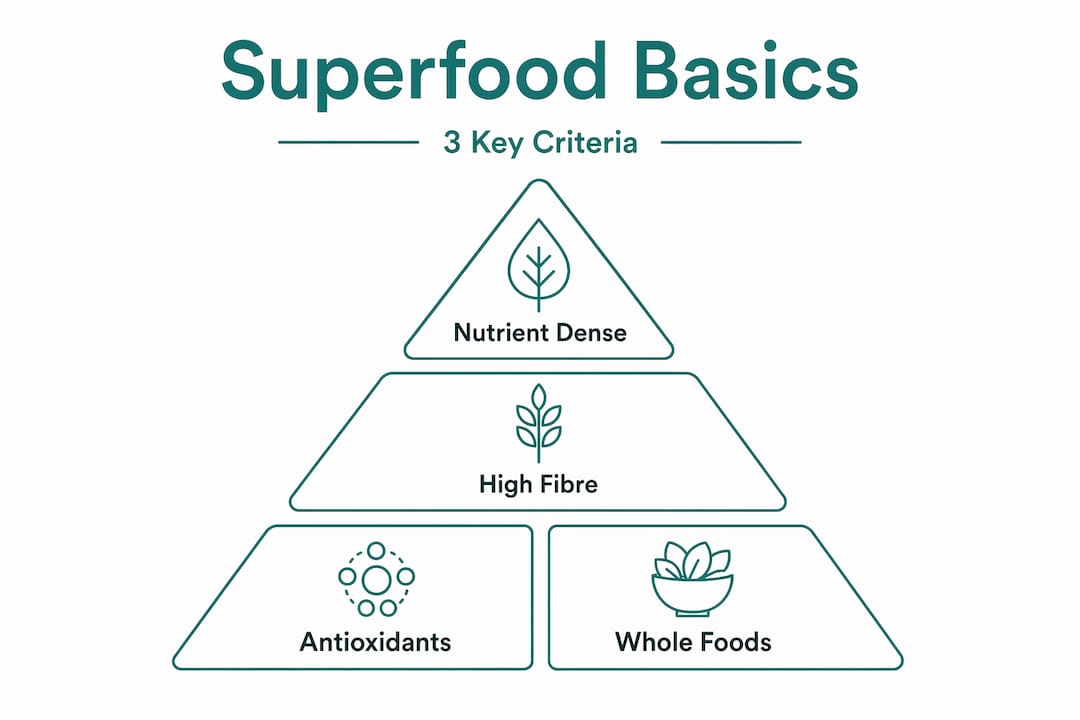
Astuce pro : Pour évaluer si un aliment mérite vraiment sa place dans votre alimentation, recherchez trois choses : une teneur élevée en fibres, une source significative de bonnes graisses ou de protéines végétales, et un profil riche en micronutriments. Les aliments qui remplissent ces trois critères offrent une réelle valeur nutritionnelle. De nombreuses options riches en antioxydants à explorer sont présentées dans ce guide des antioxydants pour le vieillissement.
Le lien avec un vieillissement en bonne santé mérite d’être souligné ici. Les antioxydants neutralisent les radicaux libres, qui sont des molécules instables s’accumulant avec l’âge et contribuant aux dommages cellulaires. Manger régulièrement des aliments riches en antioxydants est l’une des stratégies alimentaires les mieux étayées pour maintenir la vitalité à un âge avancé.

Mythes courants sur les superaliments
La plus grande idée fausse concernant les superaliments pour la santé est l’idée que manger régulièrement l’un d’eux produira des améliorations spectaculaires ou mesurables à lui seul. Ce n’est pas le cas. Aucun aliment unique ne peut produire une santé optimale isolément. Ce n’est pas ainsi que fonctionne la nutrition.
Voici quatre mythes spécifiques qu’il vaut la peine d’aborder directement :
-
Les superaliments peuvent remplacer un régime alimentaire pauvre. Ce n’est pas le cas. Manger une poignée de myrtilles chaque jour tout en consommant de grandes quantités d’aliments transformés, de sucre raffiné et d’alcool ne fera pas évoluer vos résultats de santé. Les bienfaits décrits dans les recherches s’appliquent dans le cadre de régimes alimentaires équilibrés.
-
Les superaliments exotiques sont plus efficaces que les locaux. Les baies d’açaï du Brésil et la poudre de moringa d’Asie du Sud sont impressionnantes sur le plan nutritionnel, mais il en va de même pour les pommes, le brocoli et l’avoine. Comme le soulignent les chercheurs, chaque fruit et légume contient des composés favorisant la santé. Le prix élevé des options exotiques reflète rarement un profil nutritionnel nettement supérieur.
-
Les produits superaliments transformés sont tout aussi efficaces. Les poudres vertes, les mélanges de baies et les barres de collation enrichies peuvent porter la marque superaliment, mais les produits transformés manquent souvent du profil nutritionnel complet de l’aliment entier. Les fibres, en particulier, sont fréquemment perdues lors de la transformation, et les fibres sont l’un des composants les plus bénéfiques d’un régime riche en plantes.
-
Plus n’est pas toujours mieux. Les épinards contiennent des oxalates qui peuvent interférer avec l’absorption du calcium en très grande quantité. Les noix du Brésil sont riches en sélénium, et un apport excessif peut provoquer une toxicité. Même les aliments les plus riches en nutriments fonctionnent mieux en quantités appropriées dans le cadre d’une alimentation variée.
« Les diététiciens recommandent de considérer les superaliments comme des éléments nutritionnels remarquables dans un régime alimentaire équilibré, et non comme des solutions magiques. » — Prevention
Les preuves en faveur des superaliments sont réelles, mais elles concernent des propriétés nutritionnelles spécifiques dans des contextes alimentaires précis. C’est une affirmation beaucoup plus modeste et utile que celle utilisée dans la plupart des campagnes marketing.
Comment inclure les superaliments dans votre alimentation
L’application pratique est là où la compréhension devient utile. L’objectif n’est pas de révolutionner votre alimentation ni d’investir dans des produits coûteux. Il s’agit de construire des habitudes alimentaires cohérentes qui privilégient la densité nutritionnelle à travers une grande variété d’aliments complets. Viser des objectifs nutritionnels mesurables tels que l’apport quotidien en fibres, une consommation adéquate d’oméga-3 et la variété végétale transforme le concept de superaliment en un cadre utilisable plutôt qu’en une aspiration abstraite.
Quelques principes pour guider votre approche :
- Construisez d’abord sur des bases solides. Les légumes, légumineuses, céréales complètes, noix et poissons forment le socle nutritionnel. Les superaliments fonctionnent mieux en complément de cette base, pas en substitution.
- Choisissez le complet plutôt que le transformé. Une orange entière apporte plus de bénéfices nutritionnels que la poudre d’orange contenue dans un sachet de complément. Les aliments complets contiennent des composés qui interagissent de manière synergique, ce que la transformation ne peut pas totalement reproduire.
- Privilégiez la variété à la répétition. Alterner entre différents légumes, protéines et graisses vous offre un profil en micronutriments plus large que de manger les mêmes trois aliments « sains » chaque jour.
- Privilégiez le local. Plutôt que de payer des primes pour des superaliments importés, identifiez les options les plus riches en nutriments disponibles localement et de saison. Le chou, la betterave et le maquereau sont d’excellents choix nutritionnels disponibles dans une grande partie de l’Europe à faible coût.
Un exemple pratique de ce à quoi pourrait ressembler une journée alimentaire informée par les superaliments : porridge aux noix et myrtilles au petit-déjeuner, soupe de lentilles et chou frisé au déjeuner, une poignée d’amandes en collation, et saumon grillé avec légumes rôtis au dîner. Pas besoin de poudres exotiques. Pas besoin de compléments coûteux. Ce type de structure de repas atteint systématiquement les objectifs nutritionnels associés à une réduction du risque de maladies chroniques.
Astuce pro : Avant de dépenser de l’argent dans un produit superaliment emballé, vérifiez trois choses sur l’étiquette : la teneur en fibres alimentaires, la présence de bonnes graisses insaturées et la longueur de la liste des ingrédients. Des listes courtes avec des ingrédients d’aliments complets reconnaissables sont un indicateur fiable de valeur nutritionnelle réelle. Pour un guide détaillé de ce qu’il faut rechercher, consultez le guide d’étiquetage des compléments de Vivetus.
Les meilleurs exemples de superaliments pour les seniors sont souvent les mêmes aliments complets abordables qui bénéficient à tout le monde, avec une attention particulière aux aliments soutenant la densité osseuse, la fonction cognitive et la santé cardiovasculaire avec l’âge.
Mon point de vue sur la conversation autour des superaliments
J’ai passé beaucoup de temps à étudier les recherches derrière les tendances alimentaires, et le phénomène des superaliments est l’un des exemples les plus instructifs de la manière dont le marketing peut devancer la science sans pour autant mentir techniquement.
Voici ce que j’ai constaté en pratique : les aliments qui apportent les bénéfices les plus constants et mesurables sur le long terme ne sont généralement pas ceux en couverture des magazines de bien-être. Ce sont les aliments de base peu glamour : poissons gras, légumes verts foncés, légumineuses, noix et aliments fermentés. Ils ne font pas de lancements de produits excitants, mais les preuves scientifiques qui les soutiennent sont bien plus solides que pour la plupart des ingrédients à la mode.
Ce qui me préoccupe le plus dans le discours sur les superaliments, ce n’est pas qu’il promeuve des aliments sains. C’est le cas. Ce qui m’inquiète, c’est qu’il sous-entend discrètement que votre alimentation actuelle est insuffisante sans un ingrédient spécifique, souvent coûteux. Cette approche pousse les gens à faire des achats plutôt qu’à adopter de bonnes habitudes alimentaires.
La reformulation la plus utile que j’ai rencontrée est la suivante : chaque fruit et légume contient des composés bénéfiques pour la santé. Cela signifie que l’objectif n’est pas de trouver l’aliment parfait, mais de consommer plus de plantes, plus de variété et plus d’aliments complets de façon régulière. Ce changement de perspective est vraiment plus efficace que n’importe quel ingrédient isolé.
Les compléments alimentaires ont un rôle légitime pour soutenir les apports en nutriments que vous ne pouvez pas atteindre de manière fiable par l’alimentation seule, surtout avec l’âge. Mais ils fonctionnent mieux lorsqu’ils s’inscrivent dans une stratégie nutritionnelle, et non comme un raccourci.
— Jord
Soutenez votre nutrition avec Vivetus
Si vous suivez déjà une alimentation variée et riche en plantes et souhaitez cibler plus précisément certains objectifs nutritionnels, une supplémentation ciblée peut être un complément utile. Vivetus propose un pack énergie et vitalité composé d’ingrédients riches en nutriments sélectionnés pour soutenir un vieillissement sain et un bien-être quotidien durable.

Ce pack est conçu pour les personnes qui prennent leur nutrition au sérieux et souhaitent une supplémentation fondée sur des preuves plutôt que sur le marketing. Il s’aligne sur l’approche décrite dans cet article : utiliser des nutriments ciblés pour combler de véritables lacunes, pas pour remplacer une bonne alimentation. La livraison est gratuite pour les commandes supérieures à 50 €, et la gamme complète de produits est accessible dans toute l’Europe. Vivetus expédie à l’international, ce qui facilite son intégration dans votre routine où que vous soyez.
Questions fréquentes
Que signifie réellement « superaliment » ?
« Superaliment » est un terme populaire utilisé pour décrire des aliments riches en nutriments tels que vitamines, minéraux, antioxydants et bonnes graisses. Il n’a pas de définition scientifique ou nutritionnelle formelle et est largement utilisé comme argument marketing.
Quels sont les principaux bienfaits des superaliments ?
Les aliments souvent qualifiés de superaliments fournissent des nutriments associés à une réduction de l’inflammation, une meilleure santé cardiaque, une protection antioxydante et un renforcement du système immunitaire. Ces bienfaits sont plus marqués dans le cadre d’une alimentation équilibrée et régulière que par une consommation isolée.
Les produits superaliments coûteux valent-ils la peine d’être achetés ?
Pas nécessairement. Beaucoup des aliments les plus riches sur le plan nutritionnel sont des aliments complets abordables disponibles dans la plupart des supermarchés. Les produits transformés dits superaliments, comme les poudres et mélanges, peuvent ne pas offrir le profil nutritionnel complet des aliments entiers, notamment en fibres. Évaluez toujours la teneur réelle en nutriments d’un produit plutôt que son image de marque.
Les superaliments peuvent-ils remplacer une alimentation équilibrée ?
Non. Les recherches montrent constamment que les bienfaits nutritionnels proviennent des habitudes alimentaires globales plutôt que d’aliments individuels. Les superaliments fonctionnent mieux en complément d’une alimentation variée et composée d’aliments complets, et non comme solutions isolées.
Quels aliments quotidiens sont considérés comme des superaliments ?
Les myrtilles, le chou frisé, le saumon, les noix, les lentilles, l’avoine et l’huile d’olive sont tous qualifiés en raison de leur densité nutritionnelle. De manière générale, la plupart des légumes et des fruits contiennent des composés favorisant la santé qui répondent aux critères nutritionnels derrière ce terme.
Recommandé
- Exemples de superaliments pour seniors : 10 choix incontournables – Vivetus®
- Meilleurs compléments antioxydants : preuves, options et sécurité – Vivetus®
- Nutriments pour la longévité : 5 exemples scientifiques pour la vitalité – Vivetus®
- Nutrition anti-âge : les grandes tendances de la longévité en 2026 – Vivetus®